From Mouser to Sofa Philosopher: How Indoor Life Changes Cat Behavior
Published in Cats & Dogs News
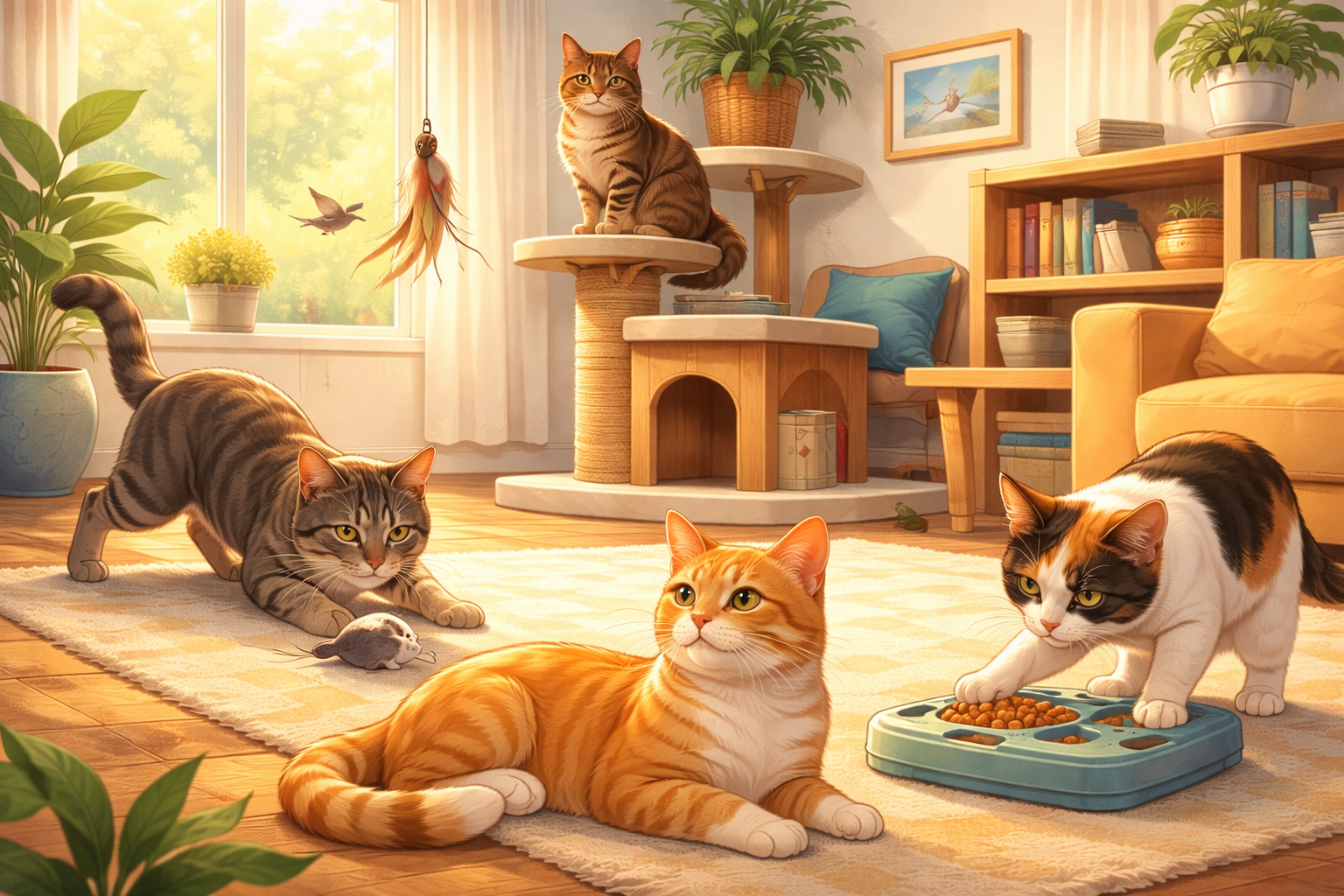
For most of feline history, survival depended on sharp senses, territorial awareness, and the ability to hunt small prey efficiently. Modern indoor cats, by contrast, may never stalk anything more threatening than a dust particle drifting through sunlight. Yet beneath the calm surface of domestic life, the ancient architecture of the hunter remains intact. The shift from mouser to house companion has not erased instinct. It has reshaped how that instinct expresses itself.
Outdoor cats operate within clearly defined territories that they patrol, scent-mark, and defend. Indoor cats inherit the same neurological blueprint, but the territory becomes walls, hallways, furniture and windowsills. What appears to be casual pacing from room to room is often a territorial check. Cats move along predictable routes not from boredom, but from habit shaped by thousands of years of survival behavior.
The most dramatic behavioral shift indoors involves hunting. A wild cat’s day is structured around the hunt–stalk–pounce–consume cycle. Indoor cats must improvise. Toys become prey substitutes. Laser dots trigger chase responses. Even sudden attacks on unsuspecting ankles can represent displaced hunting behavior. When owners interpret these moments as mischief rather than unmet predatory sequence, frustration follows on both sides.
Play, therefore, becomes more than entertainment. It is neurological maintenance. Interactive play sessions that mimic the full hunting arc—slow stalking, bursts of pursuit, a final capture—allow indoor cats to complete instinctual scripts their environment no longer naturally provides. Cats deprived of this cycle may display restlessness, nighttime activity spikes, or excessive vocalization.
Social behavior also evolves indoors. Wild cats are generally solitary hunters who tolerate others primarily when resources are abundant. In multi-cat homes, this instinct must adapt to shared space. Vertical territory, hiding spots, and predictable feeding schedules reduce conflict because they replicate resource distribution strategies found in feral colonies. Indoor life works best when it honors these underlying patterns rather than suppressing them.
Perhaps the most fascinating transformation occurs in cognitive engagement. Outdoor environments deliver constant novelty: scent trails, weather shifts, prey movement. Indoors, stimulation narrows. As a result, many cats become what might be called environmental philosophers—long stretches of watchfulness punctuated by brief bursts of activity. Window perches serve as theater seats. Household routines become predictable narratives. The cat observes, analyzes and anticipates.
This observational role often deepens the human-animal bond. Indoor cats spend more sustained time within close proximity to people than their outdoor counterparts. They learn schedules, emotional cues, and subtle changes in behavior. Some begin greeting owners at consistent times or settling nearby during moments of stress. Confinement, paradoxically, can increase social attunement.
Yet indoor life also introduces challenges. Obesity rates are higher among strictly indoor cats due to reduced calorie expenditure. Mental under-stimulation can manifest as overgrooming or furniture scratching. These outcomes are not failures of domestication but reminders that evolutionary design remains active beneath domestic comfort.
Successful indoor environments recognize that cats are not decorative companions; they are predators in a softened landscape. Rotating toys, adding vertical structures, offering puzzle feeders and maintaining routine feedings all help align modern living with ancient biology. Even something as simple as rearranging furniture can create novelty that reactivates exploratory circuits.
Over generations, some researchers speculate that domestic cats may continue adapting toward increased sociability and flexibility. Already, house cats show behavioral differences from fully feral populations, particularly in tolerance of close human contact. Domestication is not a static event but an ongoing negotiation between species.
The indoor cat may no longer patrol barns or fields, but the blueprint of the hunter persists. It manifests in midnight sprints down hallways, in the sudden fixation on a moving shadow, in the ritual of stalking a toy mouse across carpet. What has changed is not the instinct itself, but the stage upon which it plays out.
From mouser to sofa philosopher, the journey reflects adaptation rather than abandonment of identity. The modern indoor cat is still a predator—just one who has learned that sometimes the safest hunting ground is a sunbeam on the living room floor.
========
Maribel Hartwick is a freelance pet and science writer who explores animal behavior, cognition, and the evolving relationships between humans and their companion animals. This article was written, in part, utilizing AI tools.








Comments