Vertical Living: How Cats Turn Your Home Into a Three-Dimensional World
Published in Cats & Dogs News
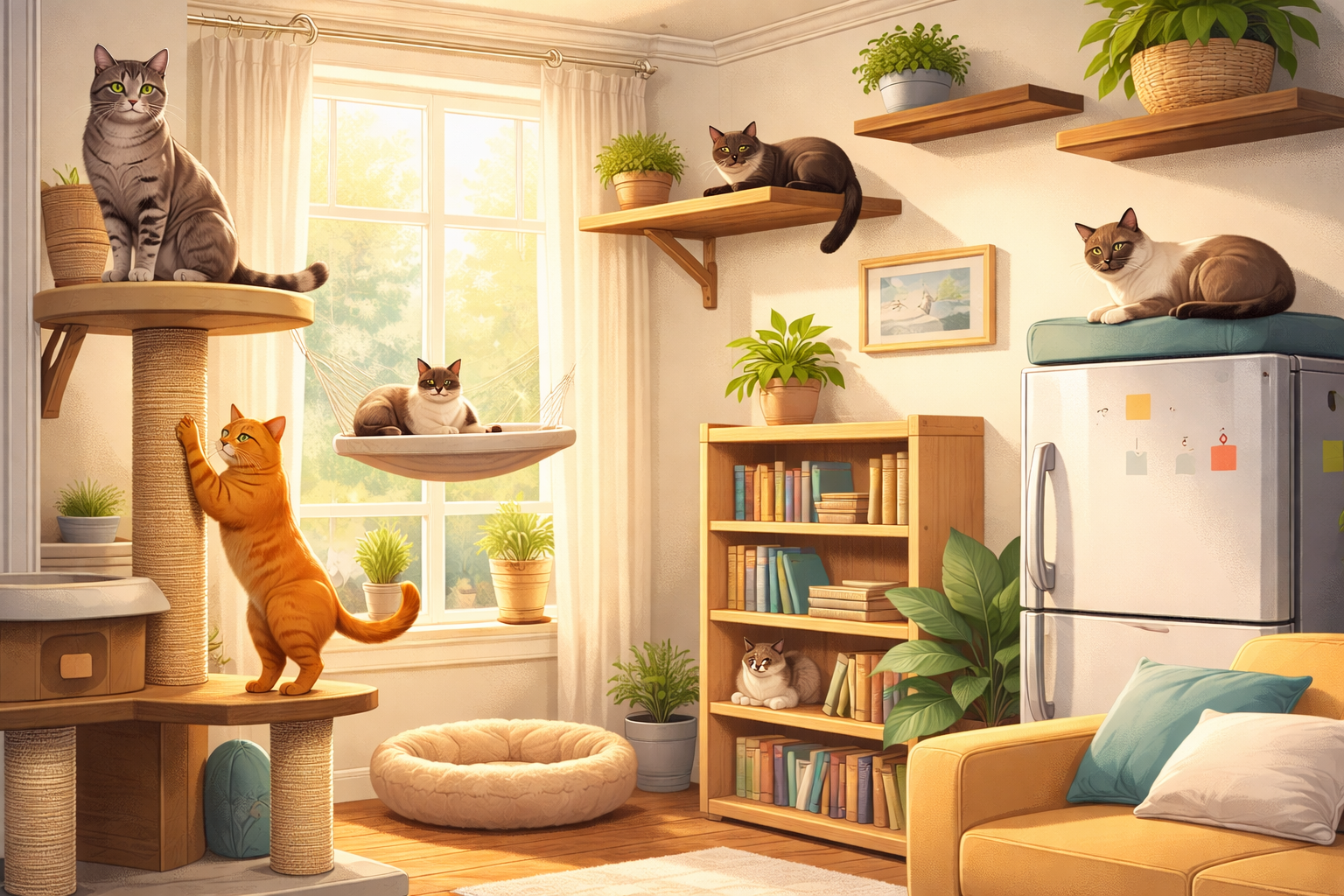
To a human, a living room is a horizontal experience. There is floor space, furniture, perhaps a table or a couch. To a cat, that same room is a layered ecosystem of perches, escape routes, observation towers and strategic ambush points. What looks like ordinary domestic space to us is, to them, an intricate vertical territory map.
Cats evolved as both predators and prey. This dual role shaped their instinctive desire to climb. Height provides safety from threats and superior vantage for hunting. In the wild, trees serve as lookout posts and refuge. Indoors, bookshelves, refrigerator tops, curtain rods and cabinet edges become the modern equivalents. When a cat leaps to the highest available surface, it is not being contrary. It is fulfilling a deep neurological expectation that elevation equals security.
Perching is also about information. Cats rely heavily on visual surveillance. A high position allows them to track movement patterns within the household: who enters, who leaves, which dog is sleeping, where the food bowl is located. From above, the entire domestic territory becomes legible. Behavioral researchers often describe this as “control of space,” but it is less about dominance and more about environmental mastery.
Height also regulates stress. Studies in multi-cat households show that vertical territory reduces conflict. When cats have access to shelves or cat trees at different elevations, they are less likely to compete for the same physical area. A room with adequate vertical options functions like a small apartment complex rather than a crowded studio. Cats can avoid each other without confrontation simply by occupying different layers of space.
The instinct to climb can sometimes puzzle owners when it results in knocked-over objects or precarious balancing acts on narrow ledges. Yet these behaviors often signal unmet needs rather than mischief. A home devoid of vertical stimulation can feel flat and monotonous to a species wired for three-dimensional exploration. Adding stable shelves, window perches or multi-level cat trees frequently reduces undesirable climbing because it channels the behavior into safer pathways.
Windows deserve special mention. A window perch effectively becomes a wildlife observation deck. Birds, insects, passing cars and shifting light patterns create cognitive enrichment. From this vantage, a cat engages in what might be called “surveillance play,” rehearsing hunting behavior through focused watching. Even indoor-only cats maintain these neural circuits; vertical access helps satisfy them without requiring actual prey.
Interestingly, senior cats often maintain the desire for elevation, though they may require assistance. Gentle ramps or staggered furniture placement allow aging joints to continue accessing preferred perches. Removing vertical options for older cats can inadvertently increase anxiety, because it removes a lifelong coping strategy.
Designers have begun incorporating feline verticality into modern architecture. Floating shelves arranged like staircases, built-in climbing walls and strategically placed ledges transform homes into shared habitats rather than human-only spaces. When done thoughtfully, these features blend aesthetics with behavioral science, creating an environment that honors feline instincts without sacrificing style.
Ultimately, a cat does not experience a room the way we do. It navigates invisible highways along curtain rods and cabinet tops. It assesses sight lines and calculates leap distances. It memorizes safe zones and escape vectors. To ignore the vertical dimension is to misunderstand how deeply three-dimensional its world truly is.
Understanding this perspective shifts the question from “Why does my cat keep climbing?” to “How can I design a space that acknowledges who this animal evolved to be?” When we expand our homes upward, we are not indulging eccentricity. We are recognizing that for a cat, life has always unfolded above ground level.
========
Maribel Hartwick is a freelance pet and science writer who explores animal behavior, cognition, and the evolving relationships between humans and their companion animals. This article was written, in part, utilizing AI tools.








Comments