The Science of Sniffing: Why Your Dog’s Nose Needs Daily Adventure
Published in Cats & Dogs News
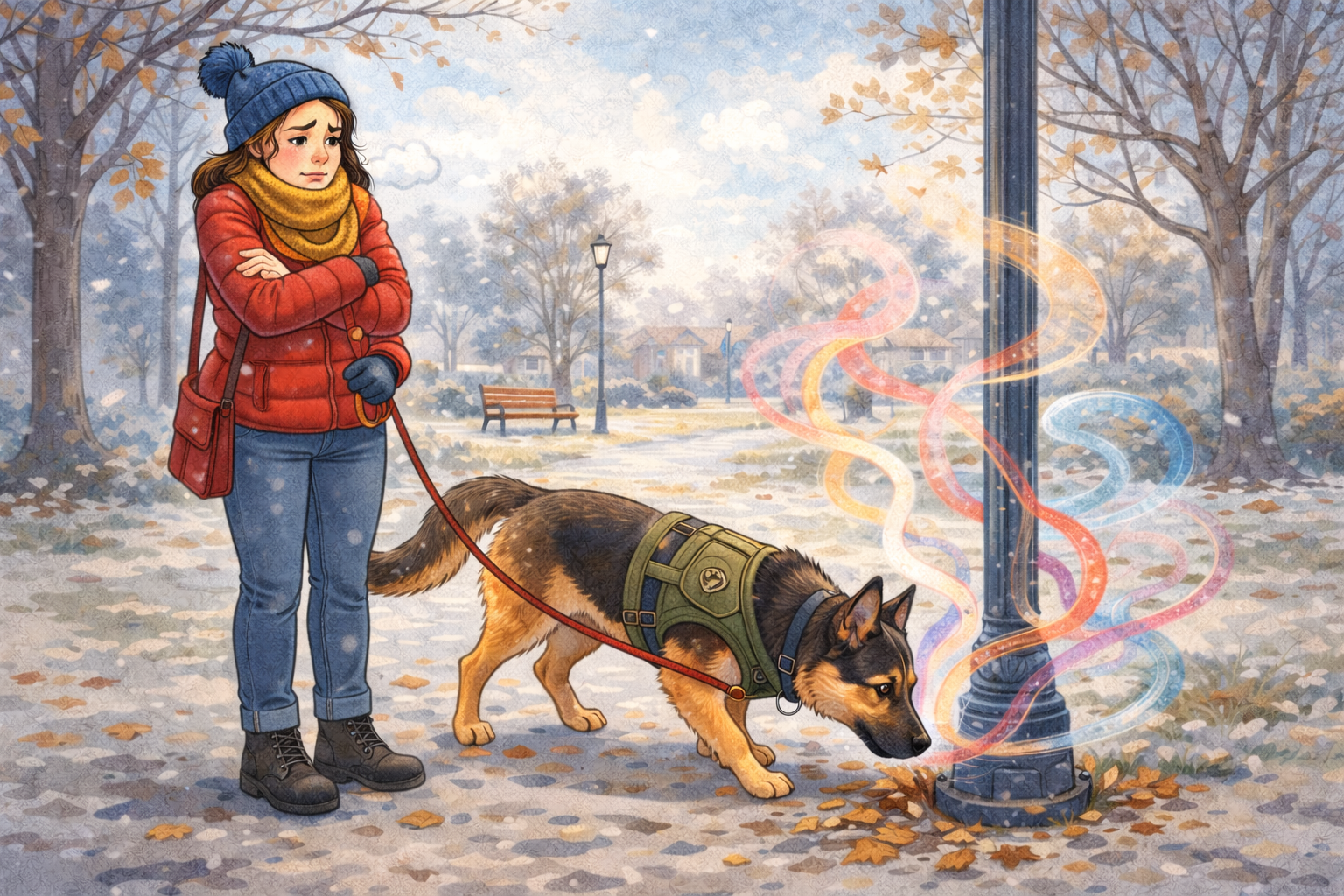
If humans walked through the world the way dogs do, we would be overwhelmed. We navigate primarily by sight. Dogs, by contrast, inhabit a landscape of scent. What looks like a patch of grass to you is a layered archive to them — who passed by, how long ago, whether they were stressed, what they ate, whether they were healthy. A daily walk is not simply exercise; it is investigative journalism conducted at nose level.
The canine sense of smell is not merely better than ours — it is staggeringly different in scale. Depending on breed, dogs possess up to 300 million olfactory receptors compared to roughly six million in humans. Their brains devote a far larger proportion of processing power to interpreting scent. Add to that the vomeronasal organ, which helps them detect pheromones, and you begin to understand why your dog pauses at what seems like nothing at all. To you, the sidewalk is blank. To your dog, it is densely annotated.
Skipping daily walks deprives dogs of mental stimulation more than physical exertion. Many behavioral problems attributed to stubbornness or defiance are better understood as boredom. A dog left indoors without sensory enrichment can develop anxiety, destructive habits, or hyperactivity. A structured walk provides not only movement but novelty — shifting smells, sounds, textures, and social cues. It is enrichment disguised as routine.
The length of the walk matters less than the quality. Ten focused minutes of sniffing exploration can sometimes exhaust a dog more effectively than a brisk, distraction-free march around the block. Allowing a dog to investigate is not indulgence; it is fulfillment of a cognitive need. A leash should guide, not drag. Think of it as giving your dog time to read the morning paper.
There is also a physiological dimension. Sniffing lowers heart rate and encourages calm engagement. Studies observing canine behavior show that dogs allowed to sniff more frequently exhibit fewer stress signals. In this sense, the daily walk becomes a form of mindfulness practice — not for you, though that can be a bonus, but for the dog.
Socialization plays a subtle but powerful role as well. Passing neighbors, hearing distant traffic, encountering other animals — these experiences help dogs maintain adaptability. The world remains familiar instead of threatening. Regular exposure builds confidence. Dogs who rarely leave home can become reactive because novelty feels alarming rather than ordinary.
Weather should not be an automatic deterrent. Light rain intensifies scent trails. Cooler temperatures sharpen olfactory acuity. Seasonal changes offer entirely new sensory palettes. Autumn leaves carry microbial shifts; spring blooms announce pollinators; winter air carries long-distance scents more cleanly. Your dog experiences the calendar differently than you do.
Breed differences influence how walks unfold. Scent hounds will prioritize olfactory data collection. Herding breeds may scan visually and monitor movement. Terriers often toggle between sniffing and quick bursts of focused investigation. Understanding your dog’s inherited tendencies allows you to tailor the walk rather than fight against instinct.
Daily walks also strengthen the relational bond. Shared exploration creates a cooperative rhythm — you provide structure and safety, the dog provides curiosity and attentiveness. Over time, that rhythm translates into better recall, calmer leash behavior, and increased trust. Training is not confined to formal sessions; it happens in micro-interactions during ordinary movement.
Ultimately, the daily walk is less about steps counted and more about stories gathered. Every scent is a headline. Every lamppost is a bulletin board. When your dog resists being hurried along, it is not obstinacy — it is immersion. The world is speaking in chemical language, and your dog is fluent.
========
Celeste Armand is a journalist covering animal behavior, sensory science, and everyday companion-animal welfare. She lives in upstate New York and spends most mornings letting her dog “read” the neighborhood at its own pace.
This article was written, in part, utilizing AI tools.







Comments