Commentary: Hollywood is trading Cannes' uncertainty for controlled hype
Published in Entertainment News
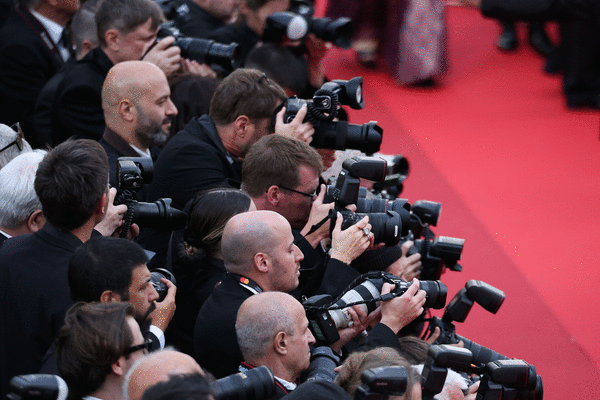
With superyachts lining the harbor and strict dress codes for gala screenings, the Cannes Film Festival is a traditionally glitzy affair — and for decades, Hollywood has been its most glamorous tenant. This year, no major Hollywood studio has brought a marquee premiere to Cannes. That hasn’t happened since 2017, when the festival was defined by tensions over Netflix’s high-profile presence and heightened security following terrorist attacks.
The absence of studios this time around arguably reflects a more profound shift. They have changed their relationship with the one thing film festivals have always offered: independent cultural legitimacy. This matters not only as a shift in marketing strategy, but as a sign of the diminished role tastemakers play in appraising studio films.
Hollywood is increasingly devaluing critics and festivalgoers in favor of tightly controlled influencer screenings and fan events designed to curate an initial wave of enthusiasm before actual reviews can land. The goal is to manufacture consensus early, so that dissent doesn’t generate traction. Cannes, with its unpredictable juries and audience sentiment, doesn’t fit that model anymore.
The studios haven’t always felt this way. For much of Hollywood’s history, the international festival circuit — Cannes, Venice, Berlin, Toronto — helped transform a film from a commercial product into an event. Premieres, critical reaction and awards positioning determined a film’s cultural standing. Studios regularly sent their most ambitious work into that pipeline. Films ranging from "Moulin Rouge" to "E.T. the Extra-Terrestrial" and "Mad Max: Fury Road" have premiered at Cannes, precisely because critical validation was worth the risk, the cost and the exposure.
What changed isn’t the festivals themselves, but the calculus. Studios have grown wary of premiering major films in spaces where critical reaction can disrupt a carefully choreographed rollout.
As social media has grown ubiquitous, early reactions don’t stay contained to the trades and the broadsheets. They spread instantly — algorithmically — in the form of posts on X, TikToks, and Letterboxd reviews that define a film’s reputation before it opens in a single market. Bad early buzz can prove difficult to overcome, as "Indiana Jones and the Dial of Destiny’s" lukewarm Cannes reception demonstrated in 2023. The conclusion studios appear to have drawn is that the upside of a glitzy premiere no longer outweighs the downside of a muted (if not outright negative) response in the room and online.
The influencer strategy is the logical extension of that thinking. Where critics are expected to assess a film on its own terms, social media personalities are rewarded for sustaining audience engagement around them.
Studios have leaned into this distinction, inviting social media creators to early screenings ahead of critics. Lionsgate, the most successful mini-major film studio in America, experimented with taking that logic a step further for its "John Wick" spinoff "Ballerina," by initially staggering embargoes to promote “spoiler-free enthusiasm” in the first wave of public reaction. As a veteran marketing executive who’s worked on campaigns for major films told The Wrap in 2024: “Influencers are just another word for fans. And if you don’t give the fans ownership and let them own a point of view first, it’s hard to manage your brand.”
What gets lost in this shift isn’t just the prestige of film festivals, but the unique conditions that give films cultural weight. Critics and festivalgoers don’t simply attend screenings; they’re gatekeepers who create space for disagreement, surprise, and discovery before a studio campaign shapes the conversation.
Replacing them with voices structurally incentivized toward enthusiasm may be safer for studios in an attention economy that rewards speed and early momentum, but it flattens how films are received — especially as publications scale back the number of critics they employ. In the process, criticism itself risks being displaced by access that’s indistinguishable from PR.
The deeper problem is that studios mistake an echo chamber for a market signal. When reception is engineered rather than organic, it measures how effectively the discourse has been managed — not whether a film will sustain an audience beyond opening weekend. That way of thinking has helped accelerate a trend in which mid-budget dramas — the kind of films that have historically been boosted by festival validation — have largely disappeared from the studio system. What remains are franchise films and IP-driven sequels that arrive effectively pre-sold, their reception curated rather than discovered.
Film festivals are a reminder that there’s a better way to launch a movie — one that involves trusting critics and audiences alike to experience a film without guardrails. In that context, Hollywood’s absence at Cannes is a signal worth reading. Studios have become increasingly risk-averse, and the fact that independent critical sentiment falls into that category says something uncomfortable about where the industry has landed.
Filmmaking has always required a certain amount of uncertainty — the kind of ambition that has allowed original films to plant a flag at a festival like Cannes. Hollywood seems less and less comfortable with that bargain, even when it comes at the expense of audiences.
———
This column reflects the personal views of the author and does not necessarily reflect the opinion of the editorial board or Bloomberg LP and its owners.
Miles Surrey is a Brooklyn-based culture writer. His work has also appeared in The Ringer, Men’s Health, and Vox.
©2026 Bloomberg L.P. Visit bloomberg.com/opinion. Distributed by Tribune Content Agency, LLC.








Comments