AI boom helps erase California's multibillion-dollar budget deficit
Published in Business News
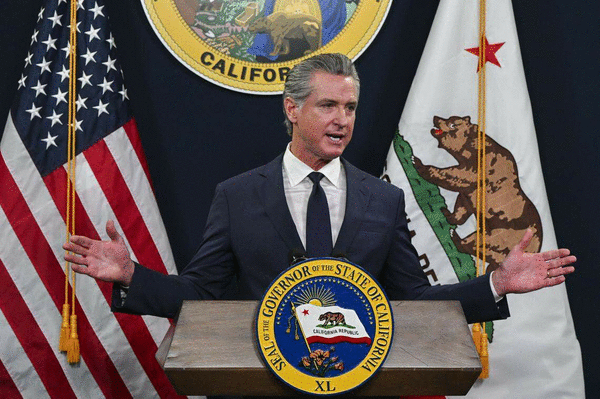
Gov. Gavin Newsom on Thursday released an updated budget plan that shows California has erased its projected deficit for the next two years, thanks to billions of dollars in additional tax revenue tied to Silicon Valley’s artificial intelligence boom.
But the windfall is unlikely to offset tens of billions of dollars in health care cuts signed into law by President Donald Trump last year, which are expected to push millions of Californians off their health insurance and could force county health systems to slash crucial services. This week, Vice President J.D. Vance announced the Trump administration will also withhold $1.3 billion in Medicaid payments to the state.
Teachers’ unions, meanwhile, warn the governor’s budget plan could exacerbate widespread school staff shortages. And local officials and homeless service providers are sounding alarms about insufficient homelessness funding in the proposal, which they say threatens to reverse recent progress in alleviating the crisis.
Even so, Newsom on Thursday touted an improved budget outlook, citing three-year revenue projections from his administration that came in $16.5 billion higher than initially forecast. The revenue boost stems mainly from taxes on high-income residents’ stock gains, which have soared with financial markets on the promise of AI.
“It shows the nature of the economy in this state – the nature of the growth engine,” Newsom said.
In January, the Newsom administration had estimated the state faced a $2.9 billion deficit for the upcoming fiscal year starting in July, followed by a $22 billion deficit the next year.
Even if those shortfalls have now been wiped out, however, budget issues likely remain, with multibillion-dollar deficits still forecast in the years ahead as spending is anticipated to outpace revenue growth. State budget analysts also warn that since the immediate revenue spike is expected to come from taxes on stock market returns, the gains could quickly evaporate in a financial downturn.
On Thursday, Republicans slammed Newsom’s proposal, arguing the governor is ignoring the state’s long-term budget challenges.
“If he and the Democratic party do not address the seriousness of continued deficits, Californians will pay the price for years of fiscal irresponsibility,” state Sen. Roger Niello, vice chair of the Senate Budget Committee, said in a statement.
Newsom’s $349 billion budget, up about $30 billion from the current fiscal year, does not include any significant new spending proposals. It also calls for raising taxes on large corporations by eliminating certain tax credits and introducing a new tax on software downloads.
The proposal will continue to evolve as financial forecasts are updated and state lawmakers, who must work with the governor to approve the budget by mid-June, negotiate changes.
Health Care
Health advocates and local officials had hoped Newsom would propose accelerating health spending to backfill federal cuts from Trump’s “One Big Beautiful Bill Act.” But the governor said “belt tightening” was in order and placed the ultimate blame on his Republican adversaries in Washington, D.C.
Because of the federal cuts, mostly from tighter eligibility requirements, about 1.3 million Californians are expected to lose health coverage through Medi-Cal, the state insurance program for low-income residents, by 2030. About 2 million Bay Area residents are Medi-Cal recipients.
In Newsom’s proposal, California would spend about $1.1 billion less on health care and social services in the next budget cycle. Much of the savings would come from paring back health care coverage for immigrants, both with and without legal status.
The federal cuts have already contributed to rapidly rising insurance premiums in California and to more people without coverage. Meanwhile, safety-net public health systems across the Bay Area have also planned to slash jobs and services. Local counties and hospital districts have sought voter approval for tax increases to cover some of the gaps.
“The Governor’s proposal fails to meaningfully address the healthcare and food assistance cuts that will affect families across California,” Santa Clara County Executive James Williams said in a statement. “The consequences will be real and immediate.”
Newsom’s plan, however, does propose spending an additional $300 million to help Affordable Care Act recipients manage higher health premiums after congressional Republicans refused to extend expiring subsidies to the program last year. But it’s a tiny fraction of the $2.5 billion in federal assistance California would have received if not for the cuts.
Education
In his initial budget plan in January, Newsom proposed temporarily withholding $5.6 billion in voter-approved education funding, arguing it was necessary to create a cushion for uncertain revenue projections.
The California Teachers Association slammed the move, which came as districts have been forced to consider layoffs of thousands of teachers and school closures. The union warned that withholding the money could set Bay Area school districts back more than $586 million.
Newsom’s updated plan now calls for withholding $3.9 billion. While that amounts to a fraction of the more than $91 billion the governor has proposed to allocate to K-12 education from the state’s general fund, the teachers union said the impact would still be felt.
“This means overcrowded, under-resourced, destabilized classrooms,” CTA President David Goldberg said in a statement.
Newsom responded to the criticism Thursday by pointing to “unprecedented supports” in the budget for education, including a 43% increase in ongoing special education funding.
Homelessness
Newsom and local officials in the Bay Area have long sparred over funding for homelessness. After spending $1 billion on a statewide program for shelters and permanent housing four years in a row, Newsom opted last year not to release more funds and demanded better results from cities, counties and providers.
This year, the governor is proposing $500 million in previously approved funding for the Homeless Housing, Assistance and Prevention program, with new accountability measures to ensure the money is well spent. That comes after a 2024 state audit found state agencies failed to track at least $24 billion spent to alleviate homelessness between 2018 and 2023.
“I want accountability,” Newsom said. “I want results that are visible.”
But local officials and providers said Thursday the reduced funding would only exacerbate homelessness, after cities and counties across the state have seen encouraging declines in the number of people living on the street.
The National Alliance to End Homelessness projected homelessness would grow 20% through 2027 with the governor’s proposal. That estimate balloons to 55% in Santa Clara County and San Jose, which has relied upon the funds to build more shelters and prevent people from falling into homelessness.
“I definitely think we’ll see a visible impact,” said Jennifer Hark Dietz, CEO of the homeless services nonprofit PATH, which does outreach in San Jose.
Environment
Newsom’s budget calls for the state to commit $125 million from Proposition 4, a climate bond passed by voters in 2024, to help purchase Golden Gate Fields, a famous horse racing track that operated along the East Bay shoreline in Berkeley and Albany from 1941 until it closed in 2024.
In March, the Trust for Public Land, a San Francisco environmental group, secured an option to buy the 161-acre property for $175 million and transfer it to the East Bay Regional Park District. The track, seating, buildings and stables will be removed by the Canadian company that owns the property, and its 1 mile of San Francisco Bay waterfront and other lands converted to a public park in the coming years.
“This significant investment demonstrates California’s commitment to expanding public access to San Francisco Bay,” said Guillermo Rodriguez, state director for the Trust for Public Land.
Thursday’s revised budget also included $40 million to continue funding the “Clean California Program,” a stepped-up effort started in 2021 by Caltrans to remove litter and homeless encampments along state highways. And it included $25 million in additional funding to support fish and wildlife restoration projects in the Sacramento-San Joaquin Delta.
©2026 MediaNews Group, Inc. Visit at mercurynews.com. Distributed by Tribune Content Agency, LLC.








Comments