Taylor Swift, lawsuits and quirky exemptions: How empty homes tax works in other cities
Published in Business News
SAN DIEGO — If Measure A passes on June 2, San Diego would join a group of cities in the U.S., Canada and abroad that tax second homes or properties that are unoccupied for most of the year.
San Diego’s “non-primary home” tax, as it is being called, would impose an initial annual levy of $8,000 on more than 5,000 homes that are vacant for 183 days or more — plus a $4,000 surcharge for corporate-owned dwellings. In subsequent years, the tax would rise to $10,000, with the surcharge increasing to $5,000.
The measure would need to pass with a simple majority and would generate much-needed revenue for the city’s general fund — $9.2 million to $21.4 million in the first year, according to the office of the Independent Budget Analyst. (A two-thirds ballot measure would be needed to earmark the funds for specific projects.)
In other cities where similar measures are in place, there are variations in exemptions, tax rates, enforcement and where the revenue is allocated. But a general trend is that they aim to generate funding for low-income renters and programs for homeless people, and they aim to add to the housing supply by encouraging owners of unoccupied properties to rent them or sell them.
They have a similar goal as San Diego’s proposed tax on unoccupied residences, which is rooted in an idea that such homes contribute to the city’s affordability crisis and should be made available to aspiring renters and homebuyers.
There are also some key differences: San Diego’s would be a flat tax, like in Oakland, Berkeley and San Francisco. In other places, the tax is a percentage of the home’s value.
One more area of contrast is in how properties are deemed vacant. In some cities, homeowners self-declare the occupancy of their properties. San Diego more closely resembles Oakland and Berkeley, where the city itself will make that determination.
Similar measures have long existed in Britain and France. In Washington, D.C., vacant and blighted homes have been taxed at a higher rate than safe and inhabited residences since 2011, and several amendments go into effect next year that will change how the tax is structured.
New York City is planning to tax high-value second homes, while Vermont and Honolulu have considered higher or new taxes on second or vacant homes.
All of the various laws have received considerable attention, but perhaps none more than Rhode Island, probably because of its headline-catching nickname. Singer Taylor Swift’s seaside mansion, assessed at nearly $30 million, was cited by lawmakers as a reason for the law. Because of this, the ordinance was dubbed the “Taylor Swift Tax.” That law imposes a penalty on non-occupied homes with an assessed value of $1 million or more.
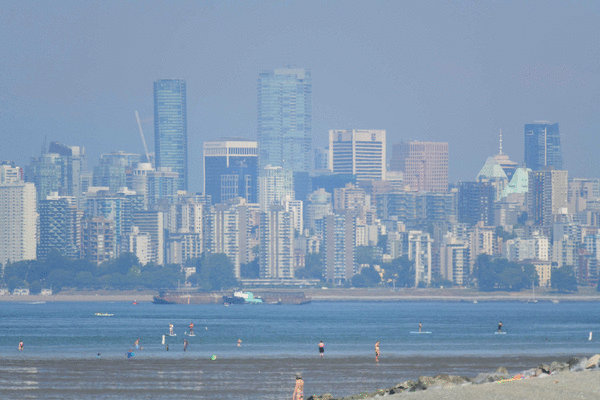
Vancouver, British Columbia
Went into effect: Started in 2017, with first payments due in 2018.
How: The tax was introduced by Vancouver’s then-mayor and passed by the City Council in 2016.
What it does: Vacant properties are subject to a 3% tax on the property’s assessed taxable value. “These funds are used to support the delivery of new social, supportive and non-profit co-op housing through the City’s Community Housing Incentive Program (CHIP) and acquisition of new land for housing,” a Vancouver spokesperson wrote in an email. All homeowners are required to let the government know if their property is vacant or occupied. If they don’t declare, the fine is 250 Canadian dollars, and the property will be considered vacant and subject to the tax, the city website says. False declarations are fined up to $10,000 per day. People can report properties that might be vacant. Declarations are subject to audits.
Number of properties impacted: The city had 2,538 vacant homes in 2017. In 2024, the most recent year with data available, there were 979 vacant homes. Tax data “suggests that the decline in vacant properties is largely driven by homes being put into use as long-term rentals. There has been a steady increase in tenanted properties since the tax began, including an increase of 1,006 tenanted properties between 2023 and 2024 alone,” a city employee wrote.
Revenue: Since 2017, the tax has raised more than $194.3 million. That goes to affordable housing initiatives.
Nuances: The annual tax began at 1% in 2017 and rose to 1.25% in 2020. In 2021, it rose to 3%. This tax is different from the British Columbia Speculation and Vacancy Tax, enacted in 2018 and which applies to a region that includes Vancouver. That tax rate is, in most cases, 3% for foreign owners and 1% for Canadian citizens and permanent residents.
Exemptions: If the owner dies and the property was not occupied for more than six months during that or the following tax year, an exemption applies. Homeowners are also excused from the annual tax if the second home’s owner or the owner’s family is getting medical care in Greater Vancouver and lives outside that area, if the home is being repaired or substantially renovated. There is also an exemption if the residential property is uninhabitable or not used as a residence for certain reasons, if the owner, tenant or occupant is in a hospital or other medical care facility, if the home is vacant by court order or if there is an ownership change. If the owner uses the property as a second home because his or her job, but not primary residence, is in Greater Vancouver, an exemption applies. In some cases, new builds are exempt.
Law text: https://bylaws.vancouver.ca/11674c.PDF
Oakland, California
Went into effect: Started in 2018, first payments due in 2019.
How: Voters approved the tax. To pass, it required more than two-thirds voter approval, which means the revenue can be earmarked for specific goals rather than directed to the city’s general fund, in accordance with state law.
What it does: The law taxes properties used for fewer than 50 days in a calendar year. Along with residences, it also taxes unused land, nonresidential and some commercial spaces. The annual tax runs $3,000 to $6,000. To identify vacant and non-exempt properties, a city administrator can use “objective, available data” and alert property owners. Property owners will be notified by mail about the possible application of the vacant property tax to their property, the city’s website says. If the home is not vacant or exempt from the tax, owners can reply within 20 days with a “petition of vacancy” by giving sworn statements, pictures, utility records and “any records necessary to demonstrate entitlement to an exemption,” an amendment to the tax states.
Number of properties impacted: The city identified 1,702 taxable properties in 2019 and 4,227 exemptions. In 2023, the most recent full-year data available, the number of taxable properties rose to 1,851, while the number of exemptions fell to 1,758.
Revenue: Goes toward affordable housing, and services and programs used by homeless people. At least 25% is earmarked for code enforcement, cleaning blighted properties, addressing illegal dumping and administrative costs for the tax. When passed, it was projected to raise $6.6 million to $10.6 million per year. From 2019 to 2023, it raised around $30 million, or $6 million a year on average. Around 33% of those bills were not paid, making those homes subject to tax liens.
Exemptions: The law allows for many exemptions, including for property owners who are “very low income,” low-income seniors, disabled, or experiencing financial or other hardship. Properties can also be exempt if they are actively under construction or in the permitting process, or owned by a nonprofit.
Law text: https://www.oaklandca.gov/files/assets/city/v/1/city-administrator/documents/chapter_4.56___vacant_property_tax.pdf
Rhode Island
Went into effect: (Pending) July 1, 2026.
How: Passed by the state Legislature in June 2025. Gov. Dan McKee allowed it to become law without his signature.
What it does: Taxes homes that are not occupied by the owner for 183 days or more in a year. However, it only applies to homes with an assessed value of more than $1 million. Assessed value is determined by cities or towns across the state, and letters are sent to owners who can dispute or declare if the home is unoccupied. Homes are taxed $2.50 for each $500 of the assessed value in excess of $1 million.
Number of properties impacted: About 4,443 potentially taxable properties, said the Rhode Island Office of Revenue Analysis. One home affected would be singer Taylor Swift’s seaside mansion, assessed at nearly $30 million. Because of this, the law was nicknamed the “Taylor Swift Tax.”
Revenue: The state’s revenue office estimates the tax will bring in $24.4 million in 2027. It predicts the tax will bring in more money each year: $25.7 million in 2028, $26 million in 2029, $26.4 million in 2030; and $27.2 million in 2031. All revenue goes to a low-income housing fund.
Exemptions: If a homeowner has a rental that has been vacant on their property — which is their primary residence — for 183 days, it is exempt. For example, a $5 million home that rents out several accessory dwelling units, but has one unit that has been vacant for a long time, would be exempt.
Nuances: Property owners can avoid the tax if they rent out homes for 183 days or more. The days do not need to be consecutive.
Law text: https://webserver.rilegislature.gov/Statutes/TITLE44/44-72/INDEX.htm
San Francisco
Went into effect: Suspended before tax collection could begin because of a legal challenge. Originally, it was set to start collection in spring 2025. The city continues to fight for implementation in court.
How: Passed by more than half of voters.
What it does: Taxes a vacant property that is unused for more than 182 days. Penalties are based on property size and how long the property has been vacant. For instance, a home that is less than 1,000 square feet would be assessed a $2,500 fee if determined to be vacant (for more than 182 days) in a one-year period. If it is more than 2,000 square feet, the fee would be $5,000. Fees would have increased annually if the home stayed unoccupied. For instance, fees for a property that is more than 2,000 square feet and stayed vacant for three years could reach $20,000.
Number of properties impacted: More than 40,000 homes, according to a 2019 report from the San Francisco Budget and Legislative Analyst. That number was heavily disputed by housing analysts. Critics argued most of the supposed 40,000 vacant properties were only temporarily empty, and included homes seeking a renter, homes that sold but whose new owners had not yet moved in and properties in the middle of a remodel. San Francisco used U.S. Census estimates to determine vacancies, which calculates unoccupied homes for any reason (even if it is temporary). How the city would determine vacant properties was expected to be similar to its commercial vacancy tax, which required all owners or lessees of commercial space to file a special tax form with the city — regardless of whether it was ever vacant.
Revenue: Estimated annual revenue of $20 million to $37 million. Ballot language suggested the creation of a special fund for rent subsidies and low-income housing, but it never came to fruition because no money was collected.
Nuances: If a home or apartment is newly constructed, it gets a one-year grace period. If a unit suffers severe damage, it would be given a two-year grace period. And certain extensions are given after the death of a primary owner while heirs sort out affairs.
Law text: https://codelibrary.amlegal.com/codes/san_francisco/latest/sf_business/0-0-0-50388
Berkeley, California
Went into effect: 2024.
How: Voted into law in 2022 with almost 65% voter approval. A simple majority was required.
What it does: The tax applies to residences vacant for more than 182 days per calendar year. For single-family homes, condominiums, duplexes and townhouses, the tax is $3,000 the first calendar year and $6,000 a year after that. Apartments in certain residential buildings are taxed double. The city’s rent board, not homeowners, identifies which properties owe the tax. City residents can also report properties. “We identify units that meet the vacancy definition, review and process exemption and exclusion requests, and transmit verified vacant‑unit data to the City of Berkeley’s Finance Department for taxation and collection,” Lief Bursell, the principal planner with Berkeley’s Rent Board, wrote in an email.
Number of properties impacted: At the end of 2023, the Berkeley Rent Registry recorded 1,355 vacant residential units. In April, there were 1,052 vacant units in the system. Bursell said that “anecdotally” observed trends, not based on systematic tracking of all vacant units, show some property owners sold vacant properties, and some vacant properties were converted to rentals.
Revenue: The money goes into the city’s general fund.
Exemptions: Properties owned by nonprofits and owner-occupied properties with fewer than five units that are owned by a person or trust with no other residential property in Berkeley.
Nuances: It expires in 2034, unless voters decide to keep it. The tax rates will be adjusted annually for inflation. To identify properties, the rent board maintains a rent registry with all the city’s rental units, and units that are either vacant or “not available for rent” in that registry are subject to the tax, unless they’re exempt.
Law text: https://berkeley.municipal.codes/BMC/7.54
Toronto
Went into effect: Approved in 2021, launched in 2022, updated in 2024.
How: Approved by the City Council.
What it does: Owners of residential properties that are vacant for at least six months during the tax year owe 3% of the assessed property value. Homeowners must declare a property’s occupancy status each year.
Number of properties impacted: Since the tax was introduced, the number of vacant homes fell from 6,944 in 2022 to 5,989 in 2024, according to a city spokesperson, a reduction of just under 1,000 properties.
Revenue: The tax generated around $107.1 million (Canadian dollars) in 2022 and 2023, when the rate was 1%. For 2024, the estimated revenue was $105 million Canadian. The money is used for housing initiatives, with a focus on increasing supply and helping people facing housing instability.
Nuances: The tax rate went up to 3% in 2024, from 1% in 2022. “The City anticipates that the higher taxation rate will encourage more previously vacant homes to be put on the market, helping to increase housing availability,” a Toronto website says. After a bumpy rollout, the tax was overhauled for the 2024 tax year.
Exemptions: Similar to those allowed in Vancouver. Also, as in Vancouver, all residential property owners must declare occupancy status, whether or not a home is vacant. If they don’t, the property could be declared vacant and taxed.
Law text: https://www.toronto.ca/legdocs/bylaws/2022/law0097.pdf
©2026 The San Diego Union-Tribune. Visit sandiegouniontribune.com. Distributed by Tribune Content Agency, LLC.








Comments