Larry Printz: Mercedes-Benz is playing both sides of the EV revolution, and it just might work
Published in Business News
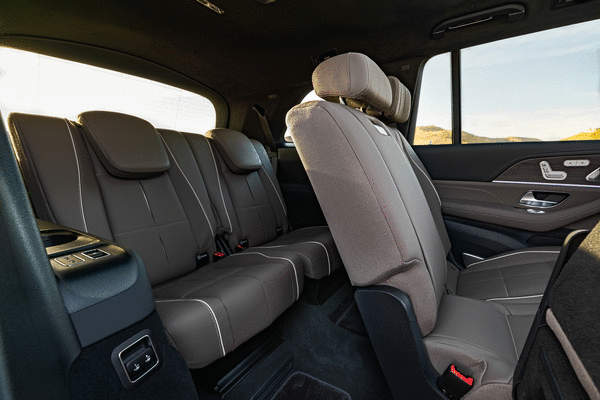
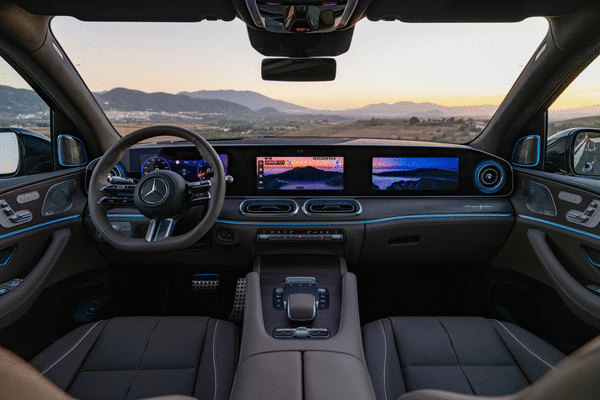
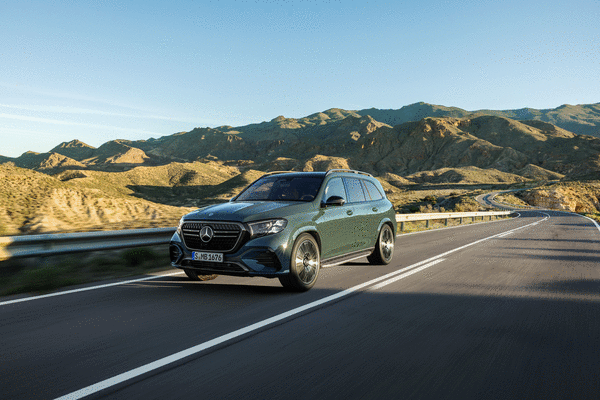
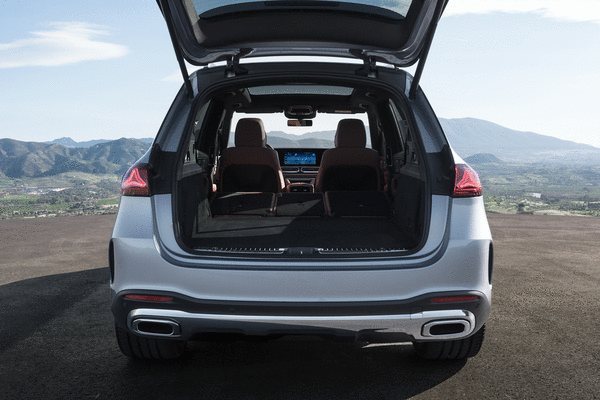
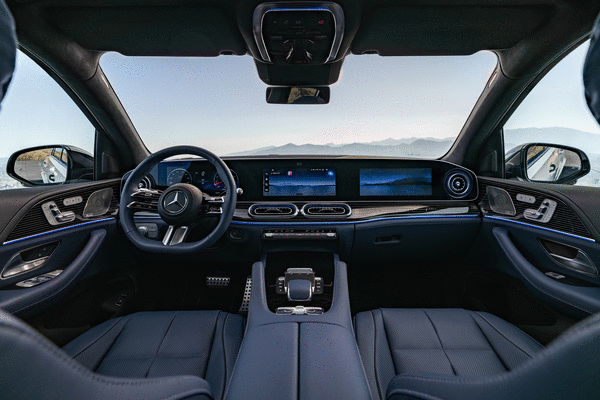




Mercedes-Benz is reaching for an increasingly familiar playbook in the luxury auto market: evolve aggressively without starting over. The automaker recently unveiled a new round of updates to its midsize GLE and flagship GLS sport-utility vehicles at its sprawling plant near Tuscaloosa, Alabama, underscoring a strategy increasingly common among automakers.
For the 2027 model year, the GLE lineup will continue to span a notably wide spectrum, from the entry-level GLE 350, powered by a 255-horsepower turbocharged 2.0-liter four-cylinder, to the range-topping AMG GLE 63 S+ mild hybrid with a twin-turbocharged 4.0-liter V-8 producing 603 horsepower. All-wheel drive is standard. The GLE comes in a choice of traditional SUV and coupe body styles, while the larger Mercedes-Benz GLS comes strictly as a three-row SUV. Buyers can choose between the 375-horsepower GLS 450, equipped with an inline-six, and the more muscular 530-horsepower GLS 580. And, in keeping with modern luxury-market expectations, all-wheel drive comes standard.
For both lines, Mercedes is refreshing the technology suite and subtly reworking the exterior design. Both have been on the market since 2020, and received their first refresh in 2023. Traditionally, 2027 would see the debut of an all-new generation. But soaring development costs and an uneven transition to electric vehicles has Mercedes-Benz playing the field more cautiously. So, they are undergoing a second major facelift designed to keep profitable models competitive without the expense of a ground-up redesign.
The German automaker is also preparing a major manufacturing shift in the U.S., with plans to begin scaling production of its compact GLC SUV at the company’s plant in Alabama by 2029. The move is tied to a $4 billion investment designed to bring assembly of its bestselling SUV to America, reducing the company’s exposure to rising American import tariffs as Mercedes-Benz builds vehicles in the markets where they sell, allowing the company to use local suppliers to satisfy local tastes.
It comes as Mercedes-Benz abandons producing one mode worldwide, as flexibility has become the new corporate survival strategy. The reason is volatility, not just in consumer sentiment but also in the global economy.
“You cannot build a strategy today that perfectly predicts where the market will be tomorrow,” said Mathias Geisen, member of the company's board of management for sales and customer experience. Oil prices have risen sharply in recent weeks, reshaping the economics of electric vs. combustion vehicles almost overnight. Geopolitical disruptions, energy costs, government incentives and charging infrastructure can all alter consumer choices faster than traditional automotive planning cycles can handle.
"Unfortunately, we live in a less globalized world than some years ago, so you have to be very specific in what you offer for different markets,” Geisen said. “In the past, let's say, five years, 10 years back, we would have developed one technology for the world. It's impossible now.”
That uncertainty is forcing automakers into a delicate balancing act of running multiple powertrains through the same production line. While it adds complexity and cost, Mercedes-Benz is willing to absorb that inefficiency in exchange for agility.
“Two or three years ago, we decided we cannot rely upon hoping that specific regulations will kick in. We have got to make sure that our strategy is flexible enough to adjust whatever it is right, and that creates more complexity on our end,” Geisen said. “Our customers tell us what they want, and we’ve got to make sure that we have it available. If you don't have it available, a competitor will.”
Consider the Mercedes-Benz CLA sedan.
Beneath the sleek exterior is a flexible architecture capable of supporting both an internal combustion engine or a fully electric powertrain, a strategy that reflects the automaker’s increasingly pragmatic approach to electrification. In Europe, where orders for the new CLA is strong, executives say the majority of buyers are gravitating toward the electric version, including many who had not initially planned to purchase an EV at all.
The lesson, Mercedes believes, is that consumers can be persuaded less by ideology than by desire.
“If you build a vehicle compelling enough,” Geisen said, “customers stop asking whether it’s electric and start deciding whether they want it in their driveway.”
That distinction is critical for luxury brands navigating an uneven global transition away from gasoline engines. Rather than forcing customers toward electrification through discounts or inventory pressure, tactics that can erode resale values and dilute a premium brand’s cachet, Mercedes is attempting to create what executives describe internally as a pull effect — that is, vehicles attractive enough in design, technology and pricing that consumers willingly make the leap.
The alternative, Geisen acknowledges, is costly. Pushing excess vehicles into the market can damage margins, weaken residual values and ultimately undermine brand equity, a particularly dangerous outcome in the luxury segment, where perception is often as valuable as the product itself.
©2026 Tribune Content Agency, LLC










Comments