The 'first lady of Chicago jazz,' Geraldine de Haas dies at 91
Published in Entertainment News
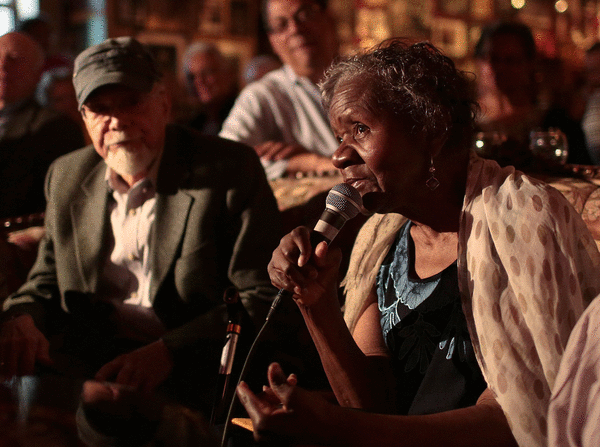
CHICAGO — She was a woman former Tribune critic Howard Reich called “the first lady of Chicago jazz,” and for decades Geraldine de Haas delighted in that role. She earned it too, through stunning performances and as a passionate promoter and producer of jazz programs and events that changed the cultural face of the city.
De Haas died the morning of July 28 in Englewood Health Hospital in New Jersey, where she had moved in 2013. She had lost her husband, bassist Eddie de Haas, in 2022; both had been living for some years at the Actors Fund Home, an assisted-living facility also in Englewood.
She was 91 years old and died of natural causes. At her bedside were her Chicago-born children, Darius and Aisha de Haas, both of them, not surprisingly, accomplished singers and actors.
“I have never known anyone more singular, dynamic, powerful, generous, hardworking, influential, inspirational and more loving than my mother,” Darius said. “She was also a great wife, artist, community leader, producer and advocate for the arts and notably for jazz, America’s original art form. Through all those things, traversing many worlds and enduring great challenges, she displayed a beautiful humanity which touched so many and will live on. I am unspeakably heartbroken at her loss but infinitely thankful for the gift of being her son.”
Of the memories that began to flow in the wake of de Haas’ death, few were livelier than those from more than a decade ago, a 2013 night at the Jazz Showcase, a goodbye party for Eddie and Geraldine, who were moving to New Jersey to be close to their children.
As Reich reported at the time, “It was a combination jam session, farewell party and benefit honoring two of the most beloved figures in Chicago jazz. … The Showcase was packed, jazz lovers from across the country forced to wait in the lobby until space opened up inside.”
Geraldine Wideman was born in Newark, New Jersey, on Jan. 16, 1935, the seventh of nine children in a home that she described as “low on money but rich in family.”
And rich in music. “We always had some kind of raggedy piano in the house,” she said. “(It) was the music house of our neighborhood. My little brother Andy (Bey) would get to the piano before anybody else. He was a prodigy, but I was always singing. In school they called me ‘Songbird.’ ”
Geraldine and Andy, along with sister Salome, formed a singing trio, “Andy and the Bey Sisters,” and were soon winning amateur talent shows and playing local clubs and Miami nightclubs. Then it was off to Europe. “We went first to Spain, then a supper club in London. We played military bases in Germany,” she said. “It was overwhelming to visit these places, three little people from Newark. And it was different. In Europe, I never sensed any racism. We felt completely free.”
They were the featured act at the legendary Blue Note nightclub in Paris, meeting most of the prominent jazz musicians of the day and stars from other realms.
She was able to resist the amorous attentions of movie star Marlon Brando, remembering, “People had told me that he was doing all kinds of things to ladies and I didn’t want to become involved in that.” But she did fall in love with and marry in 1966 a musician named Eddie de Haas.
“I really didn’t want to marry a jazz musician because I thought they were all crazy,” she said. “But Eddie was a very nice guy. He pursued me like I was a movie star. He was a good cook and used to prepare incredible meals for me. And he was a wonderful bass player.”
When Eddie got a steady job playing at the London House, they arrived in Chicago for keeps on April 4, 1968. It was a date she always remembered because, she said, “It was the day that Martin Luther King was shot and killed.”
Moving into a house in the South Shore neighborhood, she initially found the city a “very segregated place. … They said this was a city of neighborhoods, but it was a ‘Don’t you dare come in my neighborhood!’ city,” she said. “It didn’t take me long to learn, though, that this was a place where you could do something important.”
After the birth of her children, and frustrated with the local nightclub scene, she was drawn to musical theater, mentored by the Free Street Theater’s founder, Patrick Henry. She was in the Chicago premiere of “Hair,” even though she told producers, “I will sing whatever you want me to sing, but I won’t take my clothes off.” During the musical’s famous nude scene, de Haas stayed under a blanket on the stage.
There were other plays and some club work, but following the 1974 death of Duke Ellington, she joined with other musicians to plan a tribute concert. She argued that the planned event take place not in the South Side’s Washington Park, as city officials suggested, but at the centrally located Grant Park, saying, “His music was so universal that the concert should be for the whole city.”
“I wrote letters to everybody with the Park District, even the janitors,” she said, and so Grant Park it was. The August 1974 concert, the first city-sponsored music festival in Chicago, was so successful that it would be the foundation and catalyst for all the city festivals — jazz fest, blues fest, gospel fest, even Lollapalooza.
It also fueled the creation of Jazz Unites, a nonprofit group de Haas started in 1981, one of its goals to bring music back to the South Side, which it did when the first Jazz Fest was held at the South Shore Cultural Center in 1983. And she still sang.
“My brightest memory of watching Ma perform was her joy,” said her daughter, Aisha. “She absolutely loved to sing, and it was evident. She was also a lesson in perseverance. Yes, she curated fantastic jazz concerts but I watched her make countless phone calls and write endless proposals in pursuit of sponsors, underwriters, donations, funding, every year for 40 years. She was tireless in her pursuit of bringing jazz music to the masses. For free. Her life was a lesson in finding a way.”
She became increasingly involved with the annual Jazz Fests, a campaign to build a jazz museum here and so many other efforts promoting jazz and mentoring young musicians that at a party in her honor, saxophonist Eddie Johnson said, “Geraldine has done more to perpetuate jazz in Chicago than anybody.”
As her husband played all over town with practically every jazz star who passed through, she continued to advocate with a preacher’s passion, “You have to get out and support jazz,” she would say. “This is America’s music and you’ve got to support it.”
A memorial service is being planned.
©2026 Chicago Tribune. Visit chicagotribune.com. Distributed by Tribune Content Agency, LLC.









Comments