Commentary: 'The Odyssey' shows studios when to ignore critics
Published in Entertainment News
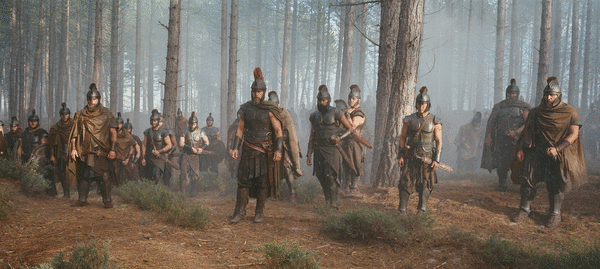
Christopher Nolan’s latest blockbuster, "The Odyssey," had a suitably epic opening weekend. The film grossed $264.1 million, becoming the biggest global launch in Nolan’s career. With such overwhelming enthusiasm from moviegoers, the right-wing backlash surrounding "The Odyssey" — concerning everything from casting decisions to the modern-day dialogue and American accents — has sunk without a trace, not unlike some of Odysseus’ ill-fated crew.
That the film successfully weathered a social media storm is a reminder that visibility and consensus aren’t necessarily the same thing. The answer isn’t that studios should ignore audience sentiment altogether. But they should stop treating every online controversy as if each carries equal weight. Hollywood’s challenge isn’t whether to listen to fans — it’s knowing which feedback actually reflects consumer demand.
Studios have long measured interest through test screenings, prerelease tracking polls, and, ultimately, whether moviegoers showed up to theaters. Additionally, services like Cinemascore and Comscore’s PostTrak poll opening-weekend audiences to provide real-time data on reception and demographics, which can indicate a film’s long-term box-office potential and validate (or invalidate) marketing strategies.
These practices remain valuable, but studios now have access to something much noisier: social media. Online sentiment is loud and immediate. As a result, it can also be mistaken for a referendum on a film from the wider public. This dynamic is especially prominent among franchises with established, passionate fanbases.
But a vocal minority doesn’t always speak for the fanbase as a whole. “The vast majority of any fandom are casual fans,” "Star Trek’s" vice president of brand development, John Van Citters, said in a 2024 interview with Variety. “The number of people who live and die on their franchises are very, very few, and then those who come after things that they espouse to love with venom are a really, really tiny subset of that already smaller subset of fandom.”
So what separates a real market signal from online noise? The first question studios need to ask is whether audiences have meaningfully engaged with a film — let alone seen it — before the complaints pour in. For instance, "Captain Marvel" was subject to a coordinated smear campaign in 2019, during which the film’s Rotten Tomatoes page was inundated with misogynistic comments and the “Want to See” audience score cratered.
The controversy generated plenty of headlines, but it did not translate into lost ticket sales. The film went on to gross more than $1 billion, and Rotten Tomatoes has since banned prerelease audience comments.
Another important distinction to consider is whether the backlash surrounding a film is representative of broader audience sentiment. Upon release, "Star Wars: The Last Jedi" received online backlash that took issue with the film’s subversive storytelling choices and the prominent role for a new character played by Kelly Marie Tran, who was subjected to months of racist and sexist comments that ultimately led to her deleting her Instagram account.
Despite being the highest-grossing film of 2017, as well as earning an “A” grade on Cinemascore from opening-weekend audiences, Lucasfilm appeared to placate the loudest corners of the fanbase. Not only were scenes Tran had already filmed cut from "The Rise of Skywalker," reducing her character to just over a minute of screen time, but the film also undid major plot developments. The outcome: the worst-reviewed entry of the Disney era, the lowest Cinemascore grade for any live-action "Star Wars" film, and roughly $250 million less at the global box office than "The Last Jedi."
A similar story played out with "The Odyssey." Sure, the backlash was visible online, especially when it was stirred, in part, by Elon Musk on his own social media platform. But Imax tickets selling out a year in advance suggested a very different reality: Nolan is a brand unto himself, and audiences await his films with the kind of fervor typically reserved for franchises.
However, not every online controversy proves meaningless or done in bad faith. If the internet identifies a genuine audience concern, studios are better served by paying attention. The difference is whether the criticism points to a specific, fixable problem.
The uproar surrounding the "Sonic the Hedgehog" movie targeted something concrete: When the first trailer was released, the title character’s redesign that featured human-like teeth and eyes was, frankly, unsettling. In response, Paramount Pictures delayed the film’s release by three months and reportedly spent an additional $5 million so that Sonic would more closely resemble how he looked in the video games. The change worked, and "Sonic the Hedgehog" launched into a successful franchise with a fourth film on the way next year.
Timing, representativeness, fixability — three different lenses, but the same underlying question: does this feedback reflect anything the people paying for tickets actually want? On all three counts, "The Odyssey" passed. The backlash was in the works before the film had a chance to be seen by critics and audiences. It was spurred by a narrow, ideologically driven group of commentators rather than the moviegoing public at large. And barring a complete recasting and script rewrite, there was no fix Universal could have offered that would have satisfied the people driving the backlash anyway.
None of this means studios should stop listening. Instead, Hollywood should stop mistaking the loudest opinions for the views of the broader audience. The data to tell them apart already exists. "The Odyssey" is proof that when a studio trusts the evidence, the online noise sinks on its own.
———
This column reflects the personal views of the author and does not necessarily reflect the opinion of the editorial board or Bloomberg LP and its owners.
Miles Surrey is a Brooklyn-based culture writer. His work has also appeared in The Ringer, Men’s Health, and Vox.
©2026 Bloomberg L.P. Visit bloomberg.com/opinion. Distributed by Tribune Content Agency, LLC.






Comments