Commentary: 'Disclosure Day' underscores a Hollywood marketing dilemma
Published in Entertainment News
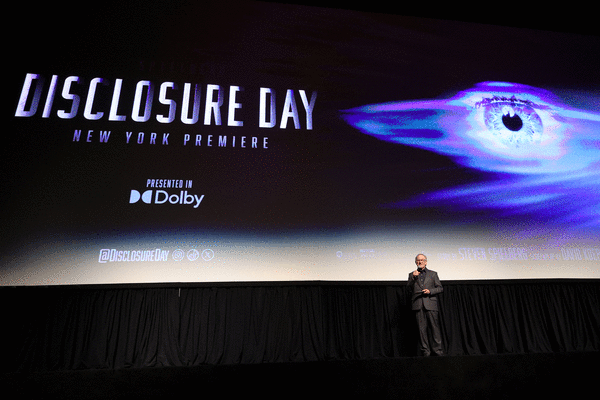
From "Close Encounters of the Third Kind" to "E.T. the Extra-Terrestrial" and "War of the Worlds," a UFO-themed blockbuster from Steven Spielberg has long been a can’t-miss event, and last weekend was no exception. His latest entry in the extraterrestrial canon, "Disclosure Day," grossed $44 million domestically, becoming his best-ever debut for an original film.
What’s especially revealing is who showed up. Per Deadline, nearly 40% of moviegoers were over the age of 45, with 55% of attendees citing Spielberg himself as the biggest reason they went. With that turnout, "Disclosure Day" dispels the notion that older audiences are no longer invested in the theatrical experience. But it also highlights a growing challenge for Hollywood: Reaching older moviegoers requires certain conditions — and considerable resources — that few films can meet.
The broader theatrical landscape is skewed toward appealing to the younger generations, and with good reason. According to a Fandango study released in April, Gen Z is the most active moviegoing demographic, with 87% seeing at least one movie in theaters over the past 12 months while averaging nearly seven visits per year. Conversely, only 58% of baby boomers have been to at least one movie in theaters within the same time frame, and average 5.7 visits per year. For studios, there’s more incentive to make films that cater to the youngest demographics — even if it means older audiences become more of an afterthought.
"Disclosure Day’s" numbers complicate that assumption. The film’s audience breakdown almost exactly mirrors that of "Top Gun: Maverick," where nearly 40% of the audience was also 45 or older, and "Elvis," where audiences 45 and up accounted for 45% of ticket buyers. "A Complete Unknown" followed a similar pattern last December: 62% of its opening-weekend audience was over the age of 35, with adults 55 and older being its single largest demographic.
Across multiple genres, the same pattern holds. When a film is positioned as a genuine cultural event — be it a revival of IP from an earlier era, a biopic of a legendary musician, or the latest release from a brand-name director — older audiences can still show up in droves.
The problem is that creating awareness among older moviegoers requires a marketing strategy that runs counter to where studios are currently investing. According to EDO Ad EnGage, a platform that tracks TV ad spending and measures its impact on consumer behavior, national TV advertising spending for theatrical movies fell 24% in 2024 as digital advertising continues to drive a larger portion of box office revenue. In that context, Universal reportedly spending $24 million on traditional TV ads as part of "Disclosure Day’s" $80 million marketing budget is notable. Most of those ads ran during events like Super Bowl LX, the Winter Olympics, and NBA playoff games. All of them are examples of appointment programming that reliably reach the kind of viewers who are less likely to discover the social media campaigns that the industry now favors.
In other words, the audience is still there, but mobilizing them appears to require increasingly expensive outreach.
To that end, "Disclosure Day" carries a $115 million production budget, and its break-even point is reportedly $300 million. Despite a historic opening weekend for an original Spielberg feature, profitability isn’t yet a guarantee. That’s what makes the film such a revealing case study. The issue isn’t demand; it’s scalability.
Of course, most adult-oriented studio films don’t operate near the scale of "Disclosure Day." If a mid-budget drama costs between $30 and $50 million to produce (see: "Black Bag," "The Bikeriders," "Juror #2"), a similar linear ad spend is prohibitive. A film like "Disclosure Day" can justify an $80 million marketing campaign because its financial ceiling is measured in hundreds of millions of dollars. Mid-budget dramas don’t have the same upside. As a result, these films become harder for older audiences to discover in theaters and increasingly end up on streaming services.
Spielberg, of all people, saw this coming. Speaking at the opening of the USC School of Cinematic Arts building in 2013 alongside longtime collaborator George Lucas, he noted that "Lincoln" was nearly released on HBO. Additionally, Lucas feared that the high cost of marketing would drive more movies of that ilk to television. “The pathway to get into theaters is really getting smaller and smaller,” Lucas said.
Thirteen years later, the only meaningful difference in Lucas’ prediction is that Netflix is the beneficiary of this shift more than HBO. "Disclosure Day’s" opening weekend didn’t disprove that notion. If anything, it illustrates the higher barrier to entry. The film found its intended audience through an eight-figure linear TV campaign and a director who’s a brand unto himself.
Most films and most filmmakers won’t have that luxury. Older audiences haven’t abandoned the theatrical experience. But if the economics of reaching them proves challenging for even the pioneer of the summer blockbuster, studios might continue to leave these moviegoers in the lurch.
———
This column reflects the personal views of the author and does not necessarily reflect the opinion of the editorial board or Bloomberg LP and its owners.
Miles Surrey is a Brooklyn-based culture writer. His work has also appeared in The Ringer, Men’s Health, and Vox.
©2026 Bloomberg L.P. Visit bloomberg.com/opinion. Distributed by Tribune Content Agency, LLC.











Comments