New venue moves controversial Live Nation into middle of Twin Cities concert scene
Published in Entertainment News
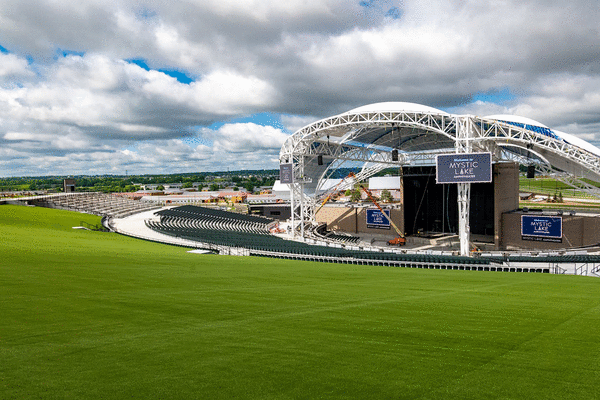
MINNEAPOLIS — It’s the amphitheater that developers and concert professionals have been pitching for more than three decades. It took one year longer than planned to build.
Now that it’s finally here, what does Mystic Lake Amphitheater mean for the future of the Twin Cities concert scene?
That’s a question on the mind of many music fans and independent concert promoters in Minnesota as concert industry giant Live Nation opens its ambitious, 19,000-person outdoor concert venue near Canterbury Park in Shakopee — widely expanding its foothold in the state.
The easy answer is Live Nation’s big move into the Twin Cities outdoor concert scene will mean more concerts overall as well as some eye-popping prices ($90 for premium parking!) and cool amenities this area hasn’t experienced.
The amphitheater will host an all-Minnesota opening concert Saturday. Next week, it welcomes its first two touring headliners, Dave Matthews Band and MGK. Other acts set to perform there through its inaugural summer include Bob Dylan, Chris Stapleton, Guns N’ Roses, Willie Nelson, Wu-Tang Clan, Pitbull and Mumford and Sons.
This probably wasn’t the best year for Mystic Lake Amphitheater to arrive. The 2026 summer concert season is a downturn year for ticket sales, as consumers spend less. Industry insiders are calling it “blue dot fever,” as Ticketmaster maps show rows and rows of empty seats on its online seating maps.
Josh Lacey, Live Nation’s president of the Minnesota market, countered those reports and pointed to robust sales at the new amphitheater as well as a strong response from artists. His team exceeded original estimates to book around 30 concerts and wound up with 40 total for its first year.
“The venue’s been incredibly well-received in the touring industry,” Lacey said. “There’s a lot of excitement from artists to get out here.”
This year also has been a very tumultuous year for Live Nation. The ubiquitous corporation — which owns Ticketmaster — has been embroiled in investigations and lawsuits by federal and state attorneys general accusing it of running a monopoly.
One of 33 state attorneys general who won an April jury trial accusing Live Nation of breaking antitrust laws — the ramifications of which are still pending — Minnesota’s Keith Ellison has joined U.S. Sen. Amy Klobuchar, D-Minn., in asking for the company to be broken up.
“Live Nation’s monopoly has made billions and billions of dollars on the backs of Minnesotans who have struggled to pay absurd rates for concert tickets, artists who have been stifled, and independent music venues that have struggled to get by,” Ellison said.
Mystic Lake Amphitheater could add to Live Nation’s reputation of monopolistic practices in Minnesota. Prior to this, the company has promoted various arena and stadium concerts here, owns the Fillmore and Varsity Theater and helps manage the Armory and Uptown Theater. The local developer behind the latter two venues, Swervo, also owns Mystic Lake Amphitheater with Live Nation as its operating partner.
Live Nation’s revenue stake in Minnesota is likely to soar with Mystic Lake Amphitheater. Not only will all tickets at the venue be sold through its sister company Ticketmaster, but Live Nation also serves as promoter for many of the tours coming to the amphitheater. It also controls just about everything else that generates money at concerts.
“They kind of have a wrap on everything at their amphitheaters,” said Matthew Smith, a talent buyer with the Berkeley Music Group, which has long faced stiff competition from Live Nation in the San Francisco Bay Area.
“They make money off all ends of a concert, from concessions and parking to merchandise and sponsorships,” added Smith, who warned: “Live Nation is going to drive up the costs in this town and make everything more expensive for the customers.”
Representatives from First Avenue — long Live Nation’s most staunch local independent competitor — are underlining their homegrown status as they prepare to compete on the amphitheater level with the Los Angeles-based corporation. First Ave and the Minnesota Orchestra will co-manage the 8,000-capacity Community Performing Arts Center (CPAC) along the Mississippi River north of downtown Minneapolis, now under construction with completion expected in summer 2027.
“We’re proud to be the independent, local option in the Twin Cities,” said Dayna Frank, First Avenue owner and CEO. “We work hard to keep tickets affordable, have a 50-plus-year history and deep ties to Minnesota artists, and a real stake in this community.”
Other locally based outdoor concert competitors of Live Nation are taking a wait-and-see approach.
Lakefront Music Fest’s event director Michelle Jirik — whose 16th annual festival lands July 10-11 in nearby Prior Lake with Keith Urban and Billy Idol for headliners — said it was harder to hire workers for security and concession positions this year with the amphitheater also staffing up. Jirik said Lakefront’s ticket sales have remained strong, though, which was a worry.
“Competition is very big this year with all the festivals that are happening and you throw in Grand Casino Arena and Target Field,” Jirik said. “It’s different, a customer/buyers’ market out there.”
The Minnesota State Fair’s booking team has had to look harder for available artists, said fair CEO Renee Alexander. They were turned down by a handful of acts wanted for the grandstand who were already in line to play the new amphitheater.
“I ran into more this year than I have in the past,” Alexander said. “It was like, ‘They have a hold on Shakopee,’ so I moved on to something else. That’s the nature of the game.”
On the upside, Alexander said Live Nation’s amphitheater adds to an overall increase in summer concert options: “It’s a great time to be a fan of music,” she said.
Many die-hard music fans sound leery about the new amphitheater raising Live Nation’s Minnesota presence.
“Don’t care how great the band is or how bad I’d like to see them, I’ll never give a dime to Live Nation/Ticketmaster if I can help it,” said Jon Evans, an avid concertgoer from Eden Prairie. “They’ve hijacked live music and held it for ransom.”
Premium options at a cost
Live Nation representatives gave local media a preview tour of the massive, tiered, partially covered outdoor venue Thursday. The venue made an undeniably big impression.
Its 18 different luxe VIP suites offer up-close views of the stage. Conversely, its sprawling general-admission area at the back of the venue has lower-buck charm, with bar-rail-lined standing sections, an artificial-turf lawn offering room to spread out and sunset views overlooking the nearby horse track. In between those two sections lies a sea of reserved seats and surrounding concession stands, with local food options including Red Lake Walleye and Ellsworth Cooperative Creamery.
“We’re taking the premium concert to the next level,” Mietra Beyer, Live Nation’s head of brand and experience, said as she showed off the VIP suites, which come with access to an exclusive bar area dubbed the Vinyl Room.
Other bar areas with tables and chairs line the perimeter of the venue, including another large VIP area, the Backyard, with a barbecue theme and lawn games. Said Beyer, “We wanted to give people more room to just hangout, which you don’t often get at concerts.”
Of course, many of these premium options come at premium prices not widely seen before in the Twin Cities.
Live Nation is selling VIP-style tickets for over $500 to some of its hottest shows, including Chris Stapleton, Mumford and Sons and Guns N’ Roses. Many of those tickets include VIP bar area access but don’t always include the premium parking option, which can be $70-$90 more.
Add to all that the concession profits and other extras — including $20-$40 blankets or $10 folding chair rentals on the lawn — you can understand why the nearly 80 amphitheaters run by Live Nation around the country count for a large portion of its increased earnings. In just the first quarter of 2026, the company reported a 12% revenue increase to almost $3.8 billion. It also spent $450 million in legal fees in that time fighting the federal and state antitrust cases against it.
When the Minnesota Star Tribune asked Live Nation’s local market president to address the company’s monopolistic image in regard to the new amphitheater, a national Live Nation publicist listening to the interview cut in and abruptly ended the conversation, saying Lacey had to go.
Live Nation did later send figures credited to Oxford Economics that trumpeted the positive impact Mystic Lake Amphitheater will have on the local economy: $73 million in annual fan spending and the creation of around 800 part-time jobs paying $18-$25 per hour.
“We’re a phenomenal concert market,” Lacey, a 14-year veteran of Live Nation’s Twin Cities office, said before his interview was cut off. “Minnesota deserves a world-class, large outdoor amphitheater like this.”
©2026 The Minnesota Star Tribune. Visit startribune.com. Distributed by Tribune Content Agency, LLC










Comments