Meta 'hid the truth' about harms to children, California says as Oakland trial opens
Published in Business News
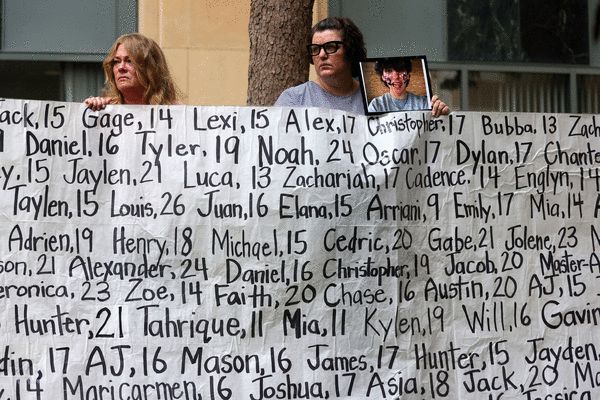
California accused Meta on Tuesday of studying “vulnerabilities in teens’ brains” to hook children on Facebook and Instagram, then concealing the harm, in opening statements of a potentially transformative federal trial in Oakland.
Meta countered that it has recognized the risks of social media, researched user safety and developed tools intended to protect young people.
California, Colorado, Kentucky and New Jersey are leading a coalition of 29 states accusing Meta of designing Facebook and Instagram to addict children, and collecting children’s data without parental consent in alleged violation of federal law. Meta has said it faces up to $1.4 trillion in penalties. Experts say any hit would likely be smaller — up to hundreds of billions of dollars — but an order restricting features designed to keep young users scrolling could prove more damaging.
The jury in the case is advisory and will issue non-binding findings. U.S. District Court Judge Yvonne Gonzalez Rogers will make the final decision.
California Department of Justice lawyer Megan O’Neill told the court that Meta researchers studied how to exploit “vulnerabilities in teens’ brains” to hook them to Facebook and Instagram and keep them scrolling the platforms as much as possible. That way, the company could “harvest their data” and use it to sell the targeted ads that fuel its profits, O’Neill said.
Meta lawyer Paul Schmidt told the judge and jury Meta has publicly communicated its concerns about problematic social media use, and possible effects of social media on mental health.
“Meta has both recognized that people can struggle with their use of social media and tried to come up with tools to help them,” Schmidt said.
O’Neill said Meta possessed numerous internal reports documenting harm even as executives, including CEO Mark Zuckerberg, publicly denied that its products hurt children.
“Meta hid the truth. It kept parents in the dark so that they didn’t have the information that they needed to protect their kids,” she said. “It repeatedly went out and said the platforms were safe for kids.”
When Meta weighed child users’ safety against its bottom line, “time and time again, profit won,” O’Neill said.
O’Neill displayed snippets of internal Meta communications that she said showed how important young users were to Meta’s business.
One report, titled “Long Term Retention: The Young Ones Are the Best Ones and Other Learnings,” described “tweens” aged 10 to 12 as “special” because they had the “highest long-term retention of all our age groups.”
A 2017 email to Instagram head Adam Mosseri described “total teen time spent” as an overall company goal.
O’Neill displayed an internal Meta chart that showed estimates that about 20% of 11-year-olds in the U.S and 30% of 12-year-olds were on Instagram.
A 2018 email from a company executive shown in court referred to kids under 13, saying, “We do very little to keep U13s off our platform.”
O’Neill also shared internal surveys showing that in the space of one week, 27% of kids 13 to 15 witnessed bullying on Meta’s platforms, 13% received unwanted sexual advances, 12% saw images or videos of violence and 19% witnessed nudity.
The judge, Gonzalez Rogers advised the jury that federal law prohibits Meta from being held liable for content posted on its platforms by other people.
But, said Vincent Joralemon, a director at University of California-Berkeley’s Center for Law & Technology, the states aren’t asking for Meta to be held liable over predatory or bullying messages on their own.
“They’re asking the judge to conclude that Meta’s own internal research showed what was happening to teenagers on its platforms, and that Meta told the public, Congress and parents something different,” Joralemon said.
Meta lawyer Schmidt told the court that the company did not dispute that some teenagers struggle to manage time online, kids under 13 sneak onto Meta’s platforms and people “post negative things on Facebook and Instagram.”
But Meta sought to learn from users’ experiences and improve the platforms, he said.
A major part of that work is safety research, Schmidt said. He displayed internal communications saying, “Where could we be better supporting our Instagram community?”, “how to best support teens” and “prioritize mental health and well-being.”
Schmidt showed popups that appear on Instagram prompting users to take breaks or to explore a different topic, which he described as tools to promote safe use. Facebook and Instagram provide safety guides for parents, he noted.
“Not only was Meta working to develop these safety tools, it was working to tell people about it,” Schmidt said.
Meta must walk a fine line in removing content — “someone will say, ‘That’s censorship'” — and the volume of social media posts makes finding problematic content difficult, he said. Still, he said from April to June in 2022, Meta removed 8.2 million posts for bullying and harassment, 13.5 million for hate speech, and 19.3 million for violence and inciting violence.
He said Meta uses “computer detection” to spot kids under 13 on its platforms, allows people to report under-13s’ accounts and trains reviewers to find and investigate possible violations of the age rule.
“If the account can’t prove that they’re over 13, then the account gets deleted,” Schmidt said.
Schmidt sought to defuse some of the inflammatory evidence the states will introduce, such as one employee emailing another calling Instagram “a drug,” and the other responding, “We’re basically pushers.” Schmidt suggested such “loose” language was typical among colleagues.
He addressed a statement of O’Neill’s that a Meta survey of users found 1 in 5 teens on Instagram said it made them feel worse about themselves. But about 40% said the website made them feel better about themselves, and a similar share said it had no effect. “Why did they focus on that 20%?” Schmidt said.
Schmidt suggested the states, seeking to prove Meta made false statements about product safety, cherry-picked “a tiny subset of those statements” from 12 years of communications between tens of thousands of Meta employees.
Unlike a criminal case, where the burden of proof is “beyond a reasonable doubt,” in this civil case, the states need to convince the jury that it is “more probably true than not” that Meta broke state and federal laws, Gonzalez Rogers told the jury.
The states want the judge to order Meta to scrap allegedly addictive design features from Facebook and Instagram feeds for children under 18, including infinite scrolling, visible “likes,” beauty filters and algorithms intended to boost use.
They also want limits on young users’ daily time on Facebook and Instagram, with blackout periods during school and at night. Meta could be required to prevent children from creating multiple accounts to evade parental controls.
©2026 MediaNews Group, Inc. Visit at mercurynews.com. Distributed by Tribune Content Agency, LLC.










Comments