US-Canada trade talks are bogged down by auto sector tariffs
Published in Business News
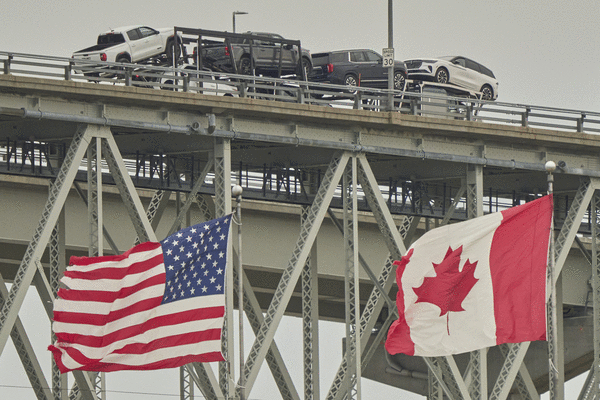
With less than 36 hours to go before new U.S. tariffs on Canada are set to kick in, automotive sector rules are proving to be a major obstacle in negotiations, according to people familiar with the matter.
Canada has pushed to reduce the tariff rate on autos to 10% or expand an exemption that currently applies to U.S. parts in vehicles, according to people with knowledge of the discussions who spoke on condition of anonymity. But the Trump administration has held firm to a minimum 15% rate, the people said.
President Donald Trump put a 25% tariff on foreign cars and trucks last year, but offered Canada and Mexico a partial break based on U.S. parts in the supply chain. A vehicle assembled in Ontario with half U.S. content would have an effective tariff rate of 12.5%, for example.
U.S. Trade Representative Jamieson Greer has demanded Canada drop all of its trade retaliation measures — including the counter-tariffs it placed on U.S. vehicles last year and provincial bans on the retail sale of American-made alcoholic drinks.
Canadian trade negotiators spent the weekend in Washington, locked in talks to try to avert tariffs that Trump has threatened to impose on Aug. 19 at 12:01 a.m. Washington time if a resolution isn’t reached. The president signed an order using a Depression-era law to put 50% duties on an array of Canadian-made goods, including milk, beer, plywood and hockey equipment.
Officials with the White House and USTR didn’t respond to requests for comment Monday. A Canadian official, speaking on condition they not be identified, said that Canada’s top two trade negotiators met with Greer and U.S. Commerce Secretary Howard Lutnick.
Canadian Prime Minister Mark Carney told reporters Monday he expects to speak with Trump before the deadline. However, he said the government is preparing for “all eventualities” if the two nations can’t come to terms.
Canadian officials have been studying options for retaliation if Trump goes through with this new round of tariffs, according to people familiar with the matter.
Carney also has to navigate a complicated political environment at home. All of Canada’s major car plants are located in Ontario, whose leader, Premier Doug Ford, has said he will not reverse his province’s alcohol ban unless the U.S. gives significant relief on tariffs.
General Motors Co., Ford Motor Co. and Chrysler parent Stellantis NV all have factories in Canada, but their production has waned over time and they accounted for less than a quarter of vehicles made in the country last year. The rest are built by Toyota Motor Corp. and Honda Motor Co. Protecting the Japanese automakers’ interests is a key concern for the Carney government.
Greig Mordue, a former Toyota executive who now teaches at McMaster University, said a 15% levy on non-U.S. content would likely be too high for the Canadian auto industry. It would amount to a 7% to 9% effective tariff rate, depending on the model — still a huge burden in a business of low margins, he said.
“If you seal it with this permanency of 15%, or whatever they land on, then that seals the long-term future of the Canadian auto industry,” Mordue said. “It will continue to wither.”
Canada must also keep an eye on the review of the continental trade deal, the U.S.-Mexico-Canada Agreement. Those talks are expected to pick up sometime in the next year, and any deal Carney signs now on autos could set a new baseline — and potentially impact Mexico’s ability to protect its own auto sector.
There are other difficult aspects to the trade talks, according to people briefed on the matter. Canada’s dairy rules and the U.S. tariffs on lumber and steel are also potential sticking points.
Greer has indicated the White House would consider holding off on the new tariffs only if Canada acts on major U.S. trade irritants, including the provincial booze bans. “If a country retaliates against us, we’re obviously not going to tolerate that. We’ll take action,” he said Friday. “My sense is the Canadians want to have a more conciliatory approach, but we’ll see.”
_____
With assistance from Nojoud Al Mallees, Derek Wallbank and Gabrielle Coppola.
_____
©2026 Bloomberg News. Visit at bloomberg.com. Distributed by Tribune Content Agency, LLC.




Comments