Race to make jet fuel sets up summer gasoline pinch
Published in Business News
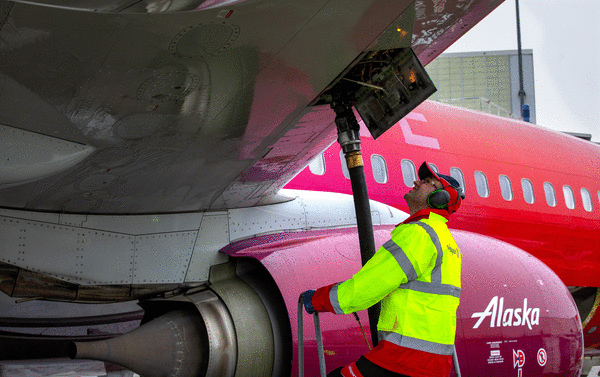
A global supply crunch has US refineries producing jet fuel at a record pace while skew output away from gasoline, setting up a potential transport fuels production clash during the peak summer travel period.
Refiners in the US Gulf Coast are some of the most price sensitive in the world, tailoring their petroleum product output to make as much money as possible. With the war in Iran upending energy markets and stockpiles, that’s meant they have ramped up jet fuel in recent months to capture a price spike. Gasoline output as a percentage of production, meanwhile, is well below seasonal norms.
“US refiners have been maximizing jet fuel production at the expense of gasoline and diesel yields,” said Natalia Losada, senior oil products analyst at consultancy Energy Aspects. “Gasoline is going to need to compete for yield going into the summer.”
The decisions US refiners make in the coming months will also have consequences outside North America. The European Union and UK — which usually receive large volumes of diesel and jet fuel from the Middle East — have been importing bigger-than-usual amounts from the Gulf Coast, according to data from Vortexa. Any reduction in those supplies, particularly while Middle East tensions continue, would be bad news for the region.
The US has produced more than two million barrels a day of jet fuel in the four most recent weeks of data from the Energy Information Administration. It’s the first time on record the US has made more than two million barrels a day for consecutive weeks, let alone four in a row.
Now the summer road trip season is approaching, when gasoline demand traditionally rises. If US refiners end up skewing more of their output toward gasoline, it would force a reduction in yields of other much-needed fuels. That could prompt the market to increase prices for whichever fuel is most needed.
“It turns into a bidding war,” said Eugene Lindell, head of refined products at consultancy FGE NexantECA. “Gasoline wins now. And then jet says ‘Hey, listen Buster, I see your 20 and I raise you.”
Oil processors such as Valero Energy Corp. and Marathon Petroleum Corp. have brought on extra jet fuel refining capacity, in some cases at facilities that typically don’t make the product. There’s a similar dynamic in Europe, where oil processors are in “max jet mode,” Frans Everts, a senior Shell Plc executive, recently said.
US gasoline stockpiles are at their lowest seasonal level since 2014, while imports are at their lowest seasonal levels this century. Meanwhile, the margin for making gasoline is sitting around $50 a barrel — the highest it’s been since the peak of the 2022 energy crunch. In short, the market is calling for barrels.
“The refiners are going to make the product that makes them the most money,” said Andy Lipow, president of Lipow Oil Associates. “If that means they’re making less gasoline, from a refining standpoint, that’s the way it is.”
In the summer, when demand is at its highest, refineries typically get less gasoline out of a barrel of crude, said Susan Bell, senior vice president of downstream research at Rystad Energy.
That’s because in the winter, refiners blend in more additives that optimize fuel for cold weather. But in the summer they blend less, meaning that a gallon of gasoline requires more crude.
If refiners maximize gasoline production at that time of year, Bell said they need to “steal” materials that typically go into jet fuel and diesel.
“Both jet yield and diesel will fall,” she said.
©2026 Bloomberg L.P. Visit bloomberg.com. Distributed by Tribune Content Agency, LLC.










Comments