China will open its market to AI chips from US, Nvidia's CEO says
Published in Business News
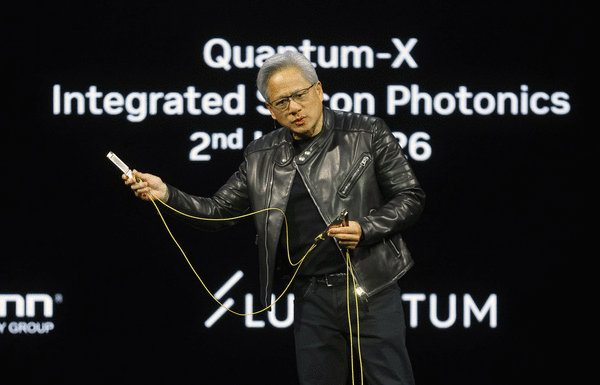
Nvidia Corp. Chief Executive Officer Jensen Huang, speaking days after he joined President Donald Trump’s summit in China, said he expects Chinese authorities to eventually allow the import of artificial intelligence chips from the U.S.
“The Chinese government has to decide how much of their local market do they want to protect,” Huang said in an interview Monday with Bloomberg Television. “My sense is that over time the market will open.”
The Nvidia chief was a last-minute addition to the delegation of American business leaders for Trump’s high-stakes meetings in Beijing with Chinese leader Xi Jinping. Huang’s presence on the trip stirred speculation among investors and China hawks in Washington that Nvidia might achieve a breakthrough on shipping AI chips to the world’s second-largest economy.
Huang said he didn’t discuss directly with Chinese officials the company’s effort to sell its H200 AI chips to customers in China, though he acknowledged that the topic came up during discussions between officials from both sides. “President Trump had some conversations with the leaders and I’m looking forward to what they decide,” Huang said.
On Friday, on his return trip to Washington, Trump said that Nvidia’s H200 chips “did come up, and I think something could happen on that,” without elaborating further. The president added that China hasn’t approved purchases of the H200 chips “because they chose not to, they want to develop their own.”
Trump agreed in December to allow Nvidia to ship its H200 AI chips to Chinese customers, a decision that marked a significant easing of measures aimed at restraining China’s growth in AI. Since then, the U.S. Commerce Department has granted licenses to clear the way for those sales. Yet officials in Beijing have held up purchases by companies in China, owing in part to their desire to achieve self-sufficiency in semiconductors and boost domestic champions like Huawei Technologies Co.
Huang has previously identified China as a $50 billion opportunity for Nvidia, though the company earlier this year maintained its projection of zero sales for AI chips in the Chinese market. Nvidia reports its results on Wednesday, when investors will be looking for an update on the prospects for AI chip shipments to China.
In March, Huang said that Nvidia had received U.S. clearance for shipments to “many customers” in China and was preparing to fire up H200 production accordingly. Though Nvidia did receive orders, according to a person familiar with the matter, Chinese companies later informed the company that they could not actually fulfill the purchases.
Huang, whose company remains reliant on Taiwan’s chip manufacturing capacity, said he wasn’t involved in the official discussions last week related to the self-governed island, which China claims as its own territory. Xi warned during his meeting with Trump that the U.S. would risk conflict if it mishandles the issue, long a sensitive topic between Washington and Beijing.
Taiwan will remain a center of semiconductor manufacturing even as the U.S. seeks to boost its domestic chipmaking capacity because “demand is so great across the board,” Huang said.
“It is possible to have supply chain diversity and resilience and everybody should be seeking to improve that,” Huang said in the interview on the sidelines of the Dell Technologies World conference in Las Vegas.
Soaring demand for AI, driven by the adoption of agent-driven software, is also pinching suppliers, especially memory makers, said Michael Dell, CEO of Dell Technologies Inc., who was interviewed Monday alongside Huang. The executives concurred that access to memory chips remains the biggest bottleneck, but they see evidence that the market’s main suppliers are making the necessary investments in capacity.
“It does take a long time to build these factories,” Dell said. “It’s really a great long-term partnership, even though we’d like more right now.”
Huang added: “We’ll still have a hard time keeping up with the build-out for at least a decade.”
(With assistance from Mackenzie Hawkins.)
©2026 Bloomberg L.P. Visit bloomberg.com. Distributed by Tribune Content Agency, LLC.







Comments