Elon Musk loses case against Sam Altman over OpenAI's overhaul
Published in Business News
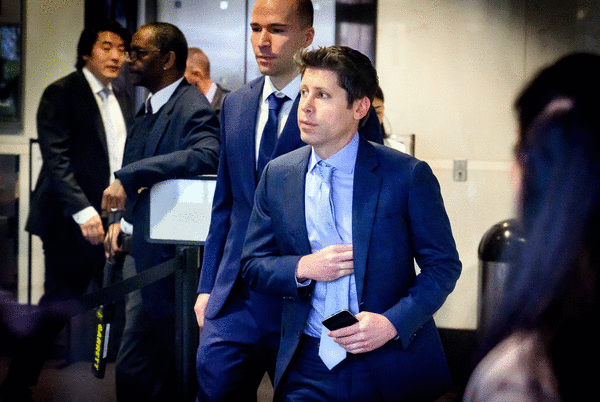
A jury rejected Elon Musk’s claims that OpenAI under Sam Altman’s leadership betrayed its mission to benefit the public by morphing into a for-profit business, finding that he waited too long to sue the company.
The verdict reached Monday in federal court in Oakland, California, follows a trial over the bitter feud between the entrepreneurs who worked together to launch the startup in 2015. OpenAI has since evolved into one of the world’s most valuable and powerful artificial intelligence companies.
“I think there is a substantial amount of evidence to support the jury’s findings,” U.S. District Judge Yvonne Gonzalez Rogers said when she accepted the nine-member jury’s unanimous conclusion after about two hours of deliberations.
The high-profile trial, in a case that has captivated Silicon Valley since Musk filed his complaint in 2024, was the culmination of years of animosity between the OpenAI co-founders.
The outcome is a major relief for the company as it eyes a potential initial public offering because Musk was seeking dramatic changes, including a court order unwinding OpenAI’s conversion last year to a for-profit entity.
“The finding of the jury confirmed that what this lawsuit was is a hypocrite’s hypocritical attempt to sabotage a competitor and to overcome a long history of very bad predictions about what OpenAI has been and will become,” OpenAI attorney William Savitt told reporters.
Musk and his lawyers vowed an appeal, but didn’t get into specifics about what they will argue.
“This reminds me of key moments in this country’s history, the Siege of Charleston, the Battle of Bunker Hill,” attorney Marc Toberoff said. “These were major losses for Americans, but who won the war? This one is not over.”
Musk generally has a strong record in court battles, but has had a couple of significant setbacks in the last year. Tesla Inc., his electric vehicle company, was hit with a $243 million verdict in August over a fatal crash, and Musk faces a tab of as much as $2.6 billion after he lost a trial in March in a case brought by Twitter Inc. investors.
The jury in Oakland concluded that Musk had enough knowledge about his claims years ago that he should have sued sooner than 2024. As a result, the panel did not address Musk’s central claim that OpenAI abandoned its responsibilities to develop AI for the benefit of humanity by pivoting to maximize commercial profits.
Jurors heard testimony over almost three weeks from Musk, Altman, OpenAI President Greg Brockman and other VIPs who had a front-row view of their falling out starting almost a decade ago.
The jury also saw hundreds of private message exchanges, journal entries and corporate documents that gave rarefied access to the tumultuous inner workings of the ChatGPT maker over the past 11 years, as it evolved from a scrappy startup into an almost trillion-dollar company.
Musk and OpenAI painted vastly different pictures of that transformation over the course of the trial.
Musk’s legal team said Altman and Brockman “stole a charity” when they decided to restructure OpenAI into a for-profit business. Musk also accused Microsoft Corp. of aiding the betrayal by investing $13 billion in OpenAI from 2019 to 2023.
Microsoft hailed the jury’s verdict.
“The facts and the timeline in this case have long been clear, and we welcome the jury’s decision to dismiss these claims as untimely,” a company spokesperson said. “We remain committed to our work with OpenAI to advance and scale AI for people and organizations around the world.”
Altman was portrayed by Musk’s lawyers as a deceptive business leader. They revisited Altman’s brief ouster as CEO in 2023 at length to make the point that even OpenAI’s board didn’t trust him.
Musk’s side also highlighted the enormous riches that OpenAI’s success created for its founders and early investors.
Brockman testified that his stake is close to $30 billion, while former chief scientist Ilya Sutskever confirmed his equity is worth about $7 billion. Microsoft CEO Satya Nadella testified the company targeted a $92 billion return on its investment. As of October, Microsoft’s stake was valued at $135 billion.
Altman does not have a direct equity stake, but said he holds interests in other companies that do business with OpenAI, including a $1.7 billion stake in fusion power company Helion Energy Inc., a $633 million stake in payment processor Stripe and shares of semiconductor company Cerebras Systems Inc. now worth about $25 million.
Lawyers for OpenAI cast Musk as a jealous rival who left the startup when his co-founders denied him complete control over the future of the business and eventually launched a competing company, xAI, in 2023.
OpenAI has said shifting from a nonprofit charity to a commercial business was critical to securing the vast amount of funding it needs to fulfill its mission of creating artificial general intelligence, or AGI, that will benefit humanity.
Altman and Brockman both described concerns they had with Musk’s all-or-nothing view of leadership. They painted him as volatile, and quick to anger when things didn’t go his way.
Brockman also denigrated Musk’s technical understanding of AI technology.
“Look, he knows rockets, he knows electric cars,” the OpenAI president said. “He did not – and I believe does not – know AI.”
Others who testified on OpenAI’s behalf said that its founding mission is still intact, even as the scope and reach of the company has grown. They pointed out that the OpenAI Foundation continues to govern the public benefit company that was established last year.
Musk’s battles with OpenAI will continue.
He has also accused OpenAI and Microsoft of creating a monopoly through their partnership, and says the nonprofit has urged its investors not to fund rival AI startups, harming competitors like his own xAI. Those claims are part of the same lawsuit, but Gonzalez Rogers chose to divide the case into multiple phases.
In a huddle with lawyers following Monday’s verdict, the judge said “it’s not clear to me they are actually good claims” because “there’s lots of competition in that particular industry.”
Musk’s xAI is also pursuing separate cases with trade-secret theft and antitrust claims against OpenAI.
©2026 Bloomberg L.P. Visit bloomberg.com. Distributed by Tribune Content Agency, LLC.






Comments