As data centers seek more power, Constellation launches nuclear plant upgrades to meet rising demand
Published in Business News
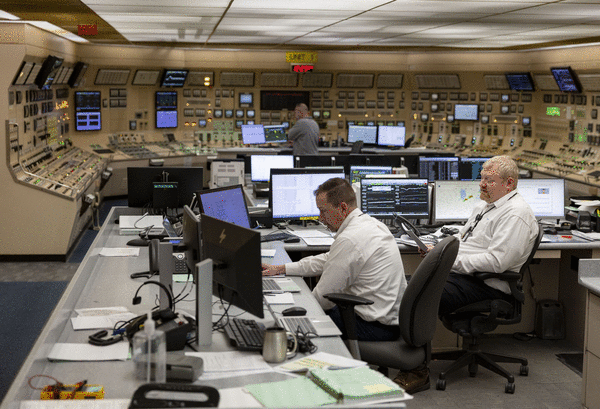
BRACEVILLE, Illinois — Inside Illinois’ largest nuclear power plant, massive turbines pull 100,000 gallons of water a minute from Braidwood Lake.
On a recent tour of the Braidwood Nuclear Generating Station, a sprawling facility the size of two football fields and anchored by dual reactors, Constellation operators and technicians worked around the clock. Every 18 months, the plant shuts down one of its nuclear reactors and brings in over a thousand specialized contractors to replace fuel and perform maintenance.
This latest refueling sets the stage as the plant prepares for its biggest upgrade yet, said Dwayne Pickett, Constellation vice president of government affairs and regulatory advocacy.
“There’s a need for power,” he said. “There’s an opportunity to add power and to meet that need.”
Rising electricity demand from data centers has broadened the state’s outlook on renewables as well as given new life to nuclear.
“We’ve had the growth of renewable power and wind and solar power,” Pickett said. “So the opportunity for nuclear just hasn’t been there. But with this growth in the data economy, there’s an opportunity for Illinois to transition from this period where nuclear plants are barely surviving to a point where we can actually invest in the plants.”
Constellation, the largest clean energy producer in the U.S., has spent $800 million to increase output at its two largest nuclear plants in Illinois: Braidwood in Will County and Byron, southwest of Rockford.
These upgrades, known as “uprates,” will add a combined 158 megawatts to the grid — enough to power roughly 100,000 homes every year. Work at Byron began in March and is expected to be completed in 2028. Braidwood will get underway next spring and be completed in 2029.
Vice President Adam Schuerman emphasized nuclear power’s reliability.
“Solar, wind, hydro, all the other renewable sources, you can almost consider them part-time power,” he said. “(Nuclear) plants are on 24/7. We don’t rely on any weather, like the whole building could freeze, and the plant would keep going.”
“We’re always here, we’re always on,” he added. “A lot of companies in the area where they’re looking for the extra power, they’re looking for the reliability that we have.”
Although nuclear power is carbon-free and considered a clean energy option, it’s not classified as renewable. Nuclear plants rely on a finite material, mined uranium, which creates hazardous, radioactive waste requiring safe storage for thousands of years to decay.
Ameren, a utility company that covers central and southern Illinois and parts of Missouri, considers nuclear generation a necessary “anchor” for the state’s grid as Illinois works toward ambitious clean energy goals, including zero carbon emissions by 2050.
“The beautiful thing about wind and solar is they don’t produce emissions, they also produce a lot of electricity when the sun is shining and the wind is (blowing),” said Matt Tomc, Ameren vice president of regulatory policy and energy supply. “But you do have those periods of time, where they are intermittent or they are not running and you’re relying on additional resources out on the grid to help support reliability as well as just add stability to the marketplace for power.”
Environmental policy groups argue wind and solar offer advantages over nuclear power as Illinois prepares for rising energy demands driven by data centers.
Jen Walling, the chief executive officer of the Illinois Environmental Council, said new nuclear plants can take up to 20 years to develop, while renewable energy projects are typically built within 18 months and connected to the grid in less than three years.
“This crisis is happening now, and if we’re going to meet it, renewables are going to be the cheapest, best option to meet the crisis that’s happening,” Walling said. “It’s the fastest and cheapest way that we can build.”
The Braidwood-Byron project will take about three years to add generation capacity to existing plants, Pickett said.
As the state faces grid reliability concerns, Tomc said it’s encouraging to see Constellation make “a positive contribution of filling the gap in supply.”
Still, both Tomc and ComEd, the primary electricity provider for Chicago and northern Illinois, cautioned that increasing nuclear power alone won’t be enough to solve the state’s looming energy challenges.
A ComEd spokesperson said increased PJM prices expected to take effect June 1 are a signal that more generation is urgently needed.
Growing energy capacity and diversifying Illinois’ generation — across wind, solar, hydro and nuclear — remains important, Tomc said.
A ‘nuclear renaissance’
Illinois is considered the birthplace of nuclear power, dating back to 1942 when the first reactor was built beneath the University of Chicago’s football stadium.
Today, the state leads the nation in nuclear energy, generating more electricity from its 11 reactors across six plants than any other state, according to an analysis from the U.S. Energy Information Administration.
A 2024 Illinois clean energy report found just over half of the state’s electricity comes from nuclear power, followed by fossil fuels at 31% and renewables at 15%.
“There is no state that’s better poised for investment in nuclear, be it uprates or be it new reactors or (small nuclear reactors),” Pickett said.
The upgrades reflect renewed momentum for nuclear energy in Illinois — an industry that, until recently, faced an uncertain future.
“Nuclear is going on a long journey,” Pickett said. “Our plants at some point were on the verge of shutting down. We told our employees, this isn’t going to work out for us economically. Until the state came in.”
State legislation has played a key role in preserving nuclear generation. The Future Energy Jobs Act of 2016 established zero-emission credits and provided subsidies to nuclear plants that helped keep Constellation’s Clinton Power Station from closing, said Pickett. Later, the Climate and Equitable Jobs Act of 2021 introduced carbon mitigation credits that supported plants like Braidwood and Byron, also on the verge of shutting down that year.
Those policies stabilized the industry, Pickett said, preserving jobs and maintaining a reliable source of carbon-free energy.
Recent state actions indicate a broader shift in support of nuclear energy.
In January, Gov. J.B. Pritzker signed the Clean and Reliable Grid Act, ending a decades-old moratorium on building new large-scale nuclear plants in the state.
“Just lifting that cap sends the signal to the market investors, to Constellation, that Illinois is open for business for nuclear again,” Pickett said.
In an email to the Tribune, Pritzker’s office said creating more affordable, clean energy is a top priority and by ending the ban on nuclear plants in Illinois, he’s “opened the door to the growing energy sector.”
A month later, Pritzker signed an executive order to accelerate new nuclear generation and add at least 2 gigawatts of power by 2033.
“People don’t like using the word nuclear renaissance,” Pickett said. “But it’s what this moment is. It’s a window in time where the need is there, the public support is there, the interest from third parties to help support it is there.”
The environmental council has supported state nuclear investments despite concerns about the environmental impacts of the plants, said Walling.
Her organization backed the reliable grid act because it codified renewable energy measures, including a state goal of building 3 gigawatts of battery storage by 2030, which she said could save Illinois residents $13 billion.
“It’s making it so that you can release wind and solar onto the grid when it’s needed and predict it,” she said, “rather than just making a huge amount of energy that sometimes is wasted.”
While subsidies for nuclear plants through the zero emissions credit and carbon mitigation programs are set to expire in 2027, Constellation said it is funding the current upgrades at Byron and Braidwood plants.
“The opportunity now is for Constellation to make investments, using our own money, non-ratepayer money or taxpayer money, to increase the output of the plants,” said Pickett.
A wave of upgrades
During scheduled refueling outages at Braidwood, thousands of specialized contractors flock to Will County to repair the nuclear plant — and even more workers are expected for the upgrade project.
In Braceville, restaurants and hotels have filled up this month as maintenance technicians and plant operators from across the Midwest arrive for the outage work, said Brett Nauman, Constellation’s senior manager of generation communications.
“For the little community near here, it’s very profound,” Nauman said. “We’ve got all these additional thousand workers staying in hotels. It ends up being a really nice boost for the area.”
As artificial intelligence giants seek more power to supply data centers, the company is pursuing similar efforts elsewhere.
In Illinois, the Clinton plant announced a 30-megawatt uprate in June after Meta founder Mark Zuckerberg agreed to take over Illinois ratepayer subsidies for the plant. In Pennsylvania, Constellation plans to restart the Three Mile Island facility — now renamed the Crane Clean Energy Center — through a deal with Microsoft.
Combined, these projects will add as much generating capacity as a new large nuclear reactor, according to Braidwood Plant Manager Donnie Hudak.
“We’re essentially bringing on a whole new nuclear reactor,” he said. “At a fraction of the cost and a fraction of the time to do it.”
After cycles of ups and downs, Pickett said nuclear energy is entering a new phase of growth and hopes Illinois will continue to take the lead.
“We’ve been a leader in clean energy,” he said. “This is an opportunity to continue that advantage.”
©2026 Chicago Tribune. Visit at chicagotribune.com. Distributed by Tribune Content Agency, LLC.









Comments