Boeing, UPS and the FAA face investigators after deadly MD-11 crash
Published in Business News
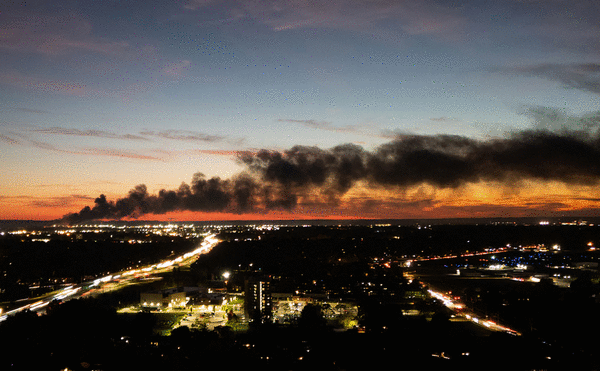
Accident investigators are set to question Boeing and other key players about a UPS MD-11 cargo plane crash in Louisville, Kentucky, that killed 15 people.
The National Transportation Safety Board will hold a two-day investigative hearing, starting Tuesday in Washington, D.C., with witnesses from UPS, Boeing and the Federal Aviation Administration, which oversees aircraft manufacturers and operators. Boeing supports the McDonnell Douglas-built MD-11.
The hearing will focus on Boeing and UPS’s maintenance and inspection programs, as well as how Boeing and the FAA judge that a plane is safe to fly. Investigators will ask what happens when an inspector finds a part of the plane is not up to standards, and how it is determined if that poses a safety risk, according to a schedule published by the NTSB before the hearing.
The second day will focus on the aircraft's pylon, a structure that holds the engine to the underside of the wing.
The deadly UPS crash in November saw the plane’s left engine and pylon separate from the wing and fly over the fuselage, causing the pilots to lose control and turning the fully fueled plane into a fireball that skidded into a nearby warehouse.
In the weeks following the crash, the NTSB said it found signs that parts of the pylon’s hardware — specifically lugs from the aft-mount bulkhead and the spherical bearing race — were fractured. In an investigation update published in January, the NTSB said Boeing had previously warned MD-11 operators of failures of that same part but the plane-maker had determined it was not a safety issue.
The two-day hearing should provide more clarity on some of the questions that remain: Why did the pylon’s hardware fracture? And why didn’t the aviation industry’s protocols catch the fractured piece before it turned deadly?
But it won’t provide conclusive answers. The NTSB will continue its investigation after the hearing; it could be several months before the safety board determines a probable cause.
The NTSB does not have regulatory authority, so it cannot require any party to change its practices. But the safety board does provide detailed recommendations following its investigations in an effort to prevent similar disasters.
Richard Reed, a former FAA safety engineer, and Stephen Carbone, a former NTSB accident investigator, both said they expect the hearing to focus on maintenance work.
From their perspective, the maintenance and inspection protocols outlined by Boeing, UPS and the FAA for the MD-11 should have guaranteed a safe plane — unless the guidance wasn’t followed by the books, they each said in separate interviews. Mistakes may've been made during UPS-led maintenance or FAA-led inspections, the two former investigators said.
Carbone worries UPS may not have had visibility into every part of the maintenance stream and wonders if UPS hired any third-party contractors to perform work on the plane. That’s a concern he has for the industry overall.
Reed pointed to an earlier crash involving the MD-11’s predecessor, the DC-10, where improper maintenance work damaged the engine and caused it to separate from the plane’s wing.
“There’s 101 things that can go absolutely wrong” during engine work, Reed said. “If everybody did their job properly, there were no shortcuts taken, the procedures they outlined would have made a safe fleet.”
Boeing, UPS and the FAA are limited in what they can say during an active investigation. UPS said Monday the hearing is a standard part of the NTSB’s investigative process and that UPS continues to cooperate with the safety board.
Boeing said it continued to support the NTSB's investigation and the company extends its deepest condolences to those who lost loved ones in this accident.
The MD-11 was originally designed and built by McDonnell Douglas but Boeing inherited the plane when it merged with that manufacturer in 1997. Boeing stopped production shortly after the acquisition, favoring newer, more fuel-efficient twin-engine models over the three-engine MD-11.
When the UPS plane crashed in November, the aging MD-11 was already facing retirement; FedEx and UPS had both announced plans to phase the planes out of their fleet.
UPS accelerated those plans after the crash but FedEx has maintained that it will return its MD-11s to service. Western Global, the only other major MD-11 operator, hasn’t responded to questions about its plans.
The MD-11 and DC-10 have been grounded since the November crash. The FAA approved an inspection and repair protocol last week to begin returning planes to the skies.
Boeing and the FAA have not shared details about the fix but FedEx, the first to publicize that a solution had been finalized, said it involves installing a new bearing in the aft mount of each side pylon. FedEx has completed the repairs on two of its MD-11s and returned them to service.
Some of the families who lost loved ones when the UPS plane crashed in November will attend the NTSB hearing this week, according to Clifford Law Offices, a legal firm representing nine of the victims’ families in a wrongful-death lawsuit filed in Kentucky.
Attorney Bradley Cosgrove, who will be at the hearing with his clients, said in a statement Monday “these families are devastated and certainly deserve answers.”
©2026 The Seattle Times. Visit seattletimes.com. Distributed by Tribune Content Agency, LLC.






Comments