Auto review: Toyota Prius Nightshade looks hot, drives easy
Published in Business News
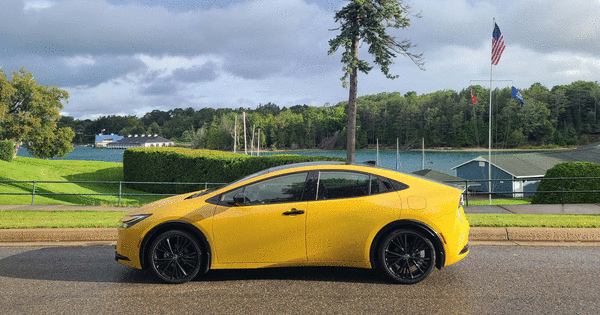
CHARLEVOIX, Michigan — The Toyota Prius is really getting cheeky.
America’s favorite green nerd car underwent a fourth-generation transformation in 2025 from ugly duckling to swan. Sleek fascia. Scalloped flanks. Horizontal rear taillight. I saw your head swivel when I sailed by.
For 2025-26 it got a hot Nightshade edition. Take a look at my hot hatch tester (also being featured at the Detroit Auto Show) with yellow paint, black wheels, black mirror caps. It’s a look familiar to enthusiast hellions like the Honda Civic Si and Ford Mustang that offer look-at-me Skittle colors.
Heck, so obsessed are enthusiasts with banana skin that Subaru announced last year to much fanfare that it will offer a limited-edition, 350-copy “Series Yellow” version of its WRX tS and BRZ tS hotties for the 2026 model year. In total, just 350 examples of each will be produced. Sweet.
Stomp the throttle and thoughts of a Prius hot hatch are quickly shelved. DROOOOOOONE goes the continuously variable transmission attached to the fuel-sipping 2.0-liter gas engine. Zero-60 mph in ... someday. It’s a Prius all right, but it’s no longer the class nerd.
When Prius entered the U.S. market 25 years ago, it was a novelty. Now Prius is now the halo of a brand that has gone almost all hybrid.
While the Prius maintains its signature aerodynamic roofline (key to mpg-aerodynamics), its design is no longer an outlier. Indeed, Prius is now Optimus, the brand’s style leader.
The tapered fascia and horizontal taillight are now echoed in the best-selling RAV4, Camry and Crown models. The interior — once a geek’s lair of toilet-bowl white console and dash-mounted shifter — is now cutting-edge Toyota, shared with the bZ EV and Crown.
In short, hybrid is now mainstream, and pioneer Prius is its patron.
Want a true hot hatch? Toyota does that, too, with the GR Crolla, one of the market’s most engaging driver’s cars with 300 horsepower from its King Kong-in-a-briefcase 1.6-liter three-cylinder engine and eager all-wheel-drive system. It’s a testament to the breadth of this once vanilla brand that now races in the Hypercar class at Le Mans while also building trucks in Texas.
The RAV4 and Camry may be the brand’s best-sellers but Prius, GR Corolla and the Tacoma pickup are its icons.
Auto analyst and muscle-car enthusiast Karl Brauer may have a Ford GT and Dodge Hellcat in his garage, but he’s a Prius junkie: “I recommend the Prius as the best daily driver in the market: easy on the eyes, great fuel economy, comfortable to drive.” High praise from someone who wouldn't be caught dead at a Greenpeace rally with Leo DiCaprio.
On a cross-state trek from Oakland County to Lake Michigan, the Prius was a peach to drive.
I didn’t come close to the advertised 52 mpg and 588 miles of range, but did get 40 mpg and only had to fill up once on my 600-mile journey. That’s a heckuva lot more efficient than the electric bZ’s 252 miles of range, at a starting price about seven grand north of Prius.
I’m a giraffe, and the extreme windshield rake does crimp headroom in the front seats, but the Prius’s roomy rear seats and hatch make this a viable family car. Toyota once proved resistant to electronics trends, but has since caught up in offering Apple CarPlay and Android Auto. Indeed, they are Prius’s sole navigation source.
“Navigate to Charlevoix, Michigan,” I barked, and Prius dutifully followed.
Key to phone apps is a charge pad lest your phone run out of juice in the middle of nowhere while navigating you to somewhere. Prius is properly equipped with a clever mail slot that held my phone vertically and proved superior to flat charging pads that take up a lot of console space.
The ergonomic thoughtfulness is inconsistent, however.
The Prius steering wheel is usefully littered with controls (adaptive cruise control, audio, instrument display info), but the controls are flat. That means I had to look away from the road to, say, increase or decrease cruise speed. Braille-like ridges identify these functions on competitor vehicles from Hyundai, Kia and Honda.
But overall, the Prius Nightshade was an easy, mainstream vehicle to drive. Gone are quirks like the split-window hatchback, which challenged rear visibility. Signature features remain, but they are useful innovations. Rear-seat access is via a C-pillar handle that aids body-line aesthetics. The recessed instrument display is unconventional but a clever solution to combining an instrument and head-up display.
Loaded with features, my Nightshade edition clocked in at a reasonable $35k. With its good looks, hybrid drivetrain and famed badge, Prius is positioned as a viable competitor to BMW and Audi. A rare mainstream badge (think Jeep) that has appeal to mainstream and premium customers.
It is better looking than a comparable Lexus IS, especially when outfitted with the sporty Nightshade trim, which gives the car significant upscale cred. Like its luxe peers, it also features an EV mode so the car runs on electrons alone under 10 mph.
Also in tune with the luxury market: Prius options AWD, though it is engineered for low-speed applications (ahem, like the Payne driveway) since it stops working over 46 mph to save energy.
Who knows? If the Prius Nightshade sells well, Toyota’s speed-obsessed Chairman Akio Toyoda may demand his halo car get a proper performance model. Think bigger battery/engine to goose low-end torque.
A Prius hot hatch would kill the nerd stigma forever.
2026 Toyota Prius
Vehicle type: Front- and all-wheel-drive, five-passenger compact sedan
Price: Base $29,745, including $1,135 destination charge ($36,663 Nightshade model as tested)
Powerplant: 2.0-liter inline-4 cylinder married to two AC motors
Power: 194 horsepower (FWD); 196 horsepower (AWD)
Transmission: Continuously variable automatic
Performance: 0-60 mph, 7.1 seconds (Car and Driver); top speed, 115 mph
Weight: 3,153 pounds
Range: EPA est. mpg, 52 city/52 highway/52 combined, 588-mile range (FWD as tested); 40 mpg, range, 452 miles (observed)
Report card
Highs: Nerd no more; roomy cabin
Lows: CVT drone; windshield rake crimps tall front seat passengers
Overall: 4 stars
____
©2026 www.detroitnews.com. Visit at detroitnews.com. Distributed by Tribune Content Agency, LLC.










Comments