National leader calls for end to Target boycott after diversity pullback
Published in Business News
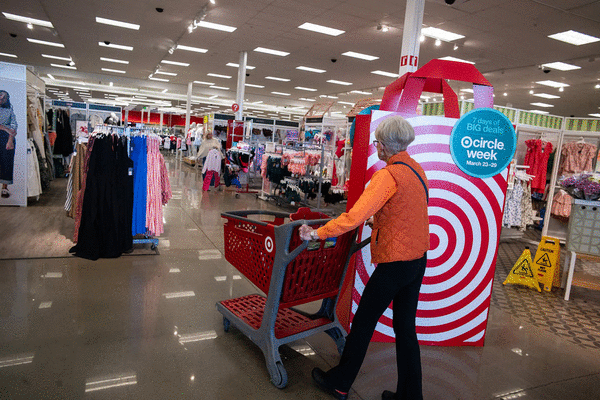
A key organizer is calling for an end to the yearlong national boycott of Target, after the retailer’s executives agreed to fulfill a previous diversity pledge.
The Rev. Jamal Bryant, one of the faith leaders who led the movement, made the announcement Wednesday, March 11, at a news conference at the National Press Club in Washington alongside former Ohio state Sen. Nina Turner and activist Tamika Mallory.
“We are claiming victory,” Bryant said. “We’ve got to celebrate small steps.”
In a statement, Minneapolis-based Target said it is “pleased to be moving forward,” and will “continue showing up as trusted neighbors while delivering results for ... team members, guests and the more than 2,000 communities” it serves.
The announcement, however, exposed fractures within the activist movement, which had pulled together several groups with different approaches. Turner and Mallory said they would continue pressing for a public apology from Target CEO Michael Fiddelke.
In Minneapolis, activists Nekima Levy Armstrong, Monique Cullars-Doty and Jaylani Hussein held a news conference that afternoon outside Target’s headquarters on Nicollet Mall. They said Target had not met any of the boycott’s goals and claimed Bryant was taking credit for “a movement built on the blood sweat and tears of the people of the state of Minnesota,” per Levy Armstrong.
The boycott began in early 2025 after the company scaled back some diversity initiatives amid pressure from the White House. The changes came several years after Target strengthened its diversity, equity and inclusion (DEI) goals following George Floyd’s murder by Minneapolis police in 2020.
Target has since agreed to fulfill a 2021 commitment to invest $2 billion in Black-owned businesses, and including adding more Black-owned brands to stores. The retailer also pledged increased spending on marketing and construction services provided by Black-owned companies and to support entrepreneurs through the Forward Founders program.
A year ago, Target announced the conclusion of that program but declined to say whether it had reached the goal. It will now complete it this year.
Bryant said the organizers confirmed Target’s progress on its stated goals.
Bryant, during a February appearance on the “Breakfast Club” radio show, said the boycott had cost Target $12 billion and contributed to the company’s stock falling from $145 to $93 per share. Foot traffic and digital sales had each dropped 9.3%, he said.
Fiddelke said recently the boycott was “one of the things” that hurt sales last year, according to the Associated Press. Target said its diversity pullback affected business in the January-to-March period of 2025 but has not addressed it directly on later earnings calls. Publicly traded companies generally must disclose consumer boycotts that pose a material risk to financial performance, though they can avoid doing so if nondisclosure would not violate U.S. Securities and Exchange Commission rules against misleading investors.
Target’s digital sales grew 3.1% for the year and its stock has risen more than 5% the past year. Sales transactions declined 2.2%.
Bryant also said in February he was “excited” about Fiddelke, who had asked how he could build better relationships with the minority community. Senior Target leaders met with the boycott organizers several times, including an April 2025 talk with then-CEO Brian Cornell and a meeting after Fiddelke took the helm.
Bryant said at the news conference Target has met or will meet by Easter three of the organizers’ four demands: $2 billion to Black-owned businesses, 13% Black representation on its board and millions donated to Black education. The company invested $100 million in Black-led community organizations such as the National Urban League in the past five years and awarded $10 million to more than 1,000 students at HBCUs since 2021.
Target is also partnering with the Pensole Lewis College of Business and Design, a private HBCU that re-opened in 2021 after a six-year closure, to offer an eight-week virtual certificate program focused on accessible and sustainable apparel design.
The unmet boycott goal: Target establishing a relationship with a Black-owned bank.
“We’ve not been able to get all that we have desired,” Bryant said. “But I am grateful for the strides that we have made.”
In January 2025, Target said it would stop participating in outside surveys related to diversity, equity and inclusion, or DEI, and shift its “supplier diversity” programs to what it called “supplier engagement.”
The announcement came a few days after President Donald Trump’sinauguration, prompting speculation that Target changed its policy as Trump sharply criticized DEI programs and pledged to eliminate them, including through executive orders.
A wave of U.S. corporations essentially rebranded their equity programs with words like “belonging” and “engagement.” Other companies, including Tractor Supply, John Deere and Walmart, also scaled back some DEI efforts, while others, including Costco and Apple, reaffirmed them.
“We remain focused on driving our business by creating a sense of belonging for our team, guests and communities through a commitment to inclusion,” Target said at the time.
Shortly afterward, a trio of Minnesota activists who previously led reform efforts after George Floyd’s murder rallied more than 70 people outside Target’s corporate headquarters, calling for a boycott.
Twin Cities Pride also dropped Target as a sponsor of its annual parade. Bryant and other national Black faith leaders then called for a 40-day “Target Fast” during Lent and later advocated for extending it indefinitely.
Cornell met with Bryant and civil rights leader the Rev. Al Sharpton in April 2025 to discuss the DEI decision. Sharpton called the meeting “very constructive and candid.” Levy Armstrong, the Twin Cities activist who originally called for the boycott, did not see it as positively, pointing out that the retailer did not include any local organizers.
Bryant said he and others, including Mallory, co-founder of Until Freedom, and Turner met with Target executives, including Fiddelke, at the end of February.
At the news conference, Bryant said 300,000 people joined the boycott but did not say how organizers arrived at that figure.
Discontent among part of Target’s customer base has extended to a new controversy this year after U.S. Border Patrol agents detained two employees, both U.S. citizens, in January at its Richfield store. Target did not comment publicly despite mounting pressure to weigh in on the federal immigration operations.
Instead, Fiddelke joined Minnesota business leaders in signing a letter calling for an “immediate de-escalation” of violence after federal agents shot and killed Renee Good and Alex Pretti. The letter released through the Minnesota Chamber of Commerce drew mixed reactions.
Mallory, Turner and Levy Armstrong are still holding out for certain Target actions.
Mallory said Fiddelke apologized to Black employees in a private meeting, but she still seeks a public apology to customers.
“As a billion-dollar company, you cannot harm people in public and apologize in private,” she said.
Turner remains frustrated Target made a “righteous promise” on DEI after Floyd’s murder but then “backtracked.”
Levy Armstrong is adamant the boycott isn’t done.
“They’ve cut up their Red Cards, and they are not going back,” she said of some Target boycotters. “I am not going back.”
(Minnesota Star Tribune reporters Christopher Vondracek and Elliot Hughes contributed to this story.)
©2026 The Minnesota Star Tribune. Visit at startribune.com. Distributed by Tribune Content Agency, LLC.







Comments