Gautam Mukunda: Anthropic is teaching CEOs everywhere a valuable lesson
Published in Science & Technology News
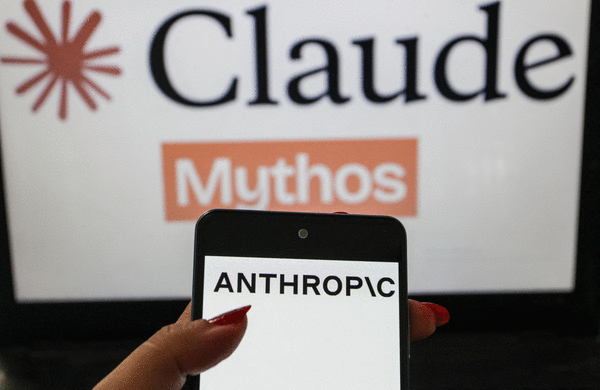
America’s artificial intelligence titans recently banded together to urge the government not to restrict so-called open-weight AI models, or those that are publicly available for users to freely download and run on their own platforms, so that they can better compete with the ones coming out of China. All the usual suspects -- Nvidia Corp., OpenAI and Google-parent Alphabet Inc. -- were on board with one exception: Anthropic PBC.
The developer of the popular Claude chatbot was depicted by at least one news organization as a lonely figure on a desert island for this and other stances it has taken on policy fights that differ from its competitors. But this isn’t a story about AI. Rather, it’s about distinctiveness, and why seemingly self-destructive acts can be key components of success.
Consider Admiral Hyman Rickover, who over 30 years built America’s nuclear navy. Ships powered by his reactors have steamed more than 179 million miles, roughly twice the distance to the sun, without a single reactor accident or any radioactive release that harmed a person or the environment. You’d think that an officer who could do that would be rewarded. Instead, he was passed over for promotion - twice.
Rickover developed perhaps the most punishing selection system in the American military. Every hire was made based on the thought that a single serious reactor accident would destroy nuclear propulsion entirely. Which is why Rickover personally interviewed every one of the tens of thousands of officers who entered the program, including a young lieutenant in 1952 named Jimmy Carter. Rickover asked the future president of the United States where he had finished at the Naval Academy. Carter said the top tenth of his class. Rickover then asked whether did his best. Carter admitted he hadn’t, and Rickover responded “Why not?” Carter had no answer. He was selected anyway and named his campaign autobiography after the question.
It’s unlikely Rickover would have hired himself. He was no one’s idea of an American Horatio Nelson. He graduated 107th in a class of 540 at the Naval Academy, and his only command at sea lasted under three months, on a almost 20-year-old minesweeper off China in 1937. What the promotion boards saw was a middling engineer with no combat record who was an impossible colleague. One day after Secretary of the Navy Dan Kimball pinned a second Legion of Merit on Rickover in July 1952, he was denied a promotion to rear admiral for the second time, which under Navy rules meant mandatory retirement. But allies in Congress forced the Navy to reconsider and he made admiral in 1953, a rank he held until Secretary of the Navy John Lehman forced him out on Jan. 31, 1982, four days after his 82nd birthday.
That was after Lehman spent most of 1981 arranging a dignified exit for Rickover, for whom he secured an offer to become a senior White House advisor. When Lehman brought Rickover to the Oval Office on Jan. 8, 1982, to meet President Ronald Reagan, he expected thanks. Instead, Rickover told Reagan that Lehman was a “piss-ant” who knew nothing about the Navy. The episode underscored how Rickover cared only about getting the job done – like he had done for decades.
It’s not hard to see echoes of Rickover in Anthropic. Isolated, rejected by peers, sometimes needlessly aggravating, and yet also remarkably effective. These traits aren’t in tension, even if they seem to be. Rickover’s mission let him recruit the best, no matter how abrasive he was. It made him willing to sacrifice anything, including his own career, to achieve the desired results. That’s what a real mission means. It can drive you to work harder and longer. It can help you recruit other people who share your sense of mission.
The downside is that you can’t compromise the mission just to make things easier on yourself. That’s just not how mission-driven people and organizations look at the world. It’s why Rickover was almost driven out of the Navy. And it’s why Anthropic is at war with the Department of Defense and getting raked over the coals for its stance on open weights models.
Although many leaders and organizations talk about having a mission, so few really have one. For most, the primary mandate is simply survival, not achieving something at all costs.
That’s not all. Missions don’t have to be worth achieving. Rickover feared his wasn’t. Three days before he was pushed out of the Navy, he told the Joint Economic Committee that he took no pride in building nuclear-powered ships, which he called a necessary evil, and he would sink them all if he could.
Unique results come from unique behavior. Those who won’t go along with the crowd are rare and critical to cultivate. Rickover understood that so well that when the Navy took his program away, he founded the Center for Excellence in Education in 1983 and launched the Research Science Institute in 1984, a summer research program for high school students (I was one) and originally named after himself. The Navy could retire him. It couldn’t stop him from picking people.
____
This column reflects the personal views of the author and does not necessarily reflect the opinion of the editorial board or Bloomberg LP and its owners.
Gautam Mukunda writes about corporate management and innovation. He teaches leadership at the Yale School of Management and is the author of "Indispensable: When Leaders Really Matter."
©2026 Bloomberg L.P. Visit bloomberg.com/opinion. Distributed by Tribune Content Agency, LLC.





Comments