Less Space Coast launches in store as SpaceX pulls back on Falcon 9
Published in Science & Technology News
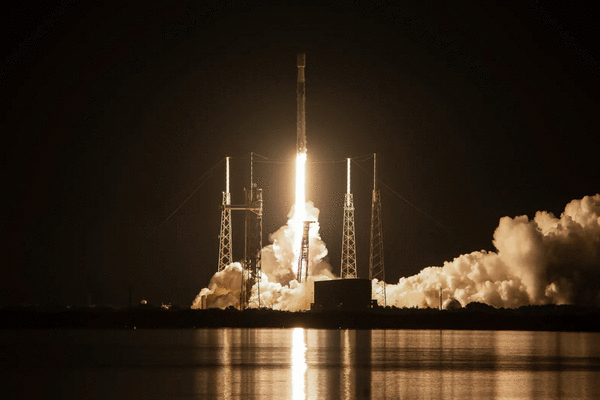
ORLANDO, Fla. — SpaceX drove the Space Coast’s record 109 launches last year with a frenetic pace of missions dedicated to its Starlink internet constellation.
That spigot has been turned off, the company’s vice president of launch said after a Starlink mission that launched early Tuesday from Cape Canaveral Space Force Station.
“This morning’s @SpaceX mission from pad 40 was the last planned Falcon 9 Starlink launch from Florida (and it launched on the fleet leading booster!!), marking the end of an era for these launches on the East Coast,” said Kiko Dontchev on a post on X.
Starlink missions have made up the majority of flights by SpaceX from its two launch pads in Florida over the last several years. But already in 2026, the pace that set a record for launches in 2025 was dialed back as the pad at Kennedy Space Center’s Launch Complex 39-A was reduced to support only Falcon Heavy launches.
That allowed the company to focus on building out a Starlink launch tower at LC-39A adjacent the existing launch pad.
Dontchev said any future missions from Florida for Starlink will have to wait until Starship’s tower is ready while Falcon 9 will still launch the satellites on missions from California.
Just this year, the company has flown more than 2,000 of the satellites across 77 missions from both coasts.
Florida has been home to 32 of those, making up more than 2/3 of SpaceX’s launches from the Space Coast this year.
Overall, the company has launched nearly 12,800 of the satellites since the first operational versions were deployed in 2019. Nearly 10,000 of those are still operational, according to statistics maintained by astronomer Jonathan McDowell.
Dontchev noted that Falcon 9 had flown around 260 missions from the Cape over the last seven years.
“Can’t wait until we launch that and many more with Starship,” he said.
Falcon 9, though, only has the payload capacity to launch 29 of the satellites at a time, and those are smaller versions than what are planned to fly on Starship.
Once it begins operational launches, Starship will be able to deploy 60 of the larger V3 versions of the Starlink satellites at a time. For now, SpaceX continues to launch Starship on test flights from Texas, although it also announced Tuesday plans to build out a massive Starship launch site in Louisiana with 10 launch towers.
SpaceX has said it is still targeting the first Starship launch from Florida before the end of the year from KSC while it also continues to build out the first of two launch towers at Canaveral’s Launch Complex 37. That site’s first launches are not planned until 2027.
With the cessation of Starlink flights, though, the skies over Florida will be much quieter.
SpaceX still has several non-Starlink missions planned this year, though.
That includes what would be only the second Falcon Heavy mission this year, and 13th ever, as early as this Sunday.
The powerhouse rocket that is essentially three Falcon 9’s strapped together, is targeting liftoff from KSC’s Launch Pad 39-A at 7:26 a.m. carrying NASA’s $4.3 billion planet-hunting Nancy Grace Roman Space Telescope.
Crewed launches will also continue from Florida.
SpaceX’s Crew-13 mission is targeting launch as early as Sept. 12 on a mission to the International Space Station. On board will be Central Florida’s Luke Delaney acting as pilot alongside fellow NASA astronaut and commander Jessica Watkins, Canadian Space Agency astronaut Joshua Kutryk and Roscosmos cosmonaut Sergey Teteryatnikov.
SpaceX also has space station resupply missions planned this year that will fly from Florida.
Meanwhile, other launch providers on the Space Coast have been facing their own issues this year.
United Launch Alliance has flown five times, with four Atlas V and one Vulcan mission. But all of ULA’s remaining Atlas V rockets are reserved for Boeing Starliner flights, and that spacecraft’s return to flight may not even happen this year.
Vulcan, meanwhile, has been off ULA’s flight plans since its launch back in February. That mission suffered an issue with one of its solid rocket boosters supplied by Northrop Grumman. While the rocket was able to get its national security payload to space, the Space Force announced afterward that it would not fly again on Vulcan until the booster issue was fixed.
Meanwhile, Blue Origin suffered a massive setback during an explosion on its pad at Canaveral’s Launch Complex 36 that did major damage. While teams have been rebuilding the pad at LC-36 and state it hopes to return to flight before the end of the year, the original plan for multiple New Glenn launches this year was taken off the board.
The source of that explosion, also, had been blamed on a valve on the BE-4 engines on New Glenn, which also affects ULA’s Vulcan, which uses versions of the BE-4 on its first stage. Blue Origin teams will have to fix ULA’s BE-4 supply before Vulcan can get back to launching as well.
ULA, though, says it does plan to return Vulcan to flight before the end of the year.
The only other launch this year came from NASA with the Space Launch System rocket on the Artemis II mission. The SLS won’t fly again until mid 2027 for Artemis III.
Combined, SpaceX, ULA, Blue Origin and NASA have flown 54 times from Florida this year.
With SpaceX yanking Starlink missions of the board and the other providers facing delays, 2025’s record 109 launches will remain untouched this year.
------------
©2026 Orlando Sentinel. Visit at orlandosentinel.com. Distributed by Tribune Content Agency, LLC.






Comments