Bill Gates warns of job losses, rising harm in plea for AI policies
Published in Science & Technology News
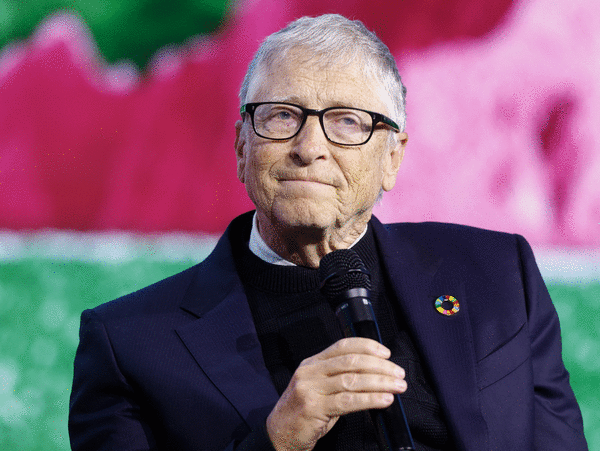
Bill Gates wants to tax robots.
Specifically, Gates is calling for a tax on artificial intelligence automated systems, like tokens and robots, that employers may use to slowly replace human workers as the technology evolves.
The idea might sound absurd on its face, which the Microsoft co-founder acknowledges in a memo released Wednesday on his rising fears and anxieties surrounding what he sees as the rapid development of AI. But it's part of one of his proposals to tip the scale in what he calls a potentially tumultuous time in human history.
Right now, if you’re an employer and you hire someone, you pay payroll taxes on their earnings. But if you buy a robot, you can usually write it off right away as a business expense," Gates wrote. "The tax system nudges you toward replacing people with machines."
Gates said taxing robots and AI usage would slow down the rush to replace human labor with machines and would raise money for building a stronger safety net.
Still, Gates is bullish on the technology, though his financial ties to Microsoft and the tech industry create an inherent bias. He wrote in the memo that he sees the AI transition as much more disruptive than previous platform shifts like personal computing and the internet. Because people can use existing infrastructure and natural language to use AI, the adoption process is much more accelerated than during other technological shifts.
With that, he listed three risks he sees riding the AI wave. Gates wrote that "many jobs will disappear forever," "AI will empower people to do more harm," and "AI could stunt our kids' development and replace human relationships."
The fear of job losses is an acute one as layoff notices for major corporations are plastered across headlines. But a looming job apocalypse may only be theoretical for now. Companies like Microsoft, which went through a 4,800-person layoff in July, are explicitly saying that affected employees aren't being replaced by bots.
AI is still catching the blame for layoffs across the tech industry over the past year but not because of automation. Rather, the immense spending by the tech industry to build the infrastructure for AI is spurring on cost-cutting across various companies.
Spending on AI also doesn't have a clear endgame yet, as the cost of high-tech computer chips to meet demand is an investment in hardware with a short lifespan. Microsoft and Amazon are on track to spend $390 billion this year on capital expenditures related to AI, mostly in the form of data centers and computer chips.
But Gates predicts that jobs remain at risk because of the technology especially in entry- and mid-level jobs, with white-collar and blue-collar jobs affected.
"Robots and AI combined can create a vicious cycle," Gates wrote. "After one company adopts them and uses the savings to lower its prices, its competitors will feel immense pressure to do the same."
Aside from fear over jobs, Gates said he worried about AI's impacts on education and children's development. While the industry touts that AI can make research easier and unlock knowledge for anyone, Gates linked to a preliminary survey that suggested heavier AI use was associated with less critical thinking. The technology could also create insular bubbles for people who use it, cutting them off from others.
"This would be the worst possible time for humans to lose their critical thinking skills," Gates said. "In an era of deepfakes and misinformation that can be tailored to you individually, the ability to tell what is true from what is not becomes an essential life skill."
Gates marries this point with the harm AI can do. He warns the technology will make "monitoring and manipulating" public opinion easier and more effective.
The risk of harm extends beyond that, as Gates tells it. AI could make infrastructure like hospitals and financial institutions more vulnerable and could empower bad actors who hold relatively little power now.
"The smartest cybersecurity experts I know are scared about the next few years, because the attackers are getting powerful new capabilities faster than the defenders can fix all the weaknesses," Gates wrote.
Gates also pointed to why AI made him optimistic. He said the technology could be used to accelerate innovation in clean energy, food availability, disease eradication and cancer treatments.
Because of the good he believes AI can do, Gates said the world needs a plan to create policy frameworks around AI development.
"We do not have the luxury of moving slowly," he wrote. "The place to start is with a process for building the right institutions before the disruption forces governments into crisis mode.
©2026 The Seattle Times. Visit seattletimes.com. Distributed by Tribune Content Agency, LLC.





Comments