Laura Yuen: He helped build the youth sports machine. Now he's trying to fix it
Published in Parenting News
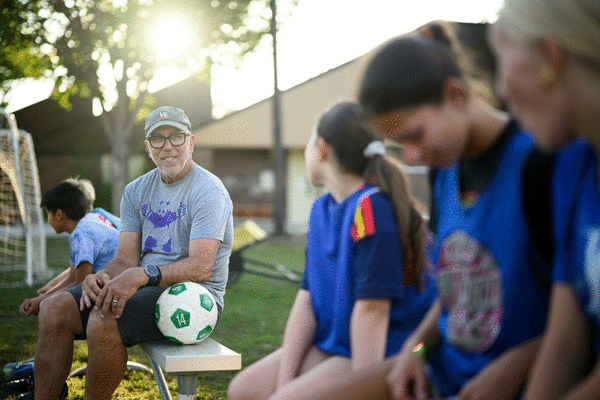
MINNEAPOLIS -- Here’s how you create an elite athlete: Wake up at 5 a.m. Run wind sprints uphill. Endure your coach’s yelling. Tally 10,000 hours of deliberate practice. Train in the offseason. And if you can’t cut it, you’re out.
That was part of the culture of American youth soccer when Ted Kroeten rose up as a coach decades ago. He believed more was more. There was structure, intensity and a tendency to treat kids like they were athletic widgets meant to be manufactured.
But then the elite club he was helping grow, the St. Paul Blackhawks, was superseded by an even more elite club, and he lost his job as coaching director in 2008. With kids of his own, he thought about the sports environment he wanted for them — and it was radically different. So he co-founded a new club for youth soccer and futsal, a fast-paced form of indoor soccer. At Joy of the People, fun and free play would come first. Winning could wait.
At Joy, there are no tryouts. Various ages and abilities play together in pickup games, whether you’re captain of the high school varsity team or a 10-year-old doing cartwheels on the field. Coaches don’t overtly coach, at least not at first. Kroeten’s vision can look chaotic, even aimless.
Surprisingly, his experiment works. The kids became very good. Its most experienced teams have won three national futsal championships, including one in July. While many adolescents quit sports because of burnout and injuries, many players at Joy continue to play soccer well beyond high school.
More than 27 million kids play sports in the U.S., and coaches and parents are all trying to devise a formula to create competent young athletes. Parents are left to believe private training, heavy travel and specialty camps are what kids need to stay competitive. The fastest track to greatness often looks like the only path.
Kroeten’s gamble shows there’s more than one way to develop lasting talent. But his approach asks families to make a choice few would consider. They must agree to play the long game.
“My goal was to show that play is the best practice — it’s nature’s masterpiece,” Kroeten said.
“I’ve made all the mistakes. I’ve bored kids. I’ve made them cry,” he added, reflecting on his time as an elite club coach. “It wasn’t until later when I figured out that joy is the key part.”
Welcome to ‘Ted’s Talks’
At 68, Kroeten is bald with glasses and a bad hip, likely from decades of competitive play. He was on the first-ever team for the Minnesota Thunder, a precursor to professional soccer in the state.
He is part sanguine “Karate Kid” teacher Mr. Miyagi, part child psychologist Jean Piaget, known for letting kids direct their own learning. Kroeten likens fluency in sport to mastery of a language, in which immersion and risk-taking lead to progress.
Think of a French-language student who sits in a classroom learning to conjugate verbs from a textbook and repeating phrases on the whiteboard. That’s traditional club soccer, Kroeten says. Meanwhile, Joy kids are becoming fluent in a different way — by moving to Paris and making friends on the playground.
One of Joy of the People’s biggest successes is former Minnesota United player Emmanuel Iwe, 26, now competing professionally in Europe. Iwe, who in 2009 was one of the first children to join Joy, compares Kroeten to the eccentric genius Doc Brown in “Back to the Future.”
“From the outside, he looks very much insane,” Iwe said fondly. “He’s been ridiculed for his ideas for the past 20 years.”
Iwe’s performance on the professional pitch is proof that Kroeten’s model can work. And many parents awakened to the excess and pressures of the $40 billion youth sports industry are finally ready to listen. So Kroeten wrote a new book, “The Talent Thief,” a blend of memoir with science, to reveal the power of play.
He reflects on his own childhood, learning hockey from older, skilled neighborhood kids on a pond in Golden Valley. The children picked teams, called their own fouls and cooperated with one another to keep the game going.
Kroeten, who also coaches boys varsity soccer at Thomas Edison High School in Minneapolis, is trying to revive that sense of casual play in the hyper-structured world of American club soccer. In a sports ecosystem where 12-year-olds believe they must board flights to face off against worthy competitors, he argues that such heroics are not only needless, they can be harmful. Joy does charge families for most programs, but the open-play sessions are free.
When I stopped by the St. Paul rec center that houses Joy’s main campus one evening, it looked like a soccer Montessori. Kids of all ages mixed together, boys and girls on the same teams. One field was contained by inflatable bounce-house walls. Tunes blared from a speaker. A coach observed the games but stood to the side, saying little. Many piggy-back rides were given.
In one game I witnessed a 12-year-old girl pull off a rainbow flick, a flashy trick in which the ball arcs over the player’s head. A lot of coaches frown upon such risky maneuvers. But no one shamed the girl for making what Kroeten likes to call “the beautiful attempt.” At Joy, creative expression is celebrated.
In other words, practice can at times look like kids goofing off in the backyard. This culture can give some parents heartburn. One dad I spoke to said when he first brought his son to Joy, he was amazed by the kids’ advanced footwork — and aghast by their ball-hogging. Why were the coaches not teaching the kids to pass?
One of the coaches, Lioul Minas, explained to me the players will learn to pass later. When they’re little, the focus should be on fostering joy and cultivating a fluency in dribbling. It’s trying to emulate how some of the most skilled athletes grew up playing every day for fun, whether it was on dirt lots of São Paulo or a frozen river in Warroad.
“The kid will tell you when they want more,” Minas reasoned. Direct instruction and sorted teams typically begin around high school.
One of the parents, Erin Rath of St. Louis Park, played high school soccer. When her eldest child’s team lost futsal games by scores of 20-0, she wondered why coaches weren’t correcting mistakes. But she stuck with the club’s philosophy of patience: “The kids will figure it out.”
She’s now sending her third kid to Joy. Annie is her tiny 10-year-old in goal, fearlessly punching away shots by older kids. And about those cartwheels? “That’s exactly what she should be doing,” Rath said.
Where’s the accountability?
Piaget, the Swiss psychologist who studied how children learn, said, “Every time we teach a child something, we keep him from inventing it himself.” Joy’s model embraces that. Kroeten said he’s seen his players find solutions on the field that defy convention.
This deference to children, of course, is not for everyone. Some parents have pulled their kids out of Joy and transferred them to more rigorous clubs. While most soccer clubs vet the kids, Kroeten screens the parents to make sure they’re on board with his approach.
Kroeten’s longtime friend is Tony Sanneh. He’s a St. Paul-grown soccer legend, not only because of his performance on the U.S. men’s team in the 2002 World Cup, but because of his free summer camps and an East Side soccer complex named after him.
Sanneh told me he credits Kroeten for building a community and a playful environment that children obsess about. Sanneh has seen young players quit sports before reaching their full potential because they only drill and compete, leaving little time for free play and having fun. Kroeten’s approach is an antidote, Sanneh said.
But he sees its limitations.
“Soccer is not about tricks and how many times you can juggle and look cool,” Sanneh said. “When you play sports, there’s accountability. You’re trying to win. If you’re dribbling every time because it’s fun, that’s not helping the team.”
Yet Kroeten says in free play, kids keep each other accountable. Refuse to pass? You stop getting the ball. He notes that dozens of Joy alumni have gone on to play for college teams. All coaches know that free play is a formidable teacher, Kroeten said. Development does not have to be coached or purchased.
Play works, but it’s overlooked. “It’s too simple,” he said. “It’s joyful, wonderful, easy.”
Playing with friends
Kroeten’s method worked for Iwe, the professional player. Born in Nigeria, Iwe resettled with his family in St. Louis Park and around age 9 started to play for Joy. He told me his parents couldn’t afford to pay for tournament and club fees, so Kroeten waived the costs.
Back then, Iwe’s athleticism and speed were obvious. After games, parents and coaches from opposing teams flocked to Iwe in hopes of recruiting him. But Iwe preferred playing with his buddies.
“I’d rather lose a final with my friends than win with a bunch of random people,” he mused.
He’s onto something. National surveys of kids say they join sports to have fun and be with their friends.
In pickup games, Iwe prided himself on beating the cockiest athletes with a ragtag crew of underestimated players that he assembled. I expected him to talk about how free play gave him more touches on the ball, which helped him develop. But he said free play instilled in him something more important that still burns today — his love for the game.
Over the summer at the USA Cup in Blaine, the country’s biggest youth soccer tournament, I met some U19 Joy teens who recently won the national futsal title in Virginia.
One was an introspective 17-year-old named Deven Leonard of Afton. Big money and pushy parents may be ruining youth sports, but he pointed me to something else: our cultural obsession with instant gratification. Everybody wants results now.
Leonard repeated something that Kroeten has often said to him. “Would you rather peak at 10?” he said with a grin. “Or would you rather peak at 20?”
©2026 The Minnesota Star Tribune. Visit at startribune.com. Distributed by Tribune Content Agency, LLC.









Comments