Laura Yuen: Every sports parent wants the best. That's the trap
Published in Parenting News
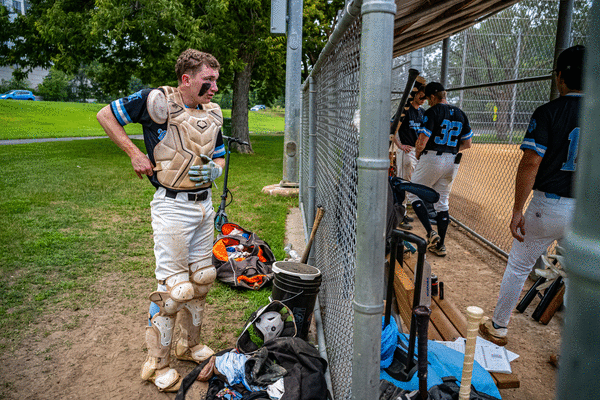
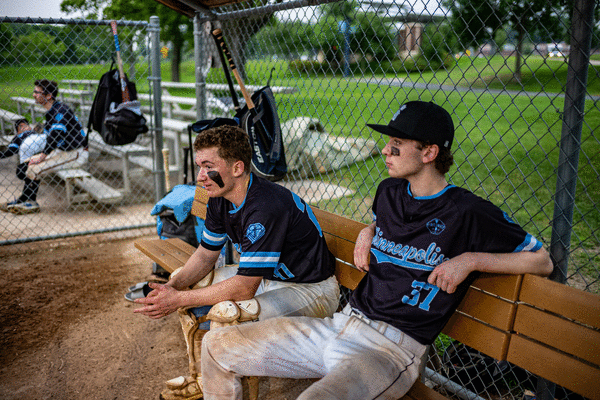



MINNEAPOLIS -- This summer a schism fractured the baseball community in tight-knit St. Louis Park, Minnesota, where the modern forces of youth sports were about to dismantle a suburban relic.
For years, kids as old as 12 could still play Little League at a local park for a couple hundred bucks, placed on teams with kids of varying abilities. No tryouts. No stacked rosters. For much of the summer, no traveling across city lines.
Children built friendships with peers they might not normally play with, and stronger players learned leadership by helping their teammates. In a packed room of parents in July, association board member Sam Ginnis remarked how special their program was. Wasn’t it worth preserving?
The crowd fired back.
“Their answer was no,” Ginnis recalled. “And people didn’t say no nicely.”
The clash in St. Louis Park was a microcosm of the changes sweeping youth sports in Minnesota and across the nation. Children are being sifted by ability at much younger ages as families spend more on travel teams, advanced competition and specialized training. It’s an investment that middle-class and wealthier parents actively seek for their children, even as they complain about the sacrifice to their pocketbooks and family life.
Meanwhile, the middle ground is disappearing. As top players and coaches migrate to competitive programs, rec offerings wither, and parents think travel culture is the only option for their kids to continue developing — or to even play at all.
I spoke to dozens of sports parents, players, coaches and experts over the past several months about the culture of youth sports. As we race to build elite young athletes, we rarely hear about the dangers of high-pressure play. Most kids quit sports even before high school, leaving them with fewer opportunities to move their bodies or learn about teamwork.
Other kids go all in, obsessing over and optimizing their performance, but no longer enjoy the game. Injuries and burnout are among the top reasons kids drop out of organized sports, according to the American Academy of Pediatrics.
Kids can train harder than ever, and parents can spend more than ever — but to what end?
‘Why are we blowing it up?’
It’s worth noting that the proposed change in St. Louis Park was hardly a leap into elite travel baseball. Registration would rise to about $450, not $4,500, and teams would travel to places like Eden Prairie, not Kansas City. But to families devoted to the inclusive culture of Little League, the shift felt like another surrender to the tidal wave of competitive youth sports.
Steve Mollick, who coached his 10-year-old, said his son enjoyed an idyllic summer playing alongside friends. The program succeeded in achieving what he considered the three most important tenets of youth sports.
“The kids had fun and got better and wanted to keep playing,” Mollick said. “Why are we blowing it up?”
The board eventually voted to eliminate in-house baseball after the age of 9 and move older children into more competitive play. Mollick, who was set to become board president, stepped down over the decision.
One of the fathers who pushed for change in St. Louis Park talked to me only if I withheld his name, fearing blowback from the community. More than 30 years ago, he got his start playing in the city’s once-thriving Little League. But participation had dwindled, and players and coaches were stretched thin. The association determined it could no longer sustain multiple tracks.
By the time St. Louis Park players entered travel ball at 13, he said, many were unprepared for larger fields and opponents who had spent years competing at a higher level. “They would get their asses kicked,” he said.
To this dad, defending the old system meant clinging to something that no longer existed. “I wish we could go into a time machine, but you have to either go with the trends or get left behind.”
Sorting starts early
The tension between recreational and competitive tiers extends well beyond Little League.
One of the parents I talked to, Lea B. Olsen, saw the shift firsthand as a Minneapolis sports mom. Now a Minnesota Lynx broadcaster and an advocate for returning to a healthy balance in youth sports, Olsen didn’t begin playing basketball until her junior year of high school — yet went on to compete at the University of Minnesota. In today’s youth sports system, such a late start followed by a Division I career would make her a unicorn.
In basketball and other sports, Olsen explained, kids are sorted early, often before puberty. If they’re aren’t already playing in an off-season circuit such as AAU, it becomes difficult to catch up with their peers, even if they have no aspiration to play at an elite level.
When rec programs disappear, there are fewer low-cost, low-stakes places for children who mature later or who take their time to discover a new sport. “Many young people feel like if I’m not in it by third grade or even younger, it’s not worth jumping in,” she said.
A Roseville parent I spoke with, Nathaniel Broughton, resisted the idea of his kids joining travel teams for as long as possible. But around age 10, competition in local rec leagues fell off a cliff. It was no longer was challenging or fun; parents held side conversations about peeling off for traveling club teams.
“What happens is everyone leaves, and anyone who enjoys the sport is recruited,” which he said was bizarre for a bunch of fifth-graders.
Experts say the early dividing is a nationwide problem, especially in the most popular sports.
“We have a huge problem if your child has to play club volleyball in the sixth grade to have any chance to make the high school team,” said Linda Flanagan, author of “Take Back the Game.”
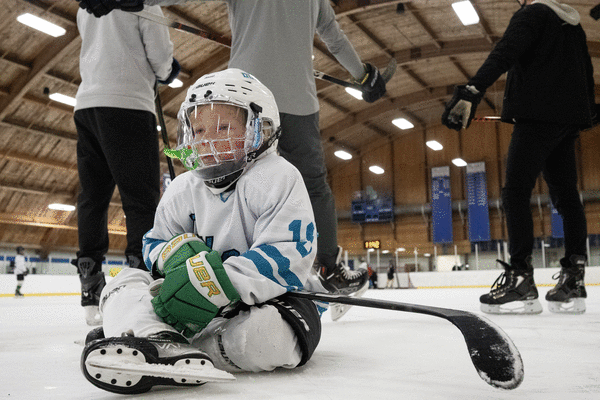
You might not find a more extreme example than hockey in state championship-rich Edina. Tommy Everson, who lives and grew up in the affluent suburb, argues there’s probably nowhere in the country where it’s tougher to land a spot on the varsity team. A number of Minnesota Wild players have notably raised their puck-obsessed kids there. Everson remembers putting his firstborn son on skates when he was still in diapers.
And even so, “kids were so far ahead of us,” Everson recalls. “The arms race has escalated, and it feels like you are never doing enough.”
Like most of the people I interviewed, Everson does not strike me as one of the over-the-top sports parents who jeers at refs or is delusional about his kids going pro. He organizes casual hockey and lacrosse outings for his kids and their friends. Raised by a single mom, Everson said he simply wants to give his young kids a childhood that was as good as his or better. That includes the option one day of playing on high school teams.
Yet Everson knows he’s complicit. Parental anxiety is helping fuel a system that requires families to schedule, spend and travel more. “It comes on us to say no, but I don’t know how to do that collectively.”
‘Why Johnny Hates Sports’
As youth sports becomes professionalized, kids are being exposed to more stress and greater risk of tearing their elbows and knees from overuse. On social media, where algorithms can feed you endless videos on how to drill your kids on the perfect jump shot, you can also feast on content pushing back on the rising intensity of kids’ sports — and the companies that profit from them.
Sometimes the trade-offs don’t become clear until years down the road. We read about athletic supernovas and marvel at their intrinsic drive and dedication to practice. We seldom hear about young athletes who burn out or question whether the sacrifice was worth it.
One of them is Charlie Wright, a thoughtful 19-year-old baseball player from Edina, who at some point lost his joy.
Through most of his teens, the batting cage was Wright’s sanctuary, a place he could perfect his mechanics, some 500 swings at a time. But it also made him anxious. He rarely took a day off of hitting and some days swung until his hands bled. He pored over YouTube highlight reels of players his age in sick uniforms, dazzling scouts and committing to college powerhouses. He thought that could be him one day.
“In reality,” he realized later, “the difference between those kids and me was astronomical.”
A serious injury during a game after his junior year of high school forced him to spend much of the season watching from the dugout. But the break offered him perspective. He wondered why he and his club team were traveling to North Carolina, only to face off against players from Blaine. Teams from all over the country had the word “elite” tacked onto their names but were no better than the clubs 10 miles from home.
The scenes he observed at tournaments on sprawling fields of concrete and turf depressed him, as if he were wasting daylight at a casino. A dad guzzled liquor out of his water bottle while berating his child in a game. Coaches furiously argued with umps. Maybe, Wright thought, adults behaving badly was a mere symptom of a disease triggered by all the cash and ego being pumped into youth sports.
“This is a money grab. Why were we all here?” Wright wondered.
The college recruiters he had hoped to impress at showcases never called with offers. During his senior year at the Blake School, he wrote a paper called “Why Johnny Hates Sports.” In it, he documented the evolution from town leagues to intense travel culture. Little League was created to mold great citizens, not superior athletes. Today, private clubs promise first-class competition, directly at odds with the inclusive culture of town ball.
It also dawned on Wright that, for too long, playing baseball felt more like a job to him. The sport consumed his identity.
“I lost the plot — it’s a game,” he said. “If it isn’t fun, there’s no reason to do it. Some kids are going through their whole athletic career, never feeling the magic, and that’s sad.”
Wright has since rediscovered the magic of baseball in more relaxed settings. The best part is playing alongside his twin brother, just for fun.
Why kids quit sports
An Aspen Institute survey found that most kids quit sports because they stop being fun. About 70% of children walk away from organized sports by the age of 13, according to the American Academy of Pediatrics.
Olsen, the WNBA analyst, remembers her son melting down around that age. She was stunned when she counted up all of the baseball games he had played in a single year and landed at 115. “You get so wrapped into it, you don’t even realize that your kids are playing as many games as professional athletes.”
Yet something a sports dad said also stuck with me: When you suck at something, that’s not fun. Sometimes kids quit sports when they don’t feel competent. Sorting players by ability can offer them the right mix of confidence and competition; constant, lopsided losses can make playing miserable.
That is the tension of youth sports today. The middle ground vanishes not necessarily when a town chooses competition over community. It happens when families would do anything for their kids to be happy and thrive.
One of the St. Louis Park baseball dads shared something that reminded me why we encourage our kids to play at all. Mike La Barbera was huddling his team of 12-year-olds after their very last Little League game. One of the players who didn’t land a single hit all season announced that he had something to say.
The boy got choked up. Tears spilled out. “I know I wasn’t the best player,” he said, “but I wanted to thank all you guys for being so nice to me.”
When teams become siloed by skill level, a star player never gets to hear those words or see those tears. We’re all trying to find a way for kids to stay in the game, be healthy and grow into empathetic adults who can work with others. Sometimes the greatest wins in life aren’t measured by what the scoreboard says.
Next in my series, I’ll profile a youth sports program in Minnesota that insists on joy first; victory is secondary. But along the way, the kids are winning national championships.
©2026 The Minnesota Star Tribune. Visit at startribune.com. Distributed by Tribune Content Agency, LLC.









Comments