Column: Youth sports are booming, and families are paying the price
Published in Parenting News
MINNEAPOLIS -- As a kid, Kristen Mueller spent her summers playing baseball with friends at a park a couple of blocks away. In high school, she was a three-sport varsity athlete and later played hockey for her college team.
But if her kids join today’s hyper-organized youth sports culture, they will be expected to get serious, not dabble. They will face pressure to specialize early and spend hours traveling to games against children they don’t know, rather than playing alongside neighbors at the park. Training for summer sports will extend into winter domes.
“You want your kids to have an experience that was the same or better than what you had — it’s the American Dream,” said the Rogers mom and coach. “But with youth sports, this is the one thing that I don’t see is going to be better for my kids.”
Thousands of Minnesota parents are, like Mueller, searching for moderation in a youth sports ecosystem that is demanding more time and money from families than ever before.
Intense club programs intended for elite players a generation ago now include more run-of-the-mill athletes, as long as they can pay. It’s a way of life that requires traveling to out-of-state games, training heavily in the offseason, and burning up thousands of dollars a year on registration fees, hotel stays and gear.
Outsiders may be shocked by the currents within the world of competitive youth sports. Out of the dozens of parents I interviewed, no one said they were selling their organs to fund their kids’ athletic dreams. But one mother tried to give plasma, one father spent six figures, and 10-year-olds now have private coaches.
The model has crowded out kids whose families can’t afford to play, as well as late athletic bloomers who feel they’re not good enough — so they abandon sports altogether.
Here’s the shocking part: Even as we organize our calendars and budgets around our children’s sports, most of us appear to be frustrated or baffled by what they require. A USA Today poll found that about 8 in 10 parents want less travel. And 73% say youth sports have lost sight of their original mission of learning teamwork and having fun.
Even the levelheaded sports parent feels compelled to hop onto the bullet train in pursuit of building an “elite” athlete.
“You get sucked into it because you feel you have no other options,” said Tom Farrey, who leads the nonprofit Aspen Institute’s Sports and Society Program. “We want our kids to be off our phones and off the couch, and so we’ll do just about anything to keep them in the game.”
While I see myself as levelheaded, I have let my kids’ sports dominate my life. Club soccer has given my boys friendship, calmed their active minds and kept them out of shenanigans. It also comes with a cost, such as missed family dinners and fewer trips to the lake.
The more I ponied up or leaned in — mostly for the hope that my boys would be good enough to play on high school teams — the more I wondered about our culture of youth sports. It hit me one afternoon while sending off my older kid to a tournament in Chicago. I watched him board a climate-controlled charter bus with gifted young athletes plucked from across the Twin Cities, all wearing slick matching warm-ups, to play on a super-select team before even reaching puberty.
I realized there might be no fee I wouldn’t pay, no sacrifice I wouldn’t make, to do right by my kid. And that’s the problem.
An elite price tag
I knew I couldn’t be the only one feeling tugged in all directions about my kids’ athletic endeavors. So I asked others about their experiences. More than 100 Minnesota parents, coaches and referees responded to my callout.
I heard from a dad who shelled out $100,000 for his daughter’s lacrosse pursuits and a pastor who took up second and third jobs to fund her kids’ youth sports. I’ve talked to teens who burned out and parents who were blindsided when their kids quit.
Some parents are financially exhausted and emotionally overwhelmed. Others remain firm believers. They say sports imbue their children with a sense of belonging and shape them into leaders. It’s also gratifying. As in piano or chess, observing your child master a skill makes any parent’s heart swell.
Tim Sellner of Minneapolis falls in the middle, constantly weighing the benefits of spending. He pays about $15,000 a year for his high school-age son’s baseball club fees, out-of-state tournaments and showcases, winter training, and bats that can cost up to $300 each. His teen aspires to play Division I baseball in college.
“If you’re willing to spend it, there’s someone who will take it,” said Sellner. “If my kid’s friends are getting speed training, you’re afraid your kid is going to fall behind if he doesn’t.”
Enrico Williams of St. Paul said he and his wife, a schoolteacher, are financially stretched but pay anyway. She landed a second job and even attempted to donate plasma to help pay for their 14-year-old son’s club soccer career.
For as long as their only child, Sami, loves soccer and is driven to compete at the highest levels in places as far as Utah and Colorado, Williams and his wife will do everything they can to keep him in the sport. A game that ended with Sami being celebrated on the shoulders of his teammates reinforces his parents’ commitment.
“We are figuring out how to support this expensive habit,” Williams said.
An Aspen Institute survey found that the average family spent $1,016 on their child’s primary sport in 2024, a 46% increase over five years. Throw in additional sports, multiple kids and heightened levels of play, and that bill quickly expands. In total, parents in the U.S. spend about $40 billion a year on their kids’ sports.
This reality contradicts the narrative we’ve often told ourselves about sports: that hard work and grit can triumph over money. From LeBron James to the “Mighty Ducks,” a central American story is that wealth doesn’t matter in the sandlot, ice rink or on the basketball court. Bringing your best game does.
But what if some kids never get the chance to suit up?
“The sheer cost of these programs is a huge barrier, and it shuts out a lot of kids,” said Jennifer DeVries, a baseball mom from Coon Rapids.
When I spoke to DeVries this summer by phone, she was at a tournament in Peoria, Illinois, wearing a $50 wristband she was required to purchase to watch her own son’s games.
Who isn’t playing?
The more parents spend, the more we expect a return on the investment. This could help explain some toxic behavior that can steal headlines. From my kids’ soccer sidelines, I’ve observed too many examples to count, from obnoxious parents to red-carded coaches. Even Kim Kardashian knows the drama that can unfold in the stands, which is why she’s producing a new reality TV series about baseball moms.
I devoured a book called “Take Back the Game: How Money and Mania Are Ruining Kids’ Sports — and Why It Matters.” At a June congressional hearing about the role of private equity in youth sports, the book’s author, Linda Flanagan, said children in the wealthiest, most educated households play the most organized sports.
Those from low-income, less educated homes play the least, missing out on the physical and emotional benefits that sports provide.
Zoe Boyle, a single mom from St. Paul, is willing to make it work because her son lives and breathes baseball. But as a woman of Haitian and Dominican descent, she’s attuned to the fact that families of color like hers are outliers in the local baseball scene.
Boyle said she is accustomed to navigating white spaces where children of color hear messages that the game does not belong to them. Her sixth-grade son, who is Black, was singled out at a suburban baseball tournament last spring for his physical maturity. When he walked up to bat, an opposing team’s coach called him “dangerous” and directed the pitcher to intentionally walk him.
After the coach challenged the age of Boyle’s son, tournament organizers asked to see a birth certificate. Bigger and taller white boys who played for her son’s local association were not questioned, Boyle said. She and her son found the experience humiliating.
The tournament director empathized with Boyle’s son, resulting in changes to how the organization will vet players’ ages.
To Boyle, the incident spoke volumes about the high stakes of youth sports. “This is Little League, not the World Series,” she said.
How did we get here?
Youth sports aren’t just intensifying. They are reshaping how American families structure their lives.
Around the country, trims to public parks and school sports programs started in the economic downturns of the 1970s, and continued with the 2008 recession and again during COVID-19. Private entities entered to fill the gap, Flanagan said.
And mega sports complexes, including the 1987 construction of the National Sports Center in Blaine, showed there was a market not only for watching youth sports, but an entire tournament industry that could attract families, fill hotels and spur local spending.
Meanwhile, families grew smaller, parents became warier of letting children roam unsupervised, and the rise of intensive parenting demanded greater sacrifices. Children’s activities took on outsized significance.
“Kids’ sports have become the central organizing principle of family life for many suburban and middle- and upper-class families,” Flanagan told me. “We’ve gotten to the point where they seem more important than they are.”
Hyper-organized sports leave little room for the free, unstructured play that is vital to child development, as training and games take over the family schedule.
Some of us don’t mind that our kids’ sports have consumed our calendars, as well as our social lives. Bleachers have replaced pews for where many parents spend their weekends. I look forward to catching up with other moms on the sidelines, and I’d rather experience the addictive rush of seeing my kid score a winning goal than spend a Saturday weeding my lawn.
On social media, we share. Photos of children in professional-looking uniforms, posing with tournament medals, make the excess and frantic rhythms of sports families look not merely normal, but enviable.
“It’s become the modern-day equivalent of ‘How big of a pool do you have in your backyard?’” said Josh Fields, a Shoreview dad of three. “Maybe in years past, families were striving for the nice car or the nice house. Now it’s like, ‘Where are your kids athletically?’ ”
‘Chum’ in the water
What poured gasoline on the competitiveness of youth sports is the rising unaffordability of college — and the dangling of an elusive scholarship. The amount of athletic aid to NCAA Division I and II athletes has grown from $250 million in the early 1990s to about $4 billion today, said the Aspen Institute’s Farrey.
Now that athletes are allowed to make money from their personal brand (name, image and likeness), there’s even more incentive to view youth sports as an investment.
“That’s a lot of chum to throw into the waters of youth sports, and it’s made the fishes — meaning, the parents — a little crazy,” he said. “They think there’s a meal at the end of the day, but there isn’t.”
Only 2% of high school athletes receive a scholarship to play in college, and typically that does not amount to a full ride.
Meanwhile, corporate interests are giddy, betting that there is no limit to what families will spend on their kids’ sports, “Take Back the Game” author Flanagan said.
Some tournaments require families to book rooms only at designated hotels, producing a cut for organizers. Such practices have snapped federal lawmakers to attention, as they try to ban “stay-to-play” policies and limit private equity in youth sports. That pushback could signal that more people are waking up to the extremes of a largely unregulated youth sports system, Flanagan said.
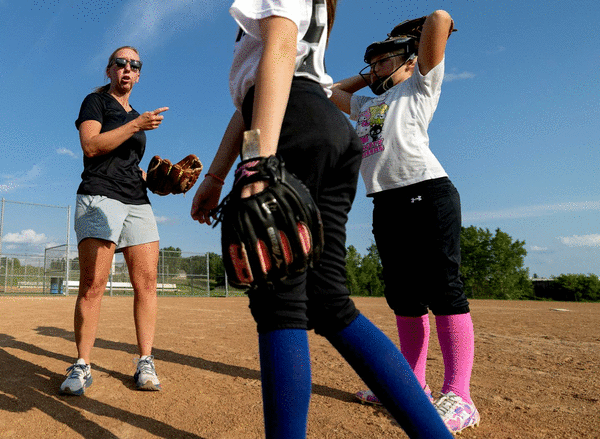
Something Mueller, the former collegiate hockey player, said this summer about her daughter’s community softball game resonated with me. The field was just six minutes from home, most of the families knew each other, and there still was time after the game for a home-cooked dinner.
But the clock was ticking. Her daughter was 9 and, this fall, she would join the swirl of travel ball — the only option for girls her age in their community.
She wondered, “Why are we ruining this for our kids and ourselves?”
©2026 The Minnesota Star Tribune. Visit at startribune.com. Distributed by Tribune Content Agency, LLC.









Comments