This Coloradan can plug his brain into a computer. He's trying to help turn science fiction into reality
Published in Health & Fitness
ELBERT, Colo. — To say Brandon Patterson’s father wasn’t fully on board when he first brought up the idea of having electrodes implanted into his brain would be an understatement — and their family doesn’t mince words.
Brandon, 41, already relied on his dad for all of his daily needs, ranging from setting up the lift to move him from bed to his wheelchair to scrubbing him down in the shower and pouring his morning coffee into a cup with a straw. That was the way it had been since Brandon broke his neck in a vehicle accident almost nine years earlier, and they made it work, with a hefty dose of gallows humor to keep from screaming.
Monty Patterson trusted the doctors at UCHealth knew what they were doing, but opening someone’s skull always carries the risk of doing further damage. What would happen if Brandon lost control of the limited muscles he could use in his arms or his ability to speak?
“I said, ‘If you’re just doing this so you can play video games, I’m gonna smack you,'” Monty said in an interview at University of Colorado Hospital in Aurora while Brandon was hooked up to a computer tracking his brain activity. “He said, ‘No, I’m doing this so I can play video games and further science.'”
Brain-computer interfaces that allow people to control artificial limbs using their minds exist at the boundary of science and science fiction. As is, a paralyzed person who has had the surgery and undergone the lengthy process of training the program can control objects on a screen and complete some movements with a robotic arm. But a system that would allow patients to regain the full abilities they had before their injuries, while possible, remains only a hope.
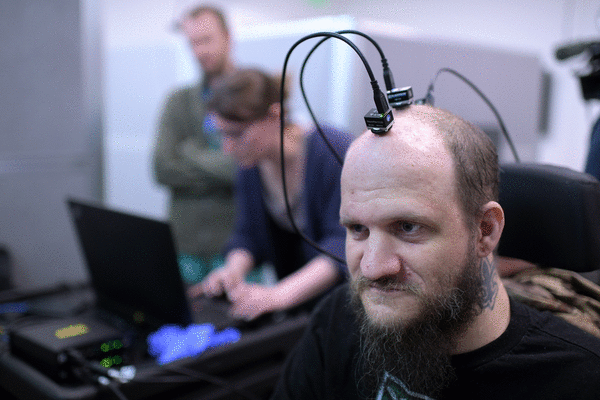
Brandon Patterson, who is paralyzed from the chest down and has limited use of his arms, was the first person in Colorado to have a brain-computer interface implanted into a part of his brain involved in decision-making during a surgery in February.
The researchers working with him aim to determine whether putting electrodes there, rather than in areas specific to movement, will produce better control of screens or artificial limbs. They are also investigating whether they can send signals the other way, to produce semi-natural sensations in limbs that can’t communicate with the brain.
Dr. Daniel Kramer implanted six arrays of electrodes, which resemble patches of tiny needles, to pick up signals from the surface of Patterson’s brain. A computer then has to learn how to decode what the electric signals in the brain mean, because two people thinking about the same action produce different patterns.
“Each brain is totally different,” said Kramer, an assistant professor of neuroscience at CU’s Anschutz Medical Campus and a neurosurgeon at University of Colorado Hospital.
The current setups are good at moving a robotic arm in the right direction, but don’t always know when to stop: something like a toddler who knocks over the toy they want to grab, Kramer said. Putting the electrodes in a part of the brain involved in higher processing might improve that, he said.
If a computer could send signals back, the brain could judge whether it needs to tighten or loosen the grip of a robotic arm, in the same way that a person using their natural hand finds the balance where they don’t crush or drop the thing they’re holding, Kramer said.
“There’s lots of things that go into making a hand movement correct for an object,” he said.
Private companies and researchers are working on parallel tracks with the technology, with the businesses trying to prove their products help patients enough that the U.S. Food and Drug Administration should approve them, Kramer said. At universities, they’re more focused on learning about how the technology and the brain work together, which could lay the groundwork for future advances, he said.
Kramer made clear that he couldn’t guarantee any benefits and that the goal of the research was to improve the technology for future patients, Patterson said. He doesn’t have any robotic devices or a computer capable of linking to his brain at home, so he only uses the technology during sessions with the research team.
“If I see some things now, fine, that’s cool, but it’s not for me,” he said.
Patterson’s wildest dream for the brain-computer interface is to someday be able to drive his wheelchair with his mind, like Professor X in the X-Men comics. But being able to use a computer more easily would also be a significant improvement, he said.
He currently uses a combination of voice controls and a stylus that attaches to his hand like a brass knuckle, allowing him to peck at a screen. Neither was enough to succeed with Microsoft Excel and pass the statistics class he took as part of his psychology major at Red Rocks Community College, he said.
On a Friday in April, researchers hooked Patterson up to a computer, plugging wires into ports sticking out of his scalp like a stegosaurus’ back. He didn’t have on the decorative metal spikes he sometimes attaches to them when going out.
“If I’m going to get looked at funny because I’ve got spikes, I’m going to make it as punk rock as possible,” he said.
Set-up complete, the researchers assigned Patterson mental tasks, such as visualizing putting his fingers through the holes of a pair of scissors or holding a cup. Just thinking about the tasks didn’t produce a significant reaction that they could detect, but holding up the scissors as a visual aid and asking him to pretend he wanted to drink from the imaginary cup got the signals firing.
Later, they set up something that looked like a 1980s computer game, with a green disk sliding on top of gray disks in a circle around it. The researchers were moving the green disk at that point while telling Patterson to imagine sending it in the right direction, Kramer said. Eventually, once the computer learns to decode his brain’s patterns, he’ll be able to move the virtual disk with his thoughts.
When he tried again, about two weeks later, Patterson could move the disk without as much support from the computer. He couldn’t budge it when asked to imagine he was playing air hockey, but a prompt to think about how the Jedi move things with their minds in the “Star Wars” movies clicked.
“The Force is strong with me,” he joked later.
People can somewhat understand the challenges of not being able to use his arms fully or his legs at all, but having quadriplegia brings a whole different set of challenges that a brain-computer interface probably can’t solve, said Tammy Neuman, Monty’s partner and Brandon’s co-caregiver.
Patterson — who lives with his father and Neuman in Elbert, about 50 miles southeast of Denver — had to relearn how to cough because his diaphragm no longer contracted and figure out what he could do with limited control of his arms. His biceps still work, but his triceps don’t, and his fingers usually stay curled under.
“Life with a quadriplegic is always about overcoming,” she said.
On top of that, the stillness can lead to blood clots, including one that went into his lungs and landed him in the hospital, Patterson said. Pressure sores from sitting or lying too long in one position are a constant threat.
Something as comparatively minor as a full bladder or bowel can trigger a dangerous spike in blood pressure because his body senses something is wrong below his spinal injury and doesn’t know how to manage it.
“I say I’m on 13 of my nine lives,” Patterson said.
_____
©2026 MediaNews Group, Inc. Visit at denverpost.com. Distributed by Tribune Content Agency, LLC.







Comments