Concerns rise over spread of measles in Washington ahead of summer, World Cup events
Published in Health & Fitness
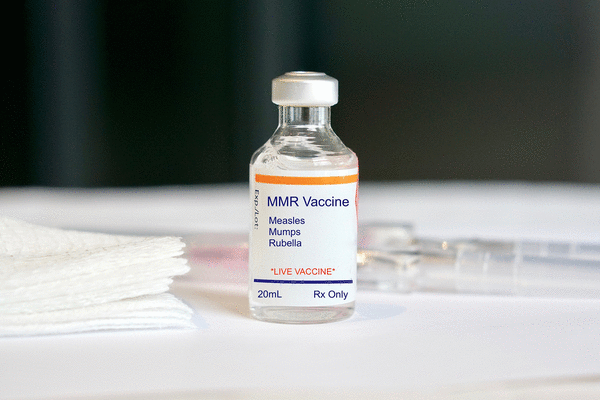
UW Medicine officials on Wednesday warned of the growing number of measles cases in Washington state ahead of the summer travel season and FIFA World Cup and related events planned in the Puget Sound region.
Measles is considered highly contagious and easily spread. According to information from the U.S. Centers for Disease Control and Prevention, “If one person has it, up to 9 out of 10 people nearby will become infected if they are not protected.”
Dr. Alex Greninger and Dr. Shireesha Dhanireddy met with reporters on Wednesday at the UW Medicine Retrovirus Lab at Harborview Medical Center.
The medical experts were on hand not only explain where things stand with measles but to show medical-testing operations to help track cases in the region.
Greninger explained the testing instruments arrived at UW in March 2020, initially for COVID testing. Tests for both include nasal swabs for sampling.
Measles infections typically spread through respiratory droplets, which can linger on surfaces long beyond initial exposure, as well as spread via person-to-person contact.
“I think the earliest sign that you see for an accelerating outbreak is just the number of cases,” said Greninger, who serves as head of UW Medicine’s Division of Infectious Disease Diagnostics.
He noted that the 26 cases already reported this year in the state are more than double the number of cases reported in all of 2025.
“There’s a lot of air travel in the United States,” he said. “And then we look ahead. We know the World Cup is coming here to Seattle. We know the cruise season is big. We know people like to come here when the weather’s really nice. Those are all signs of potentially more cases to come."
Bulk of reported cases tied to unvaccinated patients
According to figures posted online by the Washington state Department of Health, as of March 6, 21 of the reported measles cases this year are tied to an outbreak in the state, the rest are linked to other cases of measles outside the state.
Snohomish County has reported the most with 14 cases so far in 2026. Other cases have been reported since January 1 in Clark, Stevens and Kittitas counties.
Four cases in the state have involved patients under 5 years old, while 16 cases involved those ranging in age from 5 to 17; six involved patients 18 and older.
The bulk of the reported cases, 24, involved unvaccinated individuals.
Nationwide, the number of confirmed U.S. cases this year has surpassed 1,200.
Symptoms of an infection include high fever (may spike above 104 degrees Fahrenheit), cough, runny nose and watery eyes and a rash.
Serious complications from an infection can include pneumonia or brain inflammation, particularly in infants and young children, and in some cases, it can be fatal.
“I think the best chance we have for really protecting not only ourselves and our children, but those around us, is really immunization,” said Dhanireddy, who practices at Harborview Medical Center and is associate chief medical officer and a professor of medicine, allergy and Infectious diseases at UW Medicine.
“We know that these vaccines work,” she added. “They work really well, and that’s why they’re recommended for all school-aged children.”
Dhanireddy noted that “for the most part, all children age 1 and over should be getting this vaccine, and that’s a two-dose vaccine series.”
A disease once eliminated in U.S. returns
According to information from the U.S. Centers for Disease Control and Prevention, in 1978 the CDC set a goal to eliminate measles from the United States by 1982.
Measles was ultimately declared eliminated nationwide in 2000, defined as “the absence of the continuous spread of disease was greater than 12 months,” according to the CDC, “thanks to a highly effective vaccination program in the United States, as well as better measles control in the Americas region.”
“It was next up for eradication,” Greninger noted Wednesday. “There’s no animal reservoir for this virus. You can get rid of it. ... It’s very different than COVID.”
The problem now is rising cases amid lower vaccination rates occurring at the same time as an influx of tourists coming to the region for cruise ships, World Cup or other travel.
“I’m excited for the games,” he said. “That said, air travel is how measles spread typically. Before we had so many cases in the United States, it was mostly (transmitted via) international travel. That was how we saw a measles case in a Seattle hospital. Now, unfortunately ... you can get it from just domestic travel, and we know that there are going to be a lot of people to come to the city, people from areas that may not have as good vaccination coverage.”
He added, “Typically the virology lab would not be doing measles testing. We would send this to the state lab. We would send only a handful of cases or tests out a year, and have basically none of them return positive.
“Now, with the current situation, we have to be ready, and we have to offer that testing to be ready,” he noted.
“The fact that the vaccine vaccination levels aren’t getting better ... this might be a little bit of a new normal. It doesn’t have to be, but from a preparedness standpoint, it might be,” he stated.
_____
© 2026 The News Tribune (Tacoma, Wash.). Visit www.TheNewsTribune.com. Distributed by Tribune Content Agency, LLC.








Comments