Alaska takes leading role in new indie drama film 'The Sun Never Sets'
Published in Entertainment News
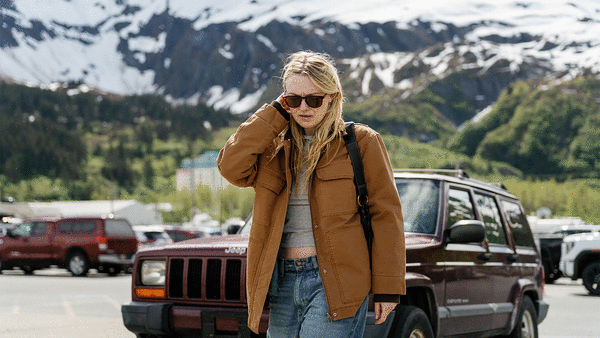
ANCHORAGE, Alaska — Joe Swanberg has made a career of maximizing the tools at his disposal.
The indie filmmaker has a knack for fostering improvisation and making movies on lean budgets.
His new feature, "The Sun Never Sets," took a kernel of an idea and a suggestion from Anchorage producer Ashleigh Snead to create a romantic drama that has charmed audiences and critics.
In the new movie starring Dakota Fanning (known for "I Am Sam" and "Uptown Girls" in childhood roles, or more recent TV series like "All Her Fault") and Jake Johnson (of "New Girl" fame), Alaska also takes a leading role.
The film was shot in the state in spring 2025 after Snead pitched the location to Swanberg, who had originally conceived the film as being set in the Pacific Northwest.
Snead knew Swanberg ("Drinking Buddies," the Netflix anthology series "Easy") as a nimble director who could tailor his story to Alaska's terrain.
"I think a lot of creativity can come from like, 'Here's the sandbox. Can you figure out how to play in it?' " Snead said. "So I think I just called Joe and said, 'Hey, here's an idea. What if we shot something up here? I think our team could do a really good job with it.' "
At that point, the script was still an idea that Swanberg had "never fully cracked." But after Snead proposed a shoulder-season shoot, Swanberg started assembling a cast and dialing in the story.
"I sort of had the seed or the kernel of an idea," Swanberg said. "I hate to say, borrowed a lot from a breakup that I was actually going through at the time, and sort of merged my old idea with my current life situation."
In "The Sun Never Sets," Fanning's character is a construction worker who reenters the dating scene and connects with a former flame after her older boyfriend — played by Johnson — determines she should explore her options to figure out what she wants in a relationship, and in her life.
The film is set mostly in Anchorage with a number of recognizable businesses and locations, such as Kincaid Park and downtown's Whisky & Ramen and Akela Space. Plenty of scenes were filmed around Turnagain Arm and as far south as Whittier.
Swanberg made a couple of scouting missions to Anchorage to help dial in the script. With Snead acting as tour guide, Swanberg got a broad view of the area on the first trip and did more location scouting on the second. He said trying to capture local authenticity was a big part of making the movie work.
"It would be a big fear of mine that people in Anchorage would watch the film and just feel that it was totally off or had nothing to do with how the city felt or where these characters might hang out," Swanberg said.
Snead said that extended to finding some locations that weren't even on her radar.
"He took me to dive bars that I've never been to that we ended up shooting at," she said. "You know, he's like, 'This is where the real people go. I will find them.' "
Often, working on a shoestring budget has meant taking a more minimalist approach for Swanberg. That's included shooting in apartments and other smaller enclosed areas. But working in Alaska allowed him to broaden the view and include more of the landscape.
"Once I got to Anchorage, I was like, all of these scenes should be outside," he said. "I mean, what am I doing? Nobody's sitting around in their apartment in the summer in Anchorage. That's crazy. They should be out hiking. They should be doing stuff."
Swanberg said that search for local authenticity extended to the actors as well. Cory Michael Smith, who plays a pilot and one of Fanning's love interests, was keen to fit in with Alaska's aviation set.
"Cory came up two weeks early just to get up in airplanes, to meet pilots and try and hang in that world," Swanberg said.
The film premiered in Anchorage earlier this month and has been screened at multiple theaters in town.
Anchorage audiences at initial screenings cheered when Snead's name appeared in the credits. The appearance of notable locations like Kincaid Park, Arctic Roadrunner and 49th State Brewing Co. on the screen also drew a big local reaction.
Other local people, groups and businesses were thanked in the credits as well. The Kaladi Brothers coffee shop on Jewel Lake Road was the setting of a key scene in the movie, and the store shut down early to allow employees to attend a screening.
"Of all the places I've worked, Anchorage was one of the friendliest, most supportive, most helpful cities I've ever shot a a movie or TV show in," Swanberg said. "It was very rewarding to feel that the community showed up for us, and business owners let us use their places. So many people came out and supported us as background actors. It was just a real nice feeling of community involvement."
Shot on 35 mm film, the movie is character-focused. But Swanberg, who is used to working with limited resources, said the landscape and locations gave the film a more boundless feel.
"I don't know if we had made this movie somewhere else, it just wouldn't look or feel nearly as big as it feels to me," Swanberg said.
Snead said some of the scenes really hit home for Alaskans who have had similar experiences at the locations represented in the movie.
"Some of our local friends have had a real reaction in seeing the movie — in a good way, but a real uncomfortable way," she said.
"They're watching characters going through these things and they're like, 'This is actually my life. These are the dramatic things that have happened to me,' " she said.
Snead and Swanberg are collaborating on another project that was shot prior to "The Sun Never Sets." The Chicago-based indie music movie is about two bandmates who are reassessing their careers in what was described as "a midlife crisis comedy drama" by Swanberg.
Snead is part of the Alaska Filming Initiative, which is working toward trying to bolster the state's economy through the film and TV industries. One of their goals is to reinstate the Alaska state film tax credit.
She hopes works like "The Sun Never Sets" and the potential for a tax credit and other infrastructure can help attract productions and jobs to the state.
"I don't think it's going to become the new Hollywood of the North or anything like that," she said. "But right now, Alaska's not even in the conversation. If you have a story that needs the kind of landscape that we have, it's either shooting in Canada or in Iceland. And if we had that incentive, we would be able to be in the conversation."
© 2026 Anchorage Daily News. Visit www.adn.com. Distributed by Tribune Content Agency, LLC.









Comments