Tim McGraw defends the Chicks, 'Song for America' and 'Indian Outlaw'
Published in Entertainment News
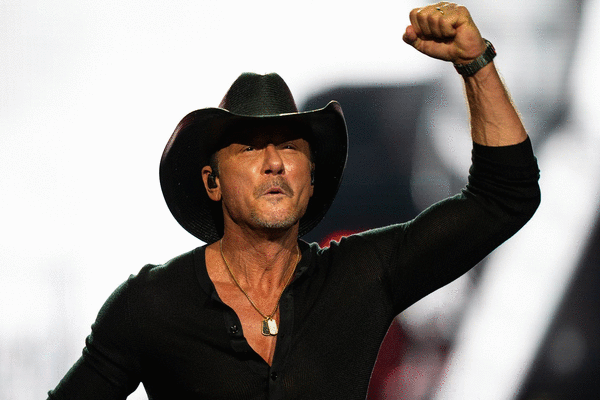
MINNEAPOLIS — Superstar Tim McGraw, the rare Democrat in country music, knows when and how to walk the line. He knows when to speak up and when to hold his tongue. He’s careful to live up to his hit “Humble and Kind.”
McGraw is not hesitant, though, to speak up about the Chicks, the once-huge yet controversial Texas trio, that will open for him Sunday at Target Field.
Formerly the Dixie Chicks, they were canceled in 2003 after criticizing the U.S. and President George W. Bush during a concert.
“I think it’s a travesty for country music,” McGraw said of the way the Chicks have been treated by the country industry and fans. “They were the best of the best and they still are. I support them 100%.”
Speaking from Nashville, Tennessee, on Tuesday, McGraw shared thoughts on his own controversial “Indian Outlaw,” Kenny Chesney and death.
Q: The country industry was quick to forgive Morgan Wallen, but the Chicks have been nearly permanently ostracized. Why?
A: It’s a crazy time in our country. I think social media has a lot to do with it.
To me, music is a sacred place. Music is a place where everybody should enjoy. It doesn’t matter about politics. It doesn’t matter about gender. It doesn’t matter about where you come from or what you do. It matters how good the music is and if it moves you and you enjoy it.
Q: You’ve met controversy with “Indian Outlaw,” your 1994 single that some thought didn’t reflect positively on Native Americans. Why couldn’t you bench it?
A: Because I’ve played so many Native American casinos and every time in the meet-and-greet, I meet the elders of the tribe I’m playing at. I always ask them: “It’s in my set. Would you like me to take it out?” I would say 99.9 % of the time they all laugh and say: “That’s the reason you’re here. We want to hear that song.”
For me, it’s a fun song, a happy song, it gets the crowd going. In my experience, everybody loves the song. I get what you’re saying and I acknowledge that.
Q: You are back on the road after four back surgeries and double knee replacements. How are you doing physically?
A: I’m 59 years old. So I’m not jumping off speakers and jumping into the crowd and all the things I used to do. It hasn’t slowed me down that much.
Q: You’ve been known as a workout fanatic. Have you changed your regimen after all those surgeries?
A: I don’t do three workouts a day like I used to do. Now I do one two-hour or three-hour workout. I’ve gotten smart enough and hurt enough to learn that I have to moderate. I lived my life like I was 20 for 30 years. It caught up with me.
I’m not going to step out [onstage] and not give 100%. If I get to a point where I can’t do that, I’m not going to be an artist who finishes out his career sitting on a stool playing music.
Q: Who is in better shape — you or your buff buddy Kenny Chesney? You’re both the same age.
A: I don’t know. Kenny’s in great shape. I think I have been more active onstage than Kenny, but Kenny is fantastic at what he does. We were friends before we had record deals. I couldn’t be more proud of him.
Q: People loved you in “Friday Night Lights” and “1883.” Anything acting-wise in the works?
A: There are two or three things in the works that I’m trying to figure out how to fit them in.
Q: Your dad, the great relief pitcher Tug McGraw didn’t make it to the Baseball Hall of Fame. You will be inducted into the Country Music Hall of Fame this fall. How does that feel?
A: I still don’t know that I’ve got my head wrapped around it. To make sense of it, it’s not an individual achievement. It’s a team effort. I’ve had mostly the same team around me for most of my career. Three guys in my band have been with me 33, 34 years. My management, my crew, all 20-plus, 30-plus years. It’s because of all those guys and my wife [country star Faith Hill] included.
Q: How much of the new album’s autobiographical title track “Pawn Shop Guitar” is true? Did you really sell your high school ring to buy a pawn shop guitar?
A: I would say the tactics are true but maybe the overall strategy isn’t true. The pawn shop guitar guy didn’t show up at a club one day. It’s me taking artistic privilege and writing a story. The impetus and the pearl of truth is there.
Q: When was the last time you put money in a busker’s case, as the song suggests?
A: Every time I walk by. My family knows it. Anywhere in the world. The last time was New York City, probably a month ago. Just walking by a guy playing a saxophone.
Q: Your “Song for America” seems to be a celebration and an olive branch?
A: That was my whole point. Nothing should be offensive about that song. It’s about the celebration of what my memories of America are. Everybody has different experiences.
Q: You are the same age your father was when he died. Do you, Mr. “Live Like You Were Dying,” think about that?
A: I think about it a lot. He found out when he was 58 that he had a glioblastoma brain tumor. Then 16, 18 months later he passed away. I wish he was around to see all of this. It stays in the back of your head. It scares you sometimes and sometimes it’s sort of the impetus to do better and treat yourself better.
©2026 The Minnesota Star Tribune. Visit startribune.com. Distributed by Tribune Content Agency, LLC









Comments