How did 'Drive find that higher gear? The director says it was thanks to 'Sixteen Candles'
Published in Entertainment News
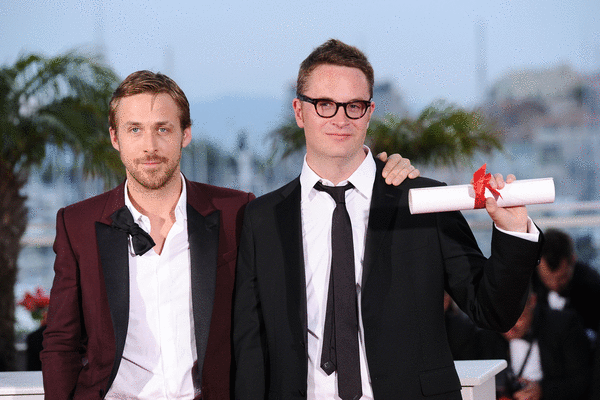
LOS ANGELES — Danish filmmaker Nicolas Winding Refn is willfully and delightfully unpredictable: part showman, part provocateur. His movies are moody and stylish, dashed with violence and a sense of spiritual grace that often wrongfoots audiences. His 2011 breakthrough, "Drive," starring Ryan Gosling, earned Refn the directing prize when it premiered that year at the Cannes Film Festival.
It captured the romantic appeal of cruising Los Angeles at night and became nothing less than an immediate local classic. Refn's first movie in America, "Drive" presents Gosling as a nameless young man who works as a mechanic and occasional stunt driver by day, criminal wheelman for hire by night. His quiet, structured existence is thrown into disarray when he befriends his vulnerable neighbor (Carey Mulligan) and her young son and soon their separate worlds collide.
Having spent the better part of the past decade making streaming series — "Too Old to Die Young" for Amazon and "Copenhagen Cowboy" for Netflix — Refn has once again returned to cinema. His newest film, the horror-fantasy hybrid "Her Private Hell," starring Sophie Thatcher and Charles Melton, opens this weekend.
In town to promote the movie, Refn will also be appearing on Friday night at American Cinematheque's Los Feliz Theatre for a 15th anniversary screening of "Drive." (The show is already sold out, but there will be a stand-by line.) Refn, 55, got on a video call this week while in L.A. to talk about the unlikely impact of "Drive" and some of its more unexpected influences.
Q: The movie was such a cultural phenomenon when it came out — the soundtrack was so popular, people wore the scorpion jacket . What do you think audiences were responding to?
A: I never look at reasons why. It was just a very magical combustion of many different things that all came together. And I was fortunate enough to have that experience. And I think that trying to reconstruct that experience almost takes away the mystery of it. It was such a collision of multiple layers that you cannot plan, you can't prepare. I was just incredibly lucky.
Q: "Drive" was much more romantic than any of your other movies. Did you set out at the time to make your version of a romance?
A: It's a teenage love story. There was a movie that made an enormous impact on me when I was fairly young in my very early teens, a film called "Sixteen Candles." I don't know if you remember it. But there was something about the innocence of falling in love that always stayed with me. And I guess "Drive" was my version of that innocence.
Q: When people talk about "Drive," they often reference tough-guy movies like "The Driver" or "Thief" or "Point Blank." But when you talk about "Drive," you talk about " Sixteen Candles" and "Pretty Woman." There's a tension there that's really exciting.
A: You always have to try to do something — not different, but creatively see what other palettes are inside of you. And obviously, I came off "Bronson" and "Valhalla Rising," which they're about the alter ego. So for me it was just an extension into "Drive." And there are certain expectations from what you make before to do it again, but not necessarily in that order. So I purely looked at "Drive" as my love story.
Q: You've spoken about how connected you and Ryan Gosling felt at that time. Where did that come from?
A: We were both naive idealists and we both had an enormous amount of emotions within us that we were trying to find places to unleash. So it was very easy for him to become my alter ego.
Q: You've said you want to make a third movie together. Do you have something specific in mind?
A: Well, it's something we always talk about whenever we connect. The act of "threes" is always an interesting odyssey because it kind of cements how you begin and what happens in the middle and then how you end. So we know that we have at least one more movie in us.
Q: The movie's vision of Los Angeles isn't typical: warehouses in the Valley, back alleys in downtown. You were pretty new to the city at that point. How did you find the L.A. of "Drive"?
A: I knew nothing really about L.A.. So when you're by nature a voyeur, which is what I am in many ways — I guess a pornographer in ways — when you come to a place and you see it from an outsider's perspective, you sometimes see the beauty in the mundane, beauty in the expected. And then when you put your eye on it, you can transform it, even though you've passed the same block a thousand times. What may be generic to you can be very exotic to me. And then that becomes exotic because it's how I see it.
When I came back to do "The Neon Demon," I moved from where I'd been living with "Drive" into another area of L.A. And then when I came back for my show "Too Old to Die Young," I moved into a third area. L.A. is my favorite place to work in because there are so many diverse opportunities and there's so much culture and interesting people and interesting performers. It's an iconography that lives in illusions. I really like working here.
Q: The success of "Drive" really set you up to have a more straightforward Hollywood career, but it seemed like you turned away from that. Why?
A: Because I didn't come from that. I prefer my freedom on all levels. What do I want to do? I find more pleasure in living my life like that. Doesn't mean that I've not had wonderful meetings and have worked at good places, but in a way, it was too limiting for me. I needed to be free as a bird and also to do other things.
Q: One of the things that really stands out watching "Drive" now is how quiet the movie is and how often we're just watching Ryan and Carey look at each other. You allow these pauses in between the lines of dialogue. That's something you've taken to even more of an extreme in "Her Private Hell." What is it you're exploring in those spaces?
A: How to provoke the soul is through stillness and silence. And so in "Drive," it was the purity of love. And that's just at that young age where you are so innocent, it's all just looking at each other and feeling each other's presence and falling in love without the complications of a relationship. So that was why the film needed that kind of language. It's almost boundless.
And from then on, it became almost like: Could I build a moving installation? Because that's what an experience is. It's visiting elements that can penetrate your soul and stay with you and inspire you or push buttons or make you angry or make you happy. So the notion of good or bad doesn't really exist in that world anymore.
Q: What do you think when someone approaches you now in a "Drive" scorpion jacket?
A: I think it's super cool.
©2026 Los Angeles Times. Visit latimes.com. Distributed by Tribune Content Agency, LLC.









Comments