Review: In 'Ride or Die' and 'Lucky,' women are on the run but also in on the action
Published in Entertainment News

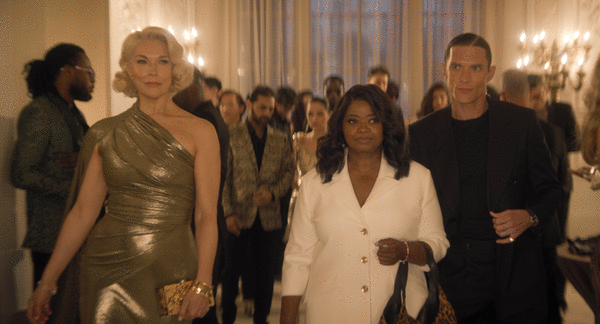

Two thrillers, unalike in style and attitude yet with much in common, arrived Wednesday to television.
"Ride or Die" on Prime Video stars Hannah Waddingham and Octavia Spencer in a gal-pal road-movie action comedy. "Lucky" on Apple TV features Anya Taylor-Joy as a con artist on the run. In each series, a large sum of money has disappeared, endangering those who know or supposedly know where it is. In each, the protagonist(s) will be sought by both police and gangsters yet will lose their own money and have to get along without any while on the run. A minor character will be tortured over a question they can't answer; an attacker will be dispatched with a sharp object driven into his ear. Someone will be drugged. Characters will question their path in life. There will be chase scenes, vehicular and pedestrian — but when aren't there?
Each does its particular similar thing very well.
In the eventful, rollicking "Ride or Die," created by Tessa Coates, Judith (Waddingham) and Debbie (Spencer) have been friends for more than two decades, in which time Judith has kept secret from Debbie the fact that her day job is not as a "forensic accountant," a meaningless term meant to stop people asking questions, but as an assassin, working for a well-established secret organization of highly trained killers.
"I'm not a murderer," Judith protests, when this finally comes out. "I'm an assassin. I kill bad people."
"For money," Deborah points out.
"Well, if I did it for free," Judith responds, "I'd be a serial killer."
The American wife of a British M.P., Debbie is guiding the political career of her noodle of a husband, David (Jamie Parker), whom she thinks, on no good evidence, might become prime minister. She writes his speeches, manages his appointments and butters up an important colleague with the gift of a ceramic pig. She has an eye for detail; later in the series, she will Sherlock Holmes a character based on his clothing. ("Six, seven months divorced; you found one good suit years ago and you wear it constantly because it shows the world you take yourself too seriously to care.")
A superimposed title in a Tyrolean font reading "Austria" at the start of the adventure signals that what follows will be no more serious than a Bond movie that doesn't star Daniel Craig and that its relation to reality might be a trifle fantastical. As indeed it is, with one crisis after another implausibly resolved but acceptable in context. (The chase on skis that opens the series tells us where we are, culturally.) Waddingham, for that matter, is a sort of fantastical creature herself, appearing from scene to scene on a sliding scale from glamorous to extremely glamorous. She is also an especially convincing action hero; you're happy when the fight scenes come along. But Debbie will inevitably come into her own in that respect — this isn't the first story in which the path to self-discovery runs through a field strewn with bodies.
Things get moving when Debbie and Judith find themselves at the same gala event, for separate professional reasons: David, who has just told Debbie he wants a divorce, is supposed to make a speech, and Judith is supposed to kill Billy (Ed Skrein), for reasons that escape me and don't mean all that much. By the end of the evening, David, or David's body, will have disappeared from a room full of dead Albanian mobsters, Billy won't be dead — he's nice, you'll be glad — and Judith and Debbie will be on the run from living Albanian mobsters. Their scenic travels will take them to Spain and Monaco, each location introduced with a typographically appropriate title card.
Aiding and abetting Judith are Sam (Calam Lynch), her nervous long-distance handler — she makes him so, with her ceaseless improvising and organizational rule-bending — and Queenie (Savannah Steyn), who, with her mother, runs an armory behind a cobbler's shop. Above them all is Bill Nighy's controlling Director, whom you are free to dislike even though it's Bill Nighy. We also get the latest in a line of hot crazy killers in the form of Ana (Sylvia Hoeks), and an open-minded Interpol agent named Jacques (Jacky Ido) — his introduction midway through the series gives it a boost.
It can be preposterous and complicated to a fault. The barely developed but welcome romantic subplots, of which there are three, are lighter than air; indeed you will recognize them before the characters do. Yet it's a straightforward narrative on the whole — all text, no subtext. You know who to root for. Even the non-thriller themes — female friendship, aging, ageism, admitting the truth about oneself to oneself and one's dearest, the invigorating effects of danger — are explicitly expressed.
Not in the least fanciful is "Lucky," created by Jonathan Tropper from Marissa Stapley's substantially different novel of the same name. As if not wanting to be mistaken for any sort of Good Time, the series presents itself in a desaturated palette, through what can feel at times like a scrim of dust. There are no jokes. It can be quite violent, but it's not off-putting — not for more than a couple minutes at a time, anyway — and even at seven episodes, the flow is so well arranged as to remain engaging.
When we meet them, Lucky (Taylor-Joy) and husband Cary (Drew Starkey) seem like just a couple of crazy kids in love, going mad in Las Vegas, like you do, but with a suitcase stuffed almost comically with cash back in the hotel room. The why and wherefore of this is helpfully specified by a news report detailing that more than $10 million remains unrecovered after "the FBI broke up a West Coast gas scam thought to have defrauded the government out of more than $200 million. How this young, seemingly unassuming couple came into possession of funds the FBI has been trying to track down for over two years is still unknown." You can forget everything but $10 million in cash, or "taxpayer dollars" as FBI agent Billie Rand (Aunjanue Ellis-Taylor), whose superior offers a Moby Dick metaphor for her obsessive pursuit of the case, insists on framing it.
But when Lucky wakes from a drugged sleep, Cary is gone and the money too, and police are pulling up outside. Most of the first episode gives us Lucky on the run, getting out of the hotel and out of Vegas, and across the tops of a field of big rigs. Taylor-Joy is an ethereal wisp of a thing — very much the somatic opposite of Waddingham — but she sells the action well.
In a flashback, young Lucky and her father, con man John (Timothy Olyphant) discuss the relativity of badness and, indeed, as in many crime dramas, there is a hierarchy of nastiness to demark the horribly bad people, who have no goodness, from the acceptably bad, who are mostly good. At the top sits the very unappealing Whittaker (William Fichtner); below him are Priscilla (Annette Bening), who is Cary's doting mother, and her right hand, Dutch (Clifton Collins Jr.); they are horrible people by any conventional yardstick but care about something besides money — about which they do care a lot. Below them is John, in prison regarding the aforementioned gas scam; a career con man, he skimmed that missing $10 million. As he is played by the most charming man in television, we are instinctively on his side — and Lucky loves him, even though he made her, still a child, an accomplice.
Indeed, if there's a theme to "Lucky," other than that crime might not pay, or that chase scenes are exciting, it's the problematic, potent relationship between parents and children — handled with surprising feeling given the circumstances. And we've all been there, with or without a bag of cash.
———
'RIDE OR DIE'
Rating: 16+
How to watch: Prime Video
———
'LUCKY'
Rating: TV-MA
How to watch: Apple TV
———
©2026 Los Angeles Times. Visit latimes.com. Distributed by Tribune Content Agency, LLC.









Comments