Neal Justin: 5 ways new 'Little House on the Prairie' differs from the '70s series
Published in Entertainment News
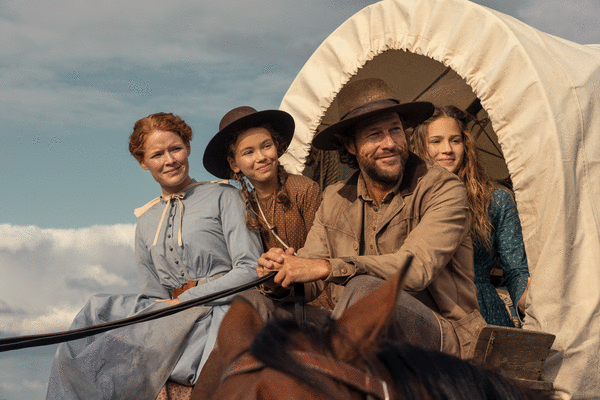
MINNEAPOLIS — Frontier life suddenly looks a lot more harrowing.
In the latest adaptation of “Little House on the Prairie,” now streaming on Netflix, creator Rebecca Sonnenshine lives up to her vow to be more faithful to Laura Ingalls Wilder’s books than the family-friendly ’70s/’80s series that often made a log cabin seem as inviting as a condo on “Melrose Place.”
But just because the eight new episodes are more accurate doesn’t mean they’re more entertaining.
Consider these five ways the new drama sets itself apart from its predecessor. You may end up wanting to skip the latest attempt and revisit the ol’ homestead on Prime Video instead.
Minnesota gets the shaft
In the two-hour pilot that premiered in 1974, the Ingalls family looked to start a new life in Independence, Kansas. But by the end, the government had kicked them off their land and they shuffled off to Minnesota, where they would reside for the drama’s entire run.
In the new version, they remain in Kansas the entire season. That squares with the setting for Wilder’s “Little House on the Prairie,” the third in her series of novels.
Sonnenshine confirmed in a press conference that the second season will take place entirely in Minnesota, just like it did in Wilder’s fourth installment, “On the Banks of Plum Creek.”
If the series extends beyond 2027, expect the Ingalls clan to end up in South Dakota. After all, five of the nine novels were set there.
“The Ingalls were always on the move,” Sonnenshine said. “So that is a very exciting element of our show.”
It’s not much fun
The older show had its fair share of plagues, storms and money woes. But there always seemed to be time for popcorn in bed and scampering down hills.
Michael Landon, the show’s head honcho both on and off the screen, was more interested in presenting a loving family than on re-creating hardships, making sure the characters possessed the same cockeyed optimism that got ”The Waltons" through the Depression.
“Wilder would have been horrified” by the original show, said Pamela Smith Hill, whose books about the late author include 2025’s “Too Good to Be Altogether Lost: Rediscovering Laura Ingalls Wilder’s Little House on the Prairie Books.” “I think the TV series was much more predictable and conservative than Wilder’s books. They were not all sunshine and rainbows. There was a deeper, darker side to those novels.“
The new series doesn’t shy away from rough stuff. When the family comes down with malaria, it’s as intense as an hour of “The Pitt.”
“I’ve seen entire families frozen to death out here,” says family doctor George Tann, played by Jocko Sims, one of several Black actors reflecting the diversity in Independence that didn’t exist in Walnut Grove. “Starve to death, get taken by fever, wolves, madness. It’s a myth that men can make it out here alone.”
Yikes.
It’s historically more accurate
In an early episode of the older series, Pa is seen reading “The Home Instructor,” a DIY classic that was published two decades after the show’s 1870s setting. But the biggest anachronism was ignoring the aftermath of the Civil War.
In the Netflix version, the Ingalls family and their friends are haunted by the battle’s emotional and physical scars. You also get a better sense of the importance of the railroad.
But not everything rings true. The new series takes liberties with Ma Ingalls’ character, especially when it comes to her opinion of Native Americans. In the books, there’s no indication that she ever overcame her racist attitudes. But in this adaptation, Ma, played by Crosby Fitzgerald, quickly becomes an advocate, standing up for her Osage neighbors with Jane Fonda-like spunk.
“When they come to the prairie, their minds are opened up,” Fitzgerald said during a press conference. “That is what the show is all about, getting to know people you haven’t known before and becoming part of a larger story of America.”
This ain’t the Brady Bunch
In the ’70s/’80s version, the Ingallses are angels. This time around, there’s quite a bit of bickering between Mary and Laura, a rivalry that also runs through the novels.
“They’re each other’s best friend and also each other’s worst enemy,” Sonneshine said. “That’s just what it means to have a sibling that you’re close to.”
Ma also lets her temper flare, something you didn’t see much of in the books or the last TV version.
“Make your own breakfast!” she snaps at her husband at one point.
Hill said the only moment from the books that shows Ma’s frustrations is during a scene in “Plum Creek” in which she learns the family will have to temporarily live in less-than-ideal dwellings.
“Oh, Charles,” she says. “A dugout.”
“The screenwriter has taken some liberties that are more relative to 20th century audiences,” Hill said.
Landon is missed
The biggest takeaway after rewatching the 1974-75 season is the high-caliber performances. Melissa Gilbert’s Laura is sweet without being cloying. Mr. Edwards (Victor French) and the Olesons provide vaudeville-inspired high jinks sorely missing in the Netflix version.
The standout is Landon. He may look like a grizzly, but he has the heart of a teddy bear.
Landon, who also directed and wrote key episodes, never got an Emmy nomination for his work on the show, one of the greatest oversights in TV history. But Landon, who died in 1991, still looms large. A new version of “Highway to Heaven,” his last family-friendly series, is in the works, too.
Let’s hope it holds up better than the new version of “Prairie” does.
———
(Neal Justin is The Minnesota Star Tribune pop culture critic.)
———
©2026 The Minnesota Star Tribune. Visit startribune.com. Distributed by Tribune Content Agency, LLC








Comments