Q&A: Kim Thayil on new memoir, final Soundgarden album, Chris Cornell and more
Published in Entertainment News
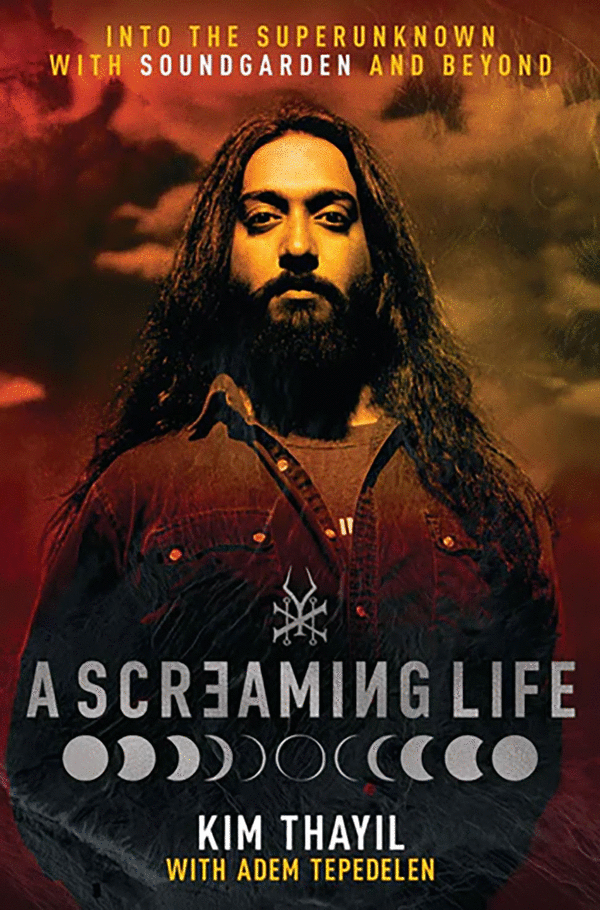



SEATTLE — For a forward-thinking guitarist best known for helping create a particularly Seattle strain of alternative rock that progressed the genre as a whole, recently, Kim Thayil has spent at least a portion of his time looking backward.
Seven months after his induction into the Rock & Roll Hall of Fame, the Soundgarden ax man published his memoir “A Screaming Life” this week, chronicling his journey as an Illinois child of Indian immigrants through the infancy of the history-making Seattle scene and its cultural explosion. A collaboration with journalist Adem Tepedelen — a Rocket magazine alum now based in British Columbia — the book gives readers a candid and revealing look at how one of the Pacific Northwest’s most important bands coalesced, unraveled and eventually found their way back together.
We caught up with Thayil to discuss the book, the band and the road ahead. This conversation has been edited for length and clarity.
Q: You write about the early Seattle scene and the mixture of “heavy rock” and punk confounding record labels, whereas it was viewed as “the way forward” in Seattle. What was it about the Seattle scene that was open to unifying and progressing those genres rather than keeping them siloed?
A: I think a lot of it had to do with our age. We were on the cusp of the baby boom and Gen X, and there were so many other transitions that were happening in popular culture at that time.
All of us kids grew up listening to the Beatles. As teenagers in the ’70s, most of the guys in the Seattle bands dug Aerosmith, and many of us liked Kiss and Black Sabbath. But as adults, as we’re coming into our own identity, we started learning instruments, we go off to college or whatever, and at the same time, we’re coming out of the ’70s. Punk rock is happening.
The fanzine and cassette trading network started happening as we’re becoming young adults with access to this new, developing part of social and popular culture. We’re participants in this now, so we’re bringing our childhood love of the Beatles, our teenage love of Aerosmith or Kiss, and now we’re sharing with each other our Minor Threat and Black Flag records.
Q: You mention Seattle having this distinct subcultural identity then. What do you think of the Seattle music scene today, or how it compares?
A: It’s a tough thing to constantly maintain, because there are a lot of little pocket cultures. It’s hard to keep track of. Seattle music culture now, from my experience when I talk to friends’ bands — and often now it’s friends’ kids — there’s such a distinction. And it seems, from my perspective, a little bit more Balkanized.
Perhaps you remember being young; one of the ways you identify yourself is in opposition to the world. “I am not what my boss tells me I should be. I am not what my parents’ culture wants me to be.”
Q: Is that like your experience with Soundgarden? I’m reminded of a quote from the book where you describe feeling like it was like Soundgarden against the world for a while.
A: Oh, yeah. Well, that was very much fraternal. One of the things that was described is four fingers clenched to comprise a fist, as opposed to these disparate parts. There is some strength in that solidarity and fraternity, especially when there’s pressure to conform to various cultural tenets — “This is how punk rock is supposed to be. This is how heavy metal is supposed to be.”
It’s like, “(Expletive) you.” If you guys need to define yourself tribally from some external criteria, go ahead. But we’re going to define ourselves by our own criteria.
Q: One thing I love about the book is how well you articulate and pinpoint how the band’s sound developed with your individual chemistry and as the songwriting evolved over years. Fast forward to making “Down on the Upside,” which sounded like a tough and less creatively fulfilling process for you. Did you sense this communal thing you all built and loved together was losing what made it special in the first place?
A: I think so. I think we wanted to have that kind of collaborative, fraternal love for Soundgarden collectively and each of us individually. (We were) failing at that for various reasons, perhaps immaturity. But communication was pretty poor.
There seemed to be a fatigue in constantly touring, working and promoting, and presenting the band in a way that showed a collective identity within this cultural context. People were probably grabbing ahold of their individual identities at that point leading up to “Down on the Upside” after the whirlwind of “Superunknown.”
I think people were focusing on their ideas, their needs, their wants. It may simply be that all four of us felt that our individual interests were not being addressed by being part of this bigger thing, and not just the bigger thing of the band — the Seattle movement, or grunge.
Q: You write about going to see Chris Cornell with Audioslave at the Paramount Theatre and feeling like Chris was “saying goodbye to Seattle. It was as if he was closing the book and moving on, and that hurt.” After he moved to Los Angeles, did you notice any changes in his personality or his outlook?
A: Well, we weren’t in direct contact regularly. It was infrequent at that point. We had so many mutual friends and colleagues, so we were always hearing about each other and what’s going on. I think there was just some changes in his life that became more prominent fixtures. His interests changed, as we do when we get older, and I think it took him somewhere else.
You develop other friendships and partnerships, both in music, business, romance. It wasn’t sad that he went toward something that made him happy — not at all. It was just sad that he was no longer including many of his friends or previous partners in that life.
©2026 The Seattle Times. Visit seattletimes.com. Distributed by Tribune Content Agency, LLC.










Comments