Appreciation: Guitar great James 'Blood' Ulmer, dead at 86, was a sonic trailblazer
Published in Entertainment News
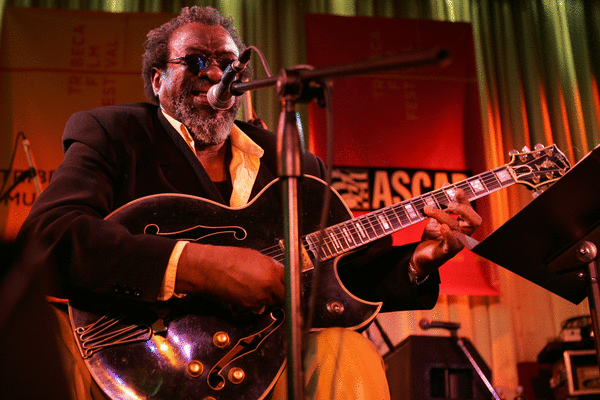
SAN DIEGO — Many up-and-coming musicians would be flattered to be hailed by both The New York Times and Rolling Stone as “the most original electric guitarist to emerge since the late Jimi Hendrix.” But not six-string innovator James “Blood” Ulmer, who died June 3 at the age of 86 in New York City and counted everyone from Ornette Coleman and Alison Krauss to the Roots, Ry Cooder and San Diego-bred alto sax great Arthur Blythe among his most notable collaborators.
“I don’t know why they made that (Hendrix) comparison,” Ulmer said in a 1985 San Diego Union interview.
“Maybe it’s the guitar, the attitude of playing the guitar, that we have in common. My concept for playing the guitar came from the alto saxophone, trumpet and keyboard. I always wanted to play something different from the way the guitar usually sounded. I wanted to figure out how to make just as much music with a guitar as with a piano.”
Ulmer succeeded, and then some, as his singular work as a guitarist, singer, band leader and songwriter handily attested. The fact that he eschewed guitar picks in favor of his thumb also made his playing stand out.
Emotionally and intellectually rewarding, Ulmer’s work was vibrant, visceral and infused with a musical logic that would have been confusing if attempted by less accomplished artists, but made perfect sense in his skilled hands.
As I wrote in my San Diego Union review of his 1985 performance here at The Spirit: “Like all great blues guitarists, Ulmer recognizes the value of economy and — even at its most frenetic — his music maintains a spacious quality in which the silences between notes are as important as the notes themselves. Alternately dissonant and lyrical, his stinging guitar work on songs like ‘Black Rock’ and ‘Jazz is the Teacher (Funk is the Preacher)’ fused harmonic sophistication with gut-wrenching emotional fervor.”
Ulmer brought those same qualities to his solo albums, most notably “Black Rock,” “Are You Glad To Be in America?” and “Odyssey,” and to the two outstanding albums he played on by San Diego-bred sax dynamo Blythe, 1979’s “Lenox Avenue Breakdown” — which opens with the ebullient, calypso-flavored “Down San Diego Way” — and 1980’s “Illusions.”
Alas, the same qualities that made Ulmer’s music so distinctive effectively limited his ability to reach a broader audience. This held true even when he made three consecutive albums in the 1980s for Columbia, then the world’s biggest record label.
“I’m not supposed to happen in that (commercially successful) way,” Ulmer said in his 1985 interview.
“It’s just not in my makeup, maybe because I started in an earlier time. I’ve already been in bands with people that have sold a lot of records, and I hope I don’t make the same mistakes as them, so that my music doesn’t become spaghetti.”
Ulmer had 30 solo albums to his credit and many more on albums by other artists. He earned a Grammy nomination for his audacious 2001 release, “Memphis Blood: The Sun Sessions," which teamed him with Living Colour guitar great Vernon Reid.
No cause of death has been cited yet for Ulmer, who retired from music in 2024 after performing his final concert at that year’s Detroit Jazz Festival.
“I don’t want to play something that only lasts for two months or a year,” he told me in the 1985 interview, which appears in full below. “And I don’t want it to last forever, either. Some people can get success without money, and I’ll never give up the hope that I can be one of them.”
James Ulmer wants more than guitar music from his guitar
George Varga, The San Diego Union-Tribune
May 10, 1985
James Blood Ulmer’s career provides sad yet irrefutable evidence that critical acclaim doesn’t always translate into commercial success.
Hailed several years ago by the New York Times as “the most original guitarist since Jimi Hendrix,” the 43-year-old musical visionary has earned justifiably lavish praise for his exceptional fusion of blues, jazz, rock, gospel and country.
His jagged, mercurial guitar style has been widely imitated by many of his peers and his most recent album for Columbia Records — 1983’s splendid “Odyssey” — topped numerous critics’ polls.
Unfortunately, the diversity and steadfast determination not to compromise that make Ulmer and his provocative music so special have effectively prevented him from earning the wide audience he deserves.
Now, after having released three highly rated albums for Columbia Records (and five more on small, independent labels), Ulmer is without a recording contract altogether.
Regardless, he remains largely undaunted.
“Everybody looks for overnight success, and some people get it,” says the pioneering singer-guitarist, who makes his San Diego concert debut tonight at 9 at the Spirit Club.
“As long as I can continue to play in clubs, and have a chance to be heard and make my audience grow, I’ll be happy. I think more people are starting to play music like mine — music that can’t be categorized.
“There have to be more people in America who don’t want to be like everyone else, and who understand that they have to constantly concentrate and be creative. I’m a patient man.”
Ulmer’s patience aside, he must surely be disappointed at the marked disparity between his critical and popular success.
Aside from Elvis Costello and Graham Parker, it is difficult to think of another contemporary artist with as much good press who has been unable to capture the general public’s fancy.
“I’m not supposed to happen in that (commercially successful) way,” insists Ulmer, while allowing that he would enjoy a larger following.
“It’s just not in my makeup, maybe because I started in an earlier time. I’ve already been in bands with people that have sold a lot of records, and I hope I don’t make the same mistakes as them, so that my music doesn’t become spaghetti.”
A stunning synthesis of different styles and approaches, Ulmer’s music is a blend of rural and urban American cultures that reflects his upbringing.
Born Feb. 8, 1940, in the small town of St. Matthews, South Carolina, he first performed in public at age 7 as a member of the Southern Sons, an adolescent gospel group managed by his father.
“My daddy says I was 4 when I picked up the guitar,” recalls Ulmer, chuckling.
“I don’t even remember what attracted me to it. I tried to quit when I was 13, but I never could. When did I decide I’d make music my career? When my family told me to get a job!
“I’ve played music all my life, and I have practiced and played a lot of hours by myself. So I’d like to play to more people than just me.”
Ulmer moved to Pittsburgh when he was 17, where he joined an R&B band called the Swing Kings. He later relocated to Ohio, where he joined a jazz combo, his first.
After a four-year stay in Detroit, during which he became heavily involved in that city’s burgeoning experimental jazz scene, Ulmer moved to New York City. Following a short stint as a member of Art Blakey’s famed Jazz Messengers, the guitarist recorded with such prominent jazz stars as organist Larry Young and saxophonist Joe Henderson. In 1972, he began a six-year association with iconoclastic saxophonist Ornette Coleman.
Coleman’s harmolodic theory — in which melody, harmony and rhythm are each treated as equal components to be performed simultaneously by each instrumentalist in a group — had a profound effect on Ulmer.
Using the harmolodic theory as a stepping stone to his own artistic path, the guitarist recorded his first solo album, the Coleman-produced “Tales of Captain Black,” in 1978.
“Coleman had the whole theory that made what I was doing work,” says Ulmer.
“You have to be a player of the guitar to understand the theory as it applies to my instrument and my work. Someone who doesn’t play guitar would never know what I was doing.”
At his best, what Ulmer does is produce powerful, often haunting music that is unmistakably his own. A combination of jazz sophistication, rock ‘n’ roll dynamics and the pure, earthy passion of blues and gospel, his wonderfully eclectic music is both challenging and rewarding; an exuberantly rhythmic amalgamation that is refreshingly unpretentious.
“I just want to make music that sounds different, and make it all danceable,” says Ulmer, who frequently performs in new music dance clubs.
“And if it’s danceable, it should be commercial enough. By that, I mean danceable at any level, not just one level. I just think my music is the blues, and the blues has been popular all the time.”
When Ulmer first began attracting the attention of rock critics five years ago, many hailed his guitar work as a modern-day counterpart to the sonic innovations established by Jimi Hendrix more than a decade earlier.
Ulmer views this well-intentioned, if somewhat misguided, praise with a mixture of pride, amusement and confusion.
“I don’t know why they made that comparison,” he says.
“Maybe it’s the guitar, the attitude of playing the guitar, that we have in common. My concept for playing the guitar came from the alto saxophone, trumpet and keyboard.
“I always wanted to play something different from the way the guitar usually sounded. I wanted to figure out how to make just as much music with a guitar as with a piano.”
As to the future, Ulmer is adamant that he and his colleagues — drummer Grant Calvin Weston and bassist Amin Ali — will continue to pursue the same bold musical style that confounds mainstream pop fans and delights critics.
“I don’t want to play something that only lasts for two months or a year,” he says. “And I don’t want it to last forever, either. Some people can get success without money, and I’ll never give up the hope that I can be one of them.
“When people remember me a hundred years from now, I hope they’ll think I’m living in paradise.”
©2026 The San Diego Union-Tribune. Visit sandiegouniontribune.com. Distributed by Tribune Content Agency, LLC.











Comments