'60 Minutes' in turmoil as talent revolts under Bari Weiss and new executive producer
Published in Entertainment News
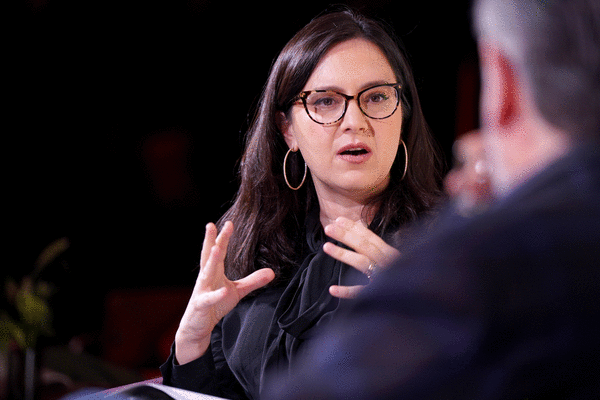
In recent months, the iconic ticking stopwatch of the CBS News magazine "60 Minutes" began to sound like a time bomb.
The explosive detonated Tuesday as the prestigious program's most high-profile correspondent, Scott Pelley, was fired after openly challenging the moves and motives of the news division's leadership and questioning the credentials of new "60 Minutes" executive producer Nick Bilton.
Pelley accused CBS News Editor in Chief Bari Weiss of "murdering" the program and berated Bilton, a former New York Times journalist, for lacking TV news experience. His forced exit along with the departure of several other veterans is raising fears about the future of the most-watched TV news program that has managed to retain its vitality and importance in the face of major changes across the media landscape.
Weiss praised Pelley's contribution to the network when she discussed his termination at the network's morning editorial meeting Wednesday, but cited a loss of "trust and mutual respect" as the reason for moving on.
"We cannot do our work without it," Weiss said. "That foundation was broken on Monday, and despite our attempts to engage with Scott Pelley and to find a way back, unfortunately we weren't able to do so, and so we had to part ways."
But industry veterans familiar with "60 Minutes" said the firings represented a notable shift in how the venerable program has been run by its predecessors.
Rome Hartman, a former longtime "60 Minutes" producer, said Wednesday in an interview that the termination of Pelley for forcefully expressing his views at a staff meeting is a fundamental misunderstanding of how the program has operated and thrived over 58 years. Spirited, and occasionally acrimonious, internal debate has always been a part of working at "60 Minutes."
"Sharp words in defense of important ideas, whether they be in stories, or whether they be about the future of the broadcast, shouldn't just be tolerated, they should be encouraged and inculcated, and they always have," Hartman said.
The insularity of the "60 Minutes" operation — which has its own suite of offices across the street from the main headquarters of CBS News — has rankled the network's executives in the past. But those dynamics were considered part of the price of having the most prestigious news program on television.
"Every single CBS News president in the history of CBS News has resented the independence of '60 Minutes,'" Hartman said. "But the smart ones have come to understand that that independence is part of the secret sauce. I don't know Bari Weiss, but she seems incredibly thin-skinned."
The turmoil inside "60 Minutes" comes at an inopportune time for CBS. Weiss is now under the gun to replenish the program's staff with three months to go before original episodes return to the prime-time schedule.
Pelley is the fourth correspondent to depart "60 Minutes" since Weiss took over as editor in chief. Last week, Weiss fired correspondents Sharyn Alfonsi — who accused Weiss of playing politics by holding a story on the government's use of El Salvador prisons for undocumented migrants — and Cecilia Vega, who was also outspoken in her criticism of the changes at "60 Minutes," saying she faced censorship. Anderson Cooper, the CNN anchor who spent nearly 20 years as a contributor to the program, chose not to sign a new contract.
Weiss also fired executive producer Tanya Simon, who has been with the program for 25 years, and her second in command. (Pelley said he was unable to get answers on the firings during his final meeting Tuesday with Weiss and CBS News President Tom Cibrowski.)
And there could be more departures on the way, adding to the upheaval. Bill Whitaker, who joined the program in 2014 and was a Pelley ally, is said to be weighing whether to walk away from the two years left on his current contract. The program's respected veteran , Lesley Stahl, is pondering her future as well amid the massive changes, according to people familiar with her thinking who were not authorized to speak publicly.
The call is out for new talent, according to one agent who said CBS News is talking to "dozens of people" for the openings.
But the company will also look within its ranks. Matt Guttman, hired away from ABC News by Weiss to become senior national correspondent, is one name being mentioned, along with Major Garrett, the network's chief Washington correspondent. Both have emerged as favorites of Weiss.
Norah O'Donnell, already a contributor to the program, is also likely to have a larger presence.
While the "60 Minutes" patina has been tarnished by the recent events, there is no shortage of journalists who would be willing to step up and join the program. But whoever does sign on will be intensely scrutinized while the Nielsen numbers are closely watched.
Newcomers on the program are rare and would have an easier time gaining audience acceptance if they were joining a stable operation.
Although every long-running TV program can use an occasional refresh, a massive overhaul is destabilizing for "60 Minutes," one of the last non-sports appointment programs for the traditional television audience that still provides broadcast networks with the bulk of their advertising revenue.
Notably, the program averaged 9.1 million viewers during the 2025-26 TV season according to Nielsen, up 9% over the previous year.
"Viewers liked the '60 Minutes' that they had," said a former CBS News executive who worked on the program who was not authorized to speak publicly. "And if they don't like it, they have many other places to go."
One of Weiss' mantras — echoed by Bilton — has been the need to pull "60 Minutes" into the digital future as traditional TV viewing declines. Insiders say she has yet to make clear how that will be achieved.
Under Weiss' watch, clips and full segments of the program gained significant traction on platforms such as YouTube. The success on digital is an encouraging sign for the program's ability to attract younger viewers who don't watch traditional talent.
But veteran TV executives say that loyal "60 Minutes" viewers still expect to see seasoned correspondents delivering in-depth investigations and analysis. A diversion from that formula poses substantial risks.
"Its audience has certain expectations," said Jim Murphy, a former executive producer for CNN and CBS News. "These guys built a literally nearly perfect program for the medium and for the audience. You're not going to make it better just because somebody cooler does a story that's, like, a little funkier. It just not going to work."
Steve Capus, a veteran network producer who worked with Pelley at the "CBS Evening News," said his former colleague was built for the meticulous work that goes into every "60 Minutes" segment.
"It's hard to do week in and week out," Capus said. "You have to be first-rate in your storytelling."
What's more, Weiss and Bilton will also have to fight the perception that their moves on the program have been guided by the desire of David Ellison, chief executive of CBS News parent Paramount, to please the Trump administration as he seeks regulatory approval of his deal to acquire Warner Bros. Discovery.
Trump sued "60 Minutes" over the editing of an interview with his 2024 presidential opponent, former Vice President Kamala Harris. The suit was settled just ahead of the Federal Communications Commission clearing the way for the takeover of Paramount by David Ellison's Skydance Media.
Ellison acquired Weiss' digital startup, the Free Press, which established itself as a voice critical of so-called woke politics.
Pelley said in a statement Tuesday that there has been pressure to shape CBS News coverage to please the Trump White House, a claim that both Vega and Alfonsi have made.
"I've been told to include assertions that are unverified," he said. "To date, in every case, I have ignored these instructions or refuse them."
In a statement, a representative of "60 Minutes" said that the exchanges with Pelley regarding editorial content were not out of the ordinary.
"There is no political interference at CBS News, not from ownership, not from Bari Weiss," the representative said. "The only 'interference' is the normal back and forth between editor and correspondent that happens in every newsroom."
©2026 Los Angeles Times. Visit latimes.com. Distributed by Tribune Content Agency, LLC.








Comments