'Power Ballad' review: Rudd, Jonas hit bum note in music comedy
Published in Entertainment News
John Carney is cinema's most soulful student of rock.
Through his movies — "Once" is his masterpiece, but also "Sing Street," "Begin Again" and "Flora and Son" — he focuses on characters who find themselves through song, and who are driven by the need and will to make music. He sees the world through the lens of pop hits.
His latest movie, "Power Ballad," hits a bit of a bum note. It's about Rick Power, played by Paul Rudd, whose eternal youth is finally starting to give way to some wrinkles of wisdom. He's the lead singer of an Irish wedding band, and there's no mention of whether Power is his stage name or his given name, but you get the picture; it's the former. (He's also playing an American, so there's no goofy attempts at Rudd doing an Irish accent.)
His band, the Bride and Groove — billed as "Ireland's grooviest wedding band" — is there to cover the hits; "we're not rock stars, we're human jukeboxes" is how one band member puts it. But Rick does dabble in songwriting, even though he long ago gave up his dreams of being a rock star when responsibility came calling in the form of his wife and his daughter. The tinges of regret over What Might Have Been for him tremble just beneath his and the movie's surface.
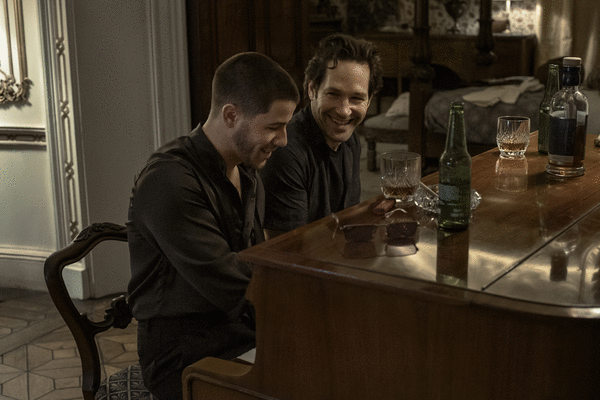
At a fancy wedding shindig one night, Rick shares the stage with Danny Wilson (Nick Jonas), a former boy bander on the verge of being officially washed up. They hit it off on stage and jam together later that night in Danny's guest quarters.
What transpires is the best scene in the movie, following two people lifted by collaboration, bonded through booze and creativity, freely sharing notes on each other's songs. It's the kind of scene and interaction Carney excels at, letting his characters live through music and the pure joy of song.
During that freewheeling jam session, Rick shares a piece of a song he wrote, "How to Write a Song (Without You)," and thinks nothing of it. But months later, Rick discovers Danny lifted his song without permission and has turned it into a worldwide smash, ushering in his comeback.
Rick has no documented proof the song is actually his, and his efforts to reach Danny and his management to claim ownership of the song are thwarted. So he slowly begins to unravel, and the movie does too, as it loses its connection with the characters that was so rich early on.
Rick feels he's owed millions in compensation, and he's also been robbed of the credit of crafting a hit song, the validation from which is worth even more to him than the money.
Danny is torn: He's instructed by his manager Mac (Jack Reynor, a Carney regular, thinly sketched here) to ignore Rick and to keep his head down, as any hint that he stole his comeback song could derail his return to the spotlight, and thereby Mac's piece of the action. Telling the truth would cost millions and would spoil every car on the gravy train.
"Power Ballad" is about the intersection of creativity and capitalism, and who gets to own inspiration. Rick wrote the song, but Danny brought it to life. So who gets to lay claim to what?
But there's not a lot of drama in songwriting credits, and Carney loses his way with the story as it turns into sitcom silliness. Rick and his loyal bandmate Sandy (Peter McDonald) decide to board a plane to Los Angeles to confront Danny in a scene which keeps finding new ways to fall away from the believability he built up in his characters early on. It's like an ill-advised drum solo in the middle of a concert, and it sucks the energy out of the room.
And the characterization of Danny — he's not a villain, but he's also not a hero — exposes either the limits of Jonas' talents or the underdeveloped nature of the character, or possibly both. But by the end we don't know enough about his internal motivations to feel one way or another about him.
At least the song is good. "How to Write a Song (Without You)," is a solid earworm, maybe not the worldwide chart topper we're told it becomes, but strong enough that you don't mind the dozen-odd times you hear it in the movie. You might even leave the movie with it rattling around in your head.
But "Power Ballad" doesn't have the same staying power as its lead single. It's a quick pass at a pop song, but not one of Carney's greatest hits. Consider it a B-side, only for the superfans.
———
'POWER BALLAD'
Grade: C
MPA rating: R (for language throughout and some drug use)
Running time: 1:38
How to watch: In wide theatrical release June 5
———
©2026 The Detroit News. Visit detroitnews.com. Distributed by Tribune Content Agency, LLC.







Comments