Review: 'The Bear's' final season: Cloudy with a chance of cornballs
Published in Entertainment News
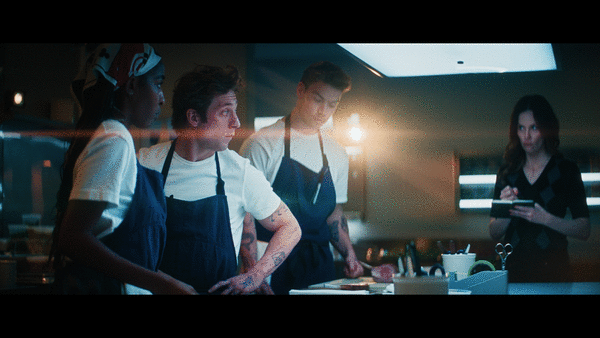
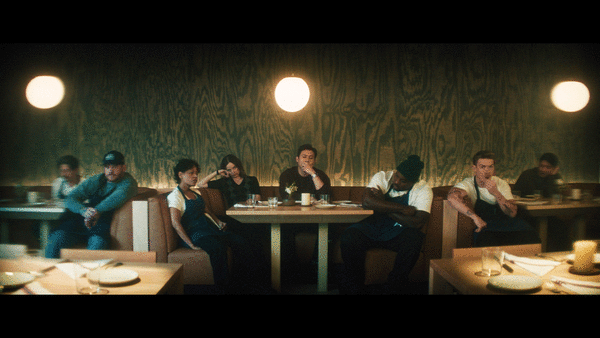
The final season of “The Bear” transpires over just a single day, when Chicago is doused with rain. Thunder and showers are the first sound we hear as the FX logo appears onscreen. It’s a constant, biblical deluge — and chaos reigns. Well, what do you expect? It’s “The Bear,” where Murphy’s Law functions as the au jus accompanying an Italian beef sandwich. Why have one without the other?
Season 5 — with all eight episodes released Thursday night on Hulu — picks up the morning after Carmy’s decision to quit. The day begins with Cousin Richie getting T-boned by a minivan, and it only gets worse from there. The reservation app is down. The walk-in refrigerator is bare. Pipes burst, the restaurant floods and the handyman Fak brothers are no help. Neither is the restaurant’s benefactor Uncle Jimmy, who has no more money to spare and is looking for a way out.
Despite it all, service begins at 5:30 p.m. Rain or shine. Hell or high water.
All signs point to the restaurant’s permanent closure — if not tomorrow, then some day in the near future. But tonight, it’s do-or-die. The clock is ticking, again, and their resources and equilibrium have dwindled, again. By now, the stakes are familiar: Snatching victory, or at least their own workplace survival, from the jaws of defeat.
But we’ve already been here before. Many times over, in fact. The show closes out its five-season run stuck in a narrative rut.
It’s the TV equivalent of “this meeting could have been an email,” absent anything meaningfully deeper to say about ambition or the interpersonal dynamics that shape this ragtag crew. For whatever reason, “The Bear” has been consistently unwilling to push its narrative beyond “Can we make it work tonight?” The sky outside may suggest ominous portents, but the bad news bears are undaunted, as if living out their own version of 1937’s “Babes in Arms”: Hey kids, let’s put on a show. Call it: Cloudy with a chance of cornballs.
You might argue that none of this matters. These characters are worth spending time with, regardless, and I would agree — to a point. Sometimes a good hang is enough. I don’t know if that’s enough this time out. Too often, the emotions don’t land, or they feel unearned. The show was so sure-footed in its initial outing, but has ultimately tumbled headlong into a grease trap of its own making, aiming for pungent but landing on precious.
This is now Sydney’s kitchen, with Richie handling front of the house. And yet Carmy shows up for work as if he hadn’t thrown in the towel the night before. Maybe he’s giving two weeks’ notice? Tina is quietly hoping for a miracle while mourning the best job she ever had. In the back office, Natalie laments the time she’s sunk into the restaurant at the expense of being with her baby. If the place goes belly up, was it all a waste? Newly minted win expert Sweeps sees the writing on the wall and is already looking for a new job.
To top it off, those busted pipes have left everyone’s uniforms drenched and unwearable, necessitating the return of their old typo-riddled merch: T-shirts that say “The Original Berf of Chicagoland.”
And the rain still comes.
Over its five seasons, “The Bear” has rarely strayed from its primary physical location. The restaurant is the Berzatto family legacy — or albatross, depending on how you look at it — and the building has always been a metaphor for the relationships within, held together by spit and duct tape, always threatening to cave in or spring a leak.
And what of those relationships? It’s hard to remember the chemistry between Carmy and Sydney was once strong enough that some viewers saw a romance in the making. I’m glad that wasn’t the endgame. But show creator Christopher Storer has steered so far from that — shaped by Carmy’s pain-in-ass default and Sydney’s socially awkward hesitancy — that even after all the drama they’ve weathered together, they lack an easy rapport until finally reconnecting with one another late in the finale.
Instead, Storer has been more interested in Richie’s efforts to take stock in middle age and redirect his energies: The jagoff finally grows up. It’s legitimately fruitful stuff and it wins me over every time. Unlike Carmy and Sydney, he’s no longer masking his feelings behind maladaptive coping mechanisms, which is why he remains the soul of “The Bear,” as well as its most effective comedic relief.
Everything is collapsing around them, but Richie has a plan. “And to demonstrate, this right here is a visual representation of a path to success,” he says, holding up a jumbled chart outlining his plan. When Carmy — self-involved to the end — stares into the void and asks, “Do you think I’m doing the wrong thing leaving?,” Richie is unmoved: “I got problems of my own, I don’t think about you 24 hours a day.” But he eventually tells him a necessary truth: “Doing something where you have to think about other people, other things — that would be good for you.”
They will improvise and problem-solve and make it through this night intact. That is a given, even if the financial realities, as laid out by the show, don’t make sense. They’ve never made sense, despite being so essential to the storytelling structure.
“The Bear” may be shot and written as realism, but it often traffics in fantasy, and that holds true for its final moments. Everyone has gathered in the gauzy, honeyed afternoon light of the restaurant’s dining room, exchanging warm smiles as if they were actors in a commercial for a life insurance company, where the tagline asks: Don’t you want to leave your loved ones in good hands?
For a show that came out of the gate defined by its shouty, beef juice-stained unruliness, it ends on a coda that has more in common with a mother gently stroking a child’s forehead. All is well.
Endings are hard and you can’t fault Storer for wanting to send his fictional family off with a sense of hope and optimism. We could use more of that right now. And to its credit, “The Bear” isn’t afraid of sentiment. It always took its characters seriously — some more than others — but the show, at least at its outset, was smart enough not to take itself seriously. It lost that balance somewhere along the way. There are worse directions to take. But maybe the show would have benefited from its own advice: To break patterns, we have to break patterns.
———
'THE BEAR' SEASON 5
Rating: TV-MA
How to watch: Hulu
———
©2026 Chicago Tribune. Visit at chicagotribune.com. Distributed by Tribune Content Agency, LLC.










Comments