Why Dogstar's comeback is still comeback-ing
Published in Entertainment News
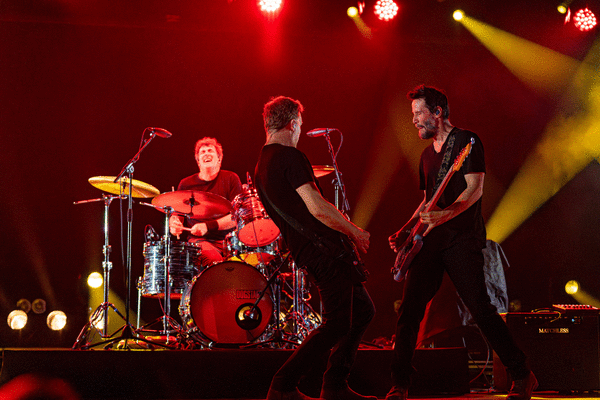
The members of Dogstar were trying to manage expectations.
Their expectations.
Almost exactly three years ago, this Los Angeles-based alt-rock trio ventured up to Napa’s annual BottleRock festival to play its first public gig in more than two decades. Dogstar had built a small but devoted audience in the post-grunge 1990s before splitting up in 2002, not long after the band’s movie-star bassist, Keanu Reeves, red-pilled himself into sci-fi history as Neo in “The Matrix.” Now the group was reconnecting on a bill that also featured Post Malone and the Red Hot Chili Peppers.
“Ten minutes before we go on, I look out and it’s empty,” singer-guitarist Bret Domrose recalls. “Massive green lawn. I’m like, This sucks, but I get it — we’re this band no one’s heard from in a while. So I go back with the guys and we do our little huddle.” He laughs. “Then we come out, and it’s f—ing packed.”
“And people stuck around — they didn’t leave,” adds drummer Robert Mailhouse. “That show really set us off on our journey.”
Indeed, Dogstar’s return — which spawned a 2023 reunion album, “Somewhere Between the Power Lines and Palm Trees,” and a world tour of nearly 100 dates — went well enough that the comeback has continued: Last week, the band released a second phase-two LP, “All In Now,” and it’s set to spend the summer on the road in Europe and the United States. Before Dogstar heads overseas, the trio will perform Tuesday night at the Grammy Museum in downtown L.A.
“I can only speak for myself, but I think we all feel this way: This is way more fun now than it’s ever been,” Domrose says as Reeves and Mailhouse nod in agreement. The three are gathered over beers on a recent afternoon at Pasadena’s Sid the Cat Auditorium; after our chat, they’re due to rehearse, which these days leads often enough to the beginning of a new song, they say.
Reckons Mailhouse: “We’re in a groove.”
Dogstar still plays like the sturdy power trio it became in the era of Nirvana and Silverchair. But “All In Now” upgrades the band’s songwriting; the music looks back to the moody yet tuneful post-punk of English bands like Joy Division and the Smiths. “And Section 25,” Mailhouse adds, dropping a more obscure name from the scene that developed around Manchester’s influential Factory Records.
Many of the LP’s songs are built on Reeves’ melodic bass lines — a musical signature that led Domrose to nickname the actor Chordal Reeves “because he plays so many chords on the bass,” Domrose says.
“That’s actually how we started when I met Keanu,” Mailhouse says. “At first there was no guitar player — it was just him on bass and me on drums.”
“We didn’t even know any guitar players,” says Reeves, by far the band’s quietest member despite (or perhaps because of) his years in the Hollywood spotlight.
Who do these guys regard as music’s greatest melodic bass player?
Mailhouse offers Paul McCartney, while Reeves points to Peter Hook of Joy Division and New Order. “One of my favorites is Arion from Third Eye Blind,” Domrose says. “That first record was undeniable. I didn’t want to like it because that ‘ Doot-doot-doot…,’” he sings, mimicking the hook of Third Eye Blind’s once-inescapable “Semi-Charmed Life.”
“Are you kidding me?” Reeves shoots back. “That’s a great pop song.”
Lyrically, “All In Now” tends toward the dreamily impressionistic, though one song, “What Is,” paints a pretty clear — and clearly disapproving — portrait of President Trump.
“It’s about someone who’s living in their own world and doesn’t see how it’s affecting the rest of the world,” Domrose says. “An egomaniac, basically.” Why did he want to write about such a character?
“I didn’t want to — I hate politics,” the singer replies. “But I was angry when I saw that Zelensky meeting in the White House. I was surprised how angry I was. Well, not surprised — I have a soul. But the notion of all those people dying, and that’s his take?” (One line in the song goes, “Just one man holds all the cards.”) “Power and money should never be able to wield that kind of effect,” Domrose goes on. “But they do. That’s where that song came from.”
Dogstar made “All In Now” at L.A.’s venerable EastWest Studios with the producer Nick Launay, who’s known for his work with the likes of Nick Cave and the Yeah Yeah Yeahs. Launay forbade Mailhouse to use a click track and pushed the band to record live as much as possible; Domrose remembers telling the producer he was ready to go back and overdub his final guitar parts only to have Launay tell him, “What do you mean? You’ve already done them.”
For Reeves, recording in an old-school L.A. studio — even as technology has made it easy to do it cheaply at home — was worth the considerable expense. “You get being together, you get the mixing board, you get the loud headphones, you get your producer there looking at you — listening to you,” he says. “It’s not carved up in sections — you’re sharing an experience.”
You’re also getting history, Domrose points out. “I was like, Tom Petty stood right here,” the singer says. “I better make everyone proud — including the ghosts.”
The result, Mailhouse says, is his favorite of Dogstar’s four albums. Speaking of which: Why aren’t the band’s first two LPs available on streaming?
Domrose says that after decades of various corporate mergers — “so many absorptions of labels into labels,” as he puts it — the band and its management can’t figure out who owns the rights to 1996’s “Our Little Visionary” and 2000’s “Happy Ending.”
“It’s like a who-built-the-pyramids mystery,” he adds.
Yet with these new songs out in the world, the three musicians don’t seem particularly bummed not to have their old ones in ready circulation.
“I think the break we took was long enough that it’s almost like we’re a new band now,” Domrose says. “Kind of feels like this is the first time for Dogstar.”
--------
©2026 Los Angeles Times. Visit at latimes.com. Distributed by Tribune Content Agency, LLC.








Comments