Movie review: Fashion and politics get a radical makeover in the riotous 'I Love Boosters'
Published in Entertainment News
If Charlie Chaplin were alive — and blitzed out of his mustachioed gourd — his favorite filmmaker would be Boots Riley. The two auteurs share a flair for spinning societal critique into maniacal physical comedy. In "Modern Times," the Little Tramp slithered through a factory's giant gears. In Riley's "I Love Boosters," a fashion tycoon named Christie Smith (Demi Moore) lives in a luxury skyscraper with floors slanted at an imposing 45-degree angle that only she has the ability to walk. Her visiting employees stumble, flail and skid.
"I Love Boosters" is a maximalist delight with practical sight gags including a menacing Indiana Jones-style boulder of unpaid bills, car chases done with unabashed miniatures, actors who disappear mid-pursuit like human Whack-A-Mole and a horde of stop-motion baddies that would make Ray Harryhausen leap to his feet and applaud.
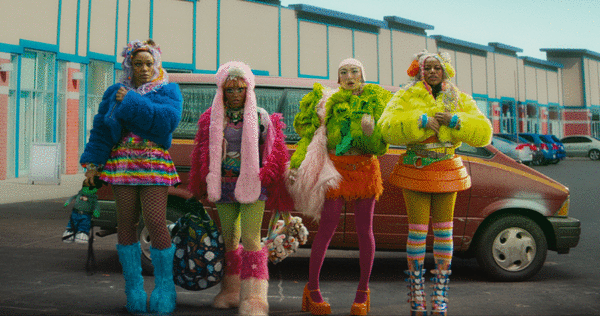
The story pits Moore's egotistical, tyrannical Christie against a pack of small-time shoplifters, Corvette (Keke Palmer), Sade (Naomi Ackie) and Mariah (Taylour Paige), a.k.a. the Velvet Gang. Scheming Corvette is Palmer's newest marvelously louche heroine. Lately, she's making a feast of roles that all remind me of that old sitcom episode in which Lucille Ball gobbles chocolates on a conveyor belt. A designer, Corvette once aspired to create her own clothing line but couldn't get her spike-heeled foot in the door. For now, she peddles stolen outfits to sleazy men and grateful women while squatting in a shuttered fast-food joint where her wall art is a vestigial menu of fried chicken.
Christie calls the Velvet Gang "lazy." But staying afloat is a full-time hustle, especially when bedazzled Corvette, headstrong Sade and dippy Mariah don't always agree on their squad goals. Corvette gets distracted by a mysterious French model played by LaKeith Stanfield, smoldering like Rudolph Valentino. (When Corvette stares at him thirstily, Natasha Braier's cinematography goes all shimmery-wobbly like he's a living mirage.) Meanwhile, Sade is taken in by a huckster named Dr. Jack (Don Cheadle) who hawks a pyramid scheme called Friends Being Friends, a pretense of community. Paige's Mariah is airhead-ish comic relief and fabulous at it.
Not so long ago, well-meaning film folk convinced rising directors that the best way to get their ideas across was to make something personal and vérité, derailing a generation of talent into the muck of samey coming-of-age movies that audiences didn't really want to see. Going to indie festivals in that era felt like being lost in a gray fog. But Riley's debut, the 2018 semi-sci-fi satire "Sorry to Bother You," was a rare bright light. (In short: a telemarketer discovers his boss' boss is turning workers into horses.) An Oakland-based musician and activist, Riley was confident enough in his identity that he couldn't be knocked off course.
"Boosters" is agit-prop that prioritizes entertaining the crowd. It roils with observations about teamwork, inequality and success, but presents as a spangled, stoner-comedy extravaganza with the moxie to give a Monty Python-esque raspberry to realism. Workers crouch on starting blocks to sprint for a snack during their 30-second lunch break; characters switch actors in the middle of a take, pretending that the swap is merely a disguise. Even within a scene, mayhem stacks up like teetering plates. At a Dr. Jack seminar held in a furniture store, Cheadle's unrecognizable cameo competes with kids jumping on a couch and a spasmodic massage chair pummeling Corvette's face.
Excess is the key word. "Boosters" is impossible to fully absorb. Yet I liked those distracting kids — I liked the life and the mess — and I like watching a director go full-gusto as he builds his universe. All the funny details gesture toward Riley's main idea: O ur modern times feel anxious and isolating.
The film doesn't have to take a swipe at AI; the handmade craft is its own rebuke. So much human work has gone into every bit of mischief that the crew's effort makes the audience put in more effort, too, to figure out why each shot was worth the time it took to accomplish. Minor moments have major intentionality. When one chase scene halts as the stop-motion pursuers squabble about their battle cry, the evident labor in the aside elbows us to run with the idea that movements sabotage themselves.
The plot also includes an invention called the Situational Accelerator. I barely understood it — to me, it functioned like a random madness machine. But gauging by the name, I suspect Riley zapped it on his own script. So, too, did all of his department heads on their own fiefdoms and the oddball band Tune-Yards on the score, a cacophony of circus oompahs, mouth harps and kazoos.
Riley is criticizing the global economy but setting this caper in the fashion world keeps the style interesting. The Velvet Gang's aesthetic changes every sequence: preppy plaids, florals, raver neons and a swollen pink jumpsuit that makes Corvette look like a hyper-feminine Gumby. Even when tasked to outfit the girls in monotone uniforms, the costume designer Shirley Kurata adds individuality with textures of sheers, cutouts and pleats. Kurata also did the ensembles for the Oscar-nominated "Everything Everywhere All at Once" with its wardrobe of googly eyes and Elvis jumpsuits. Believe it or not, she's topped herself.
Beyond looks, getting dressed is a daily expression of who we are and how we want to appear. (Even not caring about getting dressed is a choice — rewatch the original "The Devil Wears Prada" for that speech.) At the same time, our clothes also tell a financial saga that gets more complicated every year, especially as we become more aware of shipping routes, import taxes and the retail and environmental fallout from disposable fast fashion. Dressing head-to-toe in ethical clothing can feel as impossible as a stuck zipper, especially now that legacy manufacturers like Eddie Bauer and Champion have sold their brand names to a shoddier conglomerate.
The film prefers bold vibes to economic lectures, but Riley figures we'll be conversant enough in corporatese to understand what's really going on when one of Christy's store managers (Will Poulter) patronizingly orders his underpaid employees to redefine money as merely "meaningful units of light." One of those employees, played by Eiza González, will make a one-scene farce of delivering a dissertation on Karl Marx while vaping. Her use of "dialectics" gave me a vicarious headache. Point taken: Action has more impact than words. (In keeping with the film's raccoon-in-a-trash-can spirit, González's character seems to steal her style from real-life goth beauty influencer Gabbriette.)
Trying to weave together an impossible number of threads means some moments stick out sloppily, like a character's reveal of a magically healed wound we never knew they had. It's also apparent toward the end — when "Boosters" seems to run out of either money or time — that the camera framing gets uncomfortably tight.
A second big speech toward the end will almost certainly get groans that are as much our fault as his. No one likes being told that building a better society takes work. If we did, we'd probably be actually doing it. But Riley has put in so much work of his own wowing us with pointed pranks that he's earned the right to deliver an earnest plea. "Boosters" isn't perfect and that doesn't matter. The audacity of it — the exuberance Riley puts into making and loving movies — is what I want to see more of from every filmmaker, fashionista and human being still grinding at their own creative ambitions.
©2026 Los Angeles Times. Visit at latimes.com. Distributed by Tribune Content Agency, LLC.








Comments