William Pullinsi, the founder of Candlelight and inventor of dinner theater, dies at 86
Published in Entertainment News
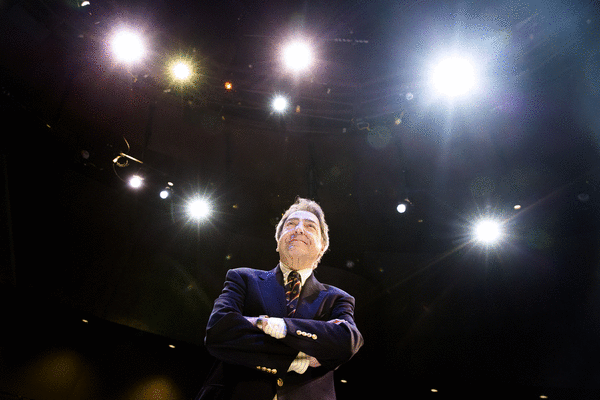
CHICAGO — William Pullinsi, the founding artistic director of the Candlelight Dinner Playhouse in southwest suburban Summit and widely regarded as the founder of dinner theater in America, died on May 17 at home in Dyer, Indiana, from natural causes. He was 86.
His death was announced by his longtime partner at Candlelight, Tony D’Angelo. “We worked together for 70 years,” D’Angelo said. “Everybody who worked for him, he considered family.”
Writer and actor Jim Jacobs has said he wrote the musical “Grease” in Candlelight’s green room while appearing as an actor in one of Pullinsi’s shows — he directed more than 400 over his decades-long career, most of them in the Chicago area.
Pullinsi was born in Sept. 1939 and raised in Summit. Along with directing, he was known for launching and nurturing talent — an incomplete roster includes the likes of Mandy Patinkin, Joe Mantegna, Shelley Long, John C. Reilly, Hollis Resnik, Mike Nussbaum, Paula Scrofano and John Reeger.
Pullinsi and D’Angelo, who had studied together at Catholic University of America, first opened a Candlelight Theatre in Washington, D.C., in 1959 when they were barely done with college. “We offered people dinner and a show for $3.95,” said D’Angelo, “located three blocks from the White House.”
The youthful duo replicated the idea in Chicago in 1961, moving what they called “The Original Dinner Playhouse” to Summit and spending the rest of their lives in the area. Unpretentious and affordably glamorous, Candlelight, first located at 5508 S. Archer Ave. not far from Midway Airport, became a multi-generational fixture in the lives of many in Chicagoland, having been built on land that had been owned by Pullinsi’s grandfather.
Pullinsi’s mother, June Pullinsi, would direct there in the early years.
The success enabled Pullinsi to move in 1964 to a new location at 5620 S. Harlem Ave., a theater with 550 seats, turning him into a serious theatrical producer. The Forum Theatre was added to that location in 1973, allowing Pullinsi to do edgier fare, sans table service.
At the Candlelight, waiters would serve cocktails, appetizers and entrees (prime rib and chicken breast being fixtures on the comforting menu) prior to the show as patrons sat at tables surrounding a small theater-in-the-round that Pullinsi would stack with actors, accompanied by a live orchestra. Dessert typically would be served at intermission. Thanks to D’Angelo’s background as an electrical engineer (his designs were credited simply to D’Angelo), the theater was amply equipped with stage hydraulics, scenery on wagons and lighting equipment in the mezzanine, unusual at the time. Alas, the theater went bust in 1997 after 36 years of operation after a bank called in a loan. At the time of the closing, which came as a shock to many of its fans, the prime rib still was in the coolers.
The theater has since been demolished, except in the memories of its staffers and audience members.
Also a longtime resident of Evanston, Pullinsi attended St. Joseph School and Benet Academy. He later pursued graduate studies at the Goodman School of Drama and also received an honorary doctorate in humanities from Lewis University.
Later in his career, Pullinsi served as artistic director of the now-defunct Theatre at the Center in Munster, Indiana, where he directed numerous musicals and comedies and insisted on a professional Equity company at the venue. Upon his retirement in 2015, the Tribune named him its Chicagoan of the Year in Theater, a nod to Pullinsi’s many contributions to the American art form. His former staffers remain very aware of his influence. (Other dinner theaters that largely copied the Candlelight operation included Burt Reynolds’ Dinner Theater in Jupiter, Florida, founded in 1979.)
“I feel like I will always want to work for Bill Pullinsi,” said Eileen LeCario, now vice president of Broadway in Chicago.
Publicist Noreen Heron, who began her career at Candlelight and now owns her own public relations and marketing office, said that “Bill gave everyone we know their start.”
Aside from long runs of such shows as “Fiddler on the Roof,” “Man of La Mancha” and “Little Shop of Horrors” at the Candlelight, Pullinsi also directed a notable show based on former Tribune columnist Mike Royko’s book on Mayor Daley, “Boss,” as the inaugural production at the Forum Theatre. He also helped reignite national interest in Stephen Sondheim’s “Follies.”
The Forum also ran the late John Powers’ play “Do Black Patent Leather Shoes Really Reflect Up?” for a remarkable four and a half years. Many more of his productions transferred far beyond Chicago.
Pullinsi is survived by his son, Jamie Pullinsi, and his former wife, Ami Silvestre. Funeral services are pending.
-------------
©2026 Chicago Tribune. Visit at chicagotribune.com. Distributed by Tribune Content Agency, LLC.







Comments