Commentary: Netflix's 'Should I Marry a Murderer?' shouldn't be shocking
Published in Entertainment News
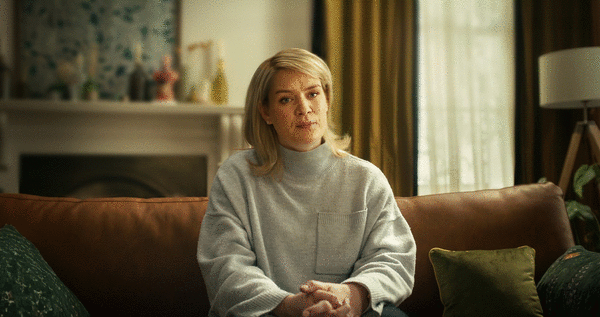
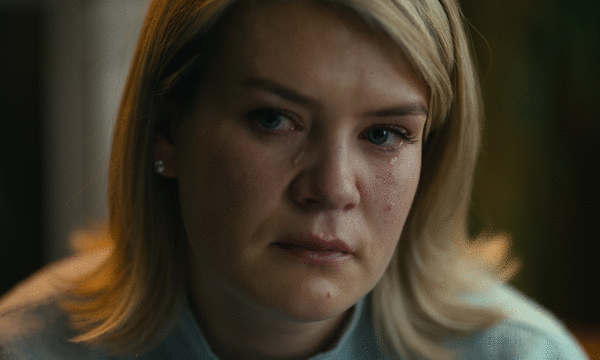
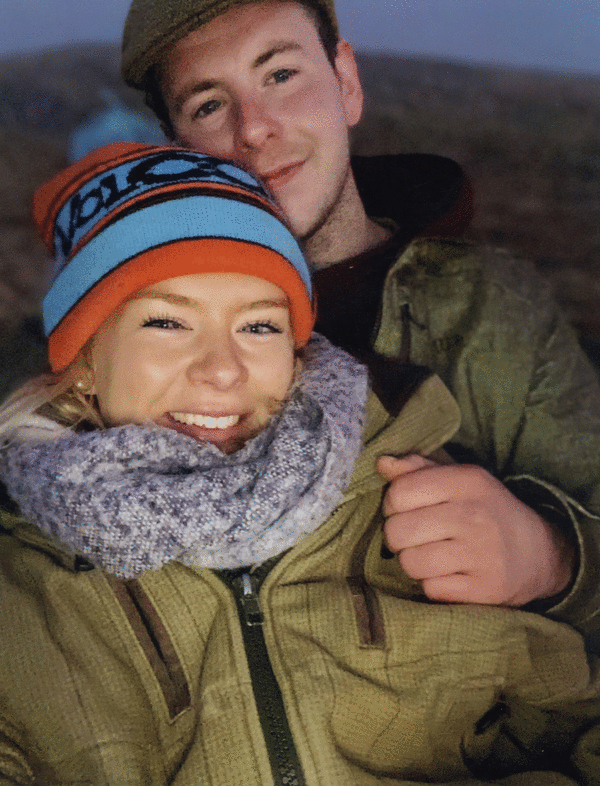



In the new Netflix documentary series "Should I Marry a Murderer?," Caroline Muirhead, a Scottish forensic pathologist, falls in love with Sandy McKellar, a man who, after proposing, reveals to her that he and his brother have committed a homicide. What follows is baffling: Even after Muirhead turns him in to the police, she returns to his side. She’s spent her career reading evidence of violence; if anyone should have been repelled by her fiancé’s brutality, it was she.
Yet she still goes back, with disastrous consequences. In my practice, I have repeatedly witnessed sensible people who, in the thrall of strong attachments, seem to throw their judgment to the wind. But there will be many watching the documentary who don’t have the same frame of reference and will be tempted to dismiss Muirhead’s decision as an outlier.
If that’s your main takeaway, you’ll miss an opportunity to see how this psychological dynamic plays out in people’s daily lives. This kind of behavior is not confined to romance. Our legal, financial and business systems were built on an unexamined assumption: A competent person of sound judgment will be so regardless of personal feelings. It’s why people stubbornly invest emotionally and financially in bad business relationships, or follow charismatic gurus or political leaders, even when the evidence shows it’s harming them.
Decades of research, however, have shown that becoming attached to someone else is not just about feeling affection — platonic or romantic. The act actually restructures the perceptual system we use to evaluate the other, often blinding us to risks. That’s not because intimacy makes us dumber. It’s because attachment is designed for bonding, not for rational assessment.
To understand why, it helps to look more closely at what attachment is. In the 1950s, John Bowlby, a psychiatrist, and Mary Ainsworth, a psychologist, began framing the drive to stay close to certain people in our lives as a biological imperative — a matter of survival encoded in our genes. Neuroimaging research has shown that the brain processes the potential loss of an attachment figure through the same neural pathways as a physical threat. We are not wired to experience the breaking of such a bond as rational or even beneficial, but as a crisis to resolve.
That is why we so often see people of sound judgment ignoring obvious red flags, believing their situation is “different,” or even transforming odious character traits into admirable ones. Intelligence provides no insulation from this neurological process; in fact the more intelligent the person, the more convincing the narrative they may construct to fool themselves. Listening to Muirhead gush about McKellar — a rugged hunter and gamekeeper — called to mind common rationalizations I’ve heard over the years: “Maybe it isn’t so bad,” “You don’t really understand them,” “It has to be true.”
Was it any different for the board of Theranos, men of legendary perspicacity, who fell for Elizabeth Holmes’ mirage? Or the institutional investors who wanted to believe that Bernie Madoff could do the impossible? What about the movie stars who give up everything to join a sex cult? Have these people suddenly lost all reason, or been blinded by greed or ambition? Often, it’s idealism, not greed, that leads them astray.
Being attached is not a personality flaw; it is what makes us capable of love, loyalty, and relationships that matter. But as "Should I Marry a Murderer?" portrays, it can also lead us down a confusing, disorienting path that challenges the very reality we live in.
Muirhead kept her wits about her for a long time. She voluntarily gathered evidence for the police at enormous personal cost, maintaining an undercover role for months. But when her mental health rapidly declined in the process, the system didn’t treat her as a person in crisis. Despite having a unit devoted to vulnerable witnesses, the authorities never referred her. After all, they reasoned in the documentary, she was a smart, highly trained medical doctor — she could handle whatever came her way.
But she couldn’t. No one seemed to account for the impossible choice of loving someone and being asked to destroy them at the same time. And when systems designed around the assumption of rational, clear-eyed judgment encounter the reality of attachment, people like Muirhead get punished rather than supported.
Being in the thrall of an attachment bond doesn’t absolve one of wrongdoing. Whether it’s Caroline Muirhead or anyone else, poor choices should have consequences. But being dismissive or thinking “I would never fall for that” is its own delusion.
———
This column reflects the personal views of the author and does not necessarily reflect the opinion of the editorial board or Bloomberg LP and its owners.
Sarah Gundle, PsyD is a psychologist in private practice and an assistant clinical professor at the Icahn School of Medicine, Mount Sinai Medical Center.
©2026 Bloomberg L.P. Visit bloomberg.com/opinion. Distributed by Tribune Content Agency, LLC.








Comments