What it's like at Paisley Park a decade after the death of its founder
Published in Entertainment News
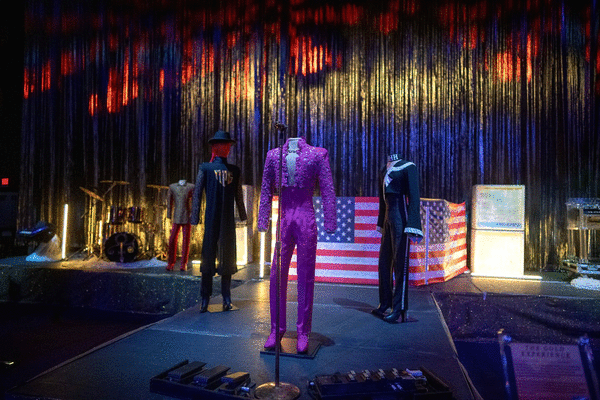
MINNEAPOLIS — With his phone locked in a security pouch, as Prince always wanted it, Kevin Stephenson kept having to ask the Morris Day question: What time is it? The CenterPoint Energy businessman was in danger of missing his 6 p.m. flight back to Houston but was too awed by the “Purple Rain” Hellcat guitar and other memorabilia to care.
“I’ve been saying for years, ‘I gotta do this tour,’ and now I’m finally here,” Stephenson said, as he entered the third hour on the Ultimate Tour at Paisley Park one Friday afternoon in March.
To the folks now running Prince’s studio-turned-museum in Chanhassen, Stephenson’s flight-risk story is proof they didn’t miss the boat.
Ten years after Prince died on site while living at Paisley Park, fans from around the world still are traveling to the Twin Cities suburb (previously most famous for Chanhassen Dinner Theatres) to visit the 65,000-square-foot facility. It has unequivocally become the mecca for Prince fans worldwide.
Tours are still offered five days a week, typically a dozen or more per day. Staff said the rather royally priced tickets, $75-$200, regularly sell out.
Celebrities including Bruno Mars, Shania Twain, Katy Perry, Green Day’s Billie Joe Armstrong and members of One Direction have gone on the tour in its first decade. From what we saw on two recent visits last month, Paisley Park’s everyday visitors are still going crazy for the opportunity.
“I honestly thought the tour might be a little boring, but it was outstanding,” raved Terence Boga, who came from Los Angeles. “Coming here you really feel like it’s part of his legacy, and you’re helping to keep it alive.”
Many locals, however, have become blasé about Paisley Park. Some die-hard hometown Prince fans have been frustrated that more new exhibits and events don’t take place there beyond the annual Celebration around Prince’s June 7 birthday (coming up again June 3-7).
“God forbid anything having to do with Prince is spontaneous,” one local fan wrote with slicing irony on Facebook after an impromptu appearance by longtime Prince collaborator Sheila E. was stymied in 2024 at Paisley Park, where the musician mined spontaneity like gold.
A new regime of museum operators — many not yet born when Paisley Park opened in 1987 — is working to open up the place more to the public while also doing the careful archival work integral to all museums.
A memorial event dubbed A Day 2 Remember has been organized to mark the 10th anniversary of Prince’s death on April 21, with a daytime vigil inside the museum and a nighttime tour and concert movie screening.
A sign of the changing, youth-leaning times: Attendees to that event and all of this year’s tours will be able to unlock their phones to snap selfies in at least two sections of Paisley Park, the soundstage area (which now houses rotating museum displays) and the smaller NPG Music Club room (where a concessions counter has been added).
Working under the direction of Prince Legacy LLC — co-managed by Prince’s longtime attorney Londell McMillan, representing half of the family estate — the current roster of about 30 mostly full-time Paisley Park employees is also working to bring in more corporate events and private parties there. Those efforts help pay for the day-to-day upkeep at the aging facility.
“We’ll do everything from team-building workshops to family reunions here,” said Jada LaFrance, an administrator who started working there in 2024 and now oversees the private bookings.
Archiving history his way
On staff since 2018, Paisley Park museum collections manager Makayla Elder stressed the exhaustive — and expensive — archival work that goes on at Paisley Park chronicling and safekeeping Prince’s personal items, from music gear to clothes.
It’s no secret: The little dude had a massive wardrobe.
“At first, everyone here was just trying to find and figure out what all the assets were in the building,” Elder said. “Now that we have a great handle on everything, we have a team going through and identifying, ‘Oh, this wardrobe is in this photo from this era,’ and doing that kind of internal cataloging.”
Both are “excited to be representing the Gen Z wave of Prince fans,” LaFrance said, as she and Elder sat for interviews during a quieter day without tours at Paisley Park in March to talk about the daily operations.
To show off some of her daily work, Elder brought out a couple of the thousands of solid, foam-lined boxes now stored on-site used for chronicling and safekeeping his personal items. She opened one box with gold and bronze jewelry in it and another with gold lamé shoes inside (high-heeled, of course), all worn by the late lord of the manor.
“Soon every shoe will have a custom mount and a custom box,” Elder said, citing 1,200 shoes in the collection. “It’s a full-time job.”
Even as they work to open up Paisley Park more, the current housekeepers are still tasked with maintaining a discernible level of secrecy about the place that Prince himself designed.
Requests to access some of the archival rooms or offices not seen on tours were denied, as were appeals to interview other staff members besides the two designated representatives. Exact visitation numbers and demographics are under lock and key, not even accessible to the state’s tourism office, Explore Minnesota.
Certain questions still go unanswered, too, including: What happened to the elevator Prince died in? (Its entrance just off the main atrium was walled off.) Were his never-publicly-seen private living quarters at the studio complex left intact? (They now deny he even had any kind of apartment space there.) And is there still a secret vault crammed with decades’ worth of recorded music yet to be unearthed? (Most of that has been removed for safer keeping, they confirm.)
“We all share the goal of honoring Prince’s legacy here, and we don’t do anything he wouldn’t be happy with,” Elder said.
LaFrance pointed out, as do the guides on the public tours, “Prince himself wanted to turn this place into a museum.”
Rebirth of Prince’s cool
Built to the tune of about $10 million in 1986 following the worldwide success of the 1984 “Purple Rain” movie, album and tour, Paisley Park was first invented to be an all-in-one production facility where all facets of his career could be overseen: recording, filming, rehearsals and wardrobe.
The reincarnation of Paisley Park as a tourist-attracting museum did not seem like a rock-solid an idea at first. Chanhassen certainly doesn’t jump to mind as a must-visit city, even among Minnesotans. The studio’s 1980s architecture — which, aside from some Princely flourishes — can be mistaken for an average office building and doesn’t exactly inspire awe.
To help relaunch Paisley Park as a museum, the Prince estate initially brought in outside help from another late rock icon’s team: Graceland Holdings LLC, which runs Elvis Presley’s home museum and hotel complex in Memphis. It ran the place for its first three years.
Graceland’s team got the tours going and Celebration events launched. Other efforts to expand the museum’s offerings, though — even including converting the separate oval-shaped building on the property into a small hotel — largely went unfulfilled.
The Prince estate took over in 2019. None of Prince’s former associates, including former drummer and longtime associate Kirk Johnson, work there anymore. The only staffer still left from when Prince was alive is a security guard.
Slowly but surely, changes have occurred. Here are the biggest differences visitors will notice at Paisley Park from when it first reopened as a museum in October 2016:
—The ceramic urn shaped like Paisley Park that holds Prince’s ashes is no longer on display in the atrium. Museum representatives said the urn cast too big a pall over tours. It is still on-site, they said, but would not say where.
—A permanent gift shop was built into the side entrance near the parking lot and is accessible on all tour days, with or without a tour ticket.
—Shuttered side rooms off the atrium (such as the former guitar-tech room) now house museum exhibits, including the café-like kitchen area where Prince purportedly liked to hang out. The kitchen’s TV now permanently shows the Minnesota Lynx’s final 2015 championship game, which Prince attended. Other rooms are based on specific albums and tours. Current exhibits there include rooms on the “Lovesexy” and “Diamonds and Pearls” eras.
—There’s also a new side room off the atrium with a video and displays on his childhood and early career in Minneapolis leading up to the construction of Paisley Park. Per the video’s narrator, “Prince chose to return to Minneapolis to lay the foundation for the rest of his career.”
—The large soundstage where Prince often performed — and where scenes for movies such as “Grumpy Old Men” were filmed — now features more museum displays, including some pianos, a “Purple Rain” motorcycle patrons can sit on and two of Prince’s personal cars.
His 1965 gold Buick Electra 225 was added to the soundstage in 2025, matching a temporary exhibit on “The Gold Experience” album for its 30th anniversary.
One area that hasn’t changed: Prince’s office down the hall from the atrium. It has been kept as-is for tourgoers to see, with photos of Paisley Park alum’s kids on display, including “Blackish” TV star Yara Shahidi (whose father, Afshin Shahidi, was Prince’s personal photographer).
The vinyl LPs Prince bought at the Electric Fetus on Record Store Day a week before his death are still kept in a pile on the office table. A reissue of “Cookin’ with the Miles Davis Quintet” is on top.
Paisley Park’s three main studio rooms were also left mostly untouched for tourgoers, who get to listen to different song mixes in some or all of the rooms depending on which tour they purchase. A new addition to the priciest Ultimate Tour, attendees get to hold a Gretsch Hollow Body guitar Prince played in one of the studios, where white gloves are handed out upon entry.
“Pretty much everything you see today is as it was when Prince was still here,” said tour guide Baibi Vegners, who’s also a local jazz singer.
New exhibits are being put together in time for June’s Celebration to mark the 30th anniversaries of the “Emancipation” and “Chaos and Disorder” albums and the 20th year of “3121.” Performers at the event (announced last week) will include the Time’s frontman Day, Chaka Khan, Miguel and members of Prince’s bands the Revolution and NPG.
Even while keeping a tight lid on access, Paisley Park’s current keepers cited the upcoming Celebration as an example of the good intentions — and good vibes — they believe are prevalent at the museum as it marks the 10th anniversary of Prince’s death.
“Celebration really feels like a ‘celebration’ now,” Elder said, “and I think it’s a good representation of the spirit and legacy he wanted to keep here. It always humbles the staff and reminds us why we’re here.”
©2026 The Minnesota Star Tribune. Visit startribune.com. Distributed by Tribune Content Agency, LLC










Comments