Movie review: 'Michael' an uncanny yet shallow portrayal of King of Pop's rise
Published in Entertainment News
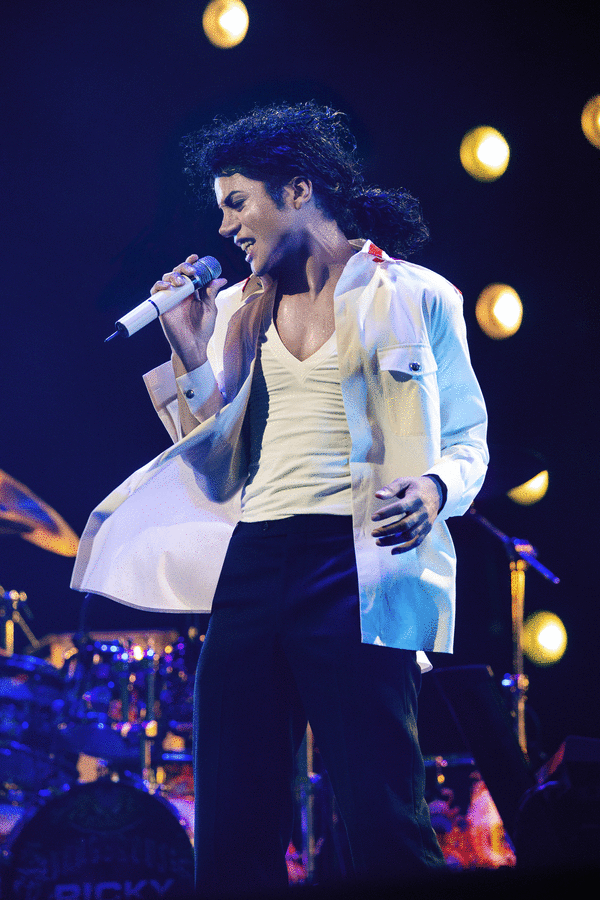


There are many uncanny things in “Michael,” the Michael Jackson biopic directed by Antoine Fuqua, that literally made my jaw drop. For example, Miles Teller’s eyebrows, inexplicably tinted and placed. He plays John Branca, the bulldog entertainment lawyer Michael Jackson hires to fire his abusive father/manager. Then there’s the computer-generated menagerie that Michael keeps on his family’s Encino compound, Hayvenhurst, including Bubbles the chimp, a giraffe and a llama in whom he often confides.
But by far the most uncanny, jaw-dropping element of “Michael” is the startling central performance, delivered by Jackson clan scion Jaafar Jackson, the son of Jermaine Jackson, who portrays his uncle Michael in the film. The producers (members of the Jackson family and inner circle) are extremely lucky to have Jaafar, who bears those Jackson looks, and conjures a physical embodiment of the King of Pop that is eerily, almost mathematically correct. He nails every pop, point, slide and moonwalk; the voice, the gestures and set of his mouth: a grimace of effort on stage, a tight smile off, a genuine toothy grin for the cameras. Genetics might be on Jaafar Jackson’s side, but there’s also tremendous amount of hard work that has gone into this performance, which is technically perfect if a bit emotionally shallow.
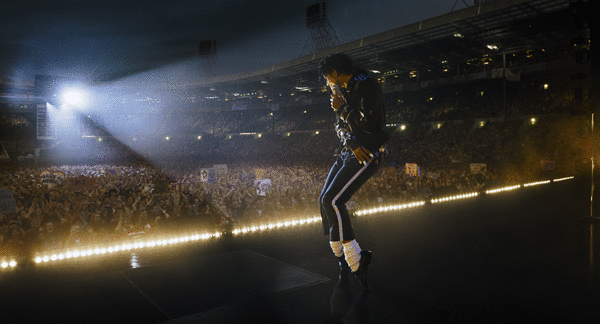
That sums up the whole “Michael” endeavor, a film that begins and ends in 1988 with a triumphant Wembley performance of “Bad” and leaves the audience with the hilariously vague parting words “his story continues” — the understatement of the year. Perhaps the Jackson family were hoping that the film would attract new fans to Michael’s undeniably amazing music, and that they wouldn’t go digging any further, simply enjoying the story of a quirky genius who emerges from a traumatic, abusive upbringing as a child star to write, record and perform some of the greatest songs of all time, up until 1988.
John Logan’s script doesn’t just skirt the biggest, ugliest parts of Michael Jackson’s story, it almost rewrites history in its selectiveness. Whole siblings are left out (Janet and Randy), and ending when it does, the film avoids the main events of Jackson’s tabloid-scrutinized life, from his marriage to Lisa Marie Presley, unconventional family planning, untimely death, and of course, the elephant in the room, the horrifying sexual abuse allegations detailed in the docuseries “Leaving Neverland.” “His story continues” — well, it certainly did.
The film also doesn’t give us much about the rest of the Jacksons, even though they’re onscreen plenty. Then again, the film is titled “Michael,” not “Michael, Tito, Jermaine and Marlon.” The only other character who shares Michael’s story equally is patriarch Joe, played with simmering menace by an always excellent Colman Domingo. With a narrative confined to the early years, the film focuses on Michael getting out from under the thumb of his controlling, abusive father in order to live his own life and make his own music. As soon as Michael attains a modicum of power, he dispatches white men like Branca and various record executives to fight his battles with his father for him.
“Michael” presents Michael as a lonely oddball genius unfortunately stuck in arrested development thanks to his childhood forced to rehearse and perform as the frontman of the Jackson 5 (the incredibly talented Juliano Valdi plays young Michael). As an adult, he is childlike but brilliant, and Logan emphasizes his altruism, couching Michael’s desire to be around children as charitable (without addressing the more sinister side of this). A voracious media consumer, we watch as Michael synthesizes James Brown and Charlie Chaplin and Vincent Price and current events with his musical talent to create the most indelible songs of the 20th century.
Fuqua’s focus is on the music, with songwriting, video production and choreography scenes, and full-length live performances tackled with staggering precision by Jaafar Jackson, who also sensitively delivers Michael’s repressed anguish in confrontational scenes with his father. These are fun to experience in a theater, especially since it has felt so icky to listen to Jackson’s music since “Leaving Neverland.”
But there’s the rub. Because when the credits roll with producer credits for the entire Jackson clan, Michael’s kids and his associates, you start to think about the motives. When the estate is involved, a musical biopic is usually about the money: the record sales, charts, streaming, merchandise, etc. The film is an opportunity to celebrate a great — if troubled — artist, but it’s also the chance to launder Michael Jackson’s catalog, to make it suitable for polite consumption once again. And they do it with one of their own, the Jackson family still a closed circuit, exploiting Michael’s talent years after his death.
The music is great. Jaafar Jackson is a star. But the movie itself is uncomfortably problematic in a way that’s hard to overlook.
———
‘MICHAEL’
2 stars (out of 4)
MPA rating: PG-13 (for some thematic material, language, and smoking)
Running time: 2:07
How to watch: In theaters April 24
———
©2026 Tribune Content Agency, LLC










Comments