In 'Jungle Red!' Illeana Douglas explores the stories behind 'The Women'
Published in Books News
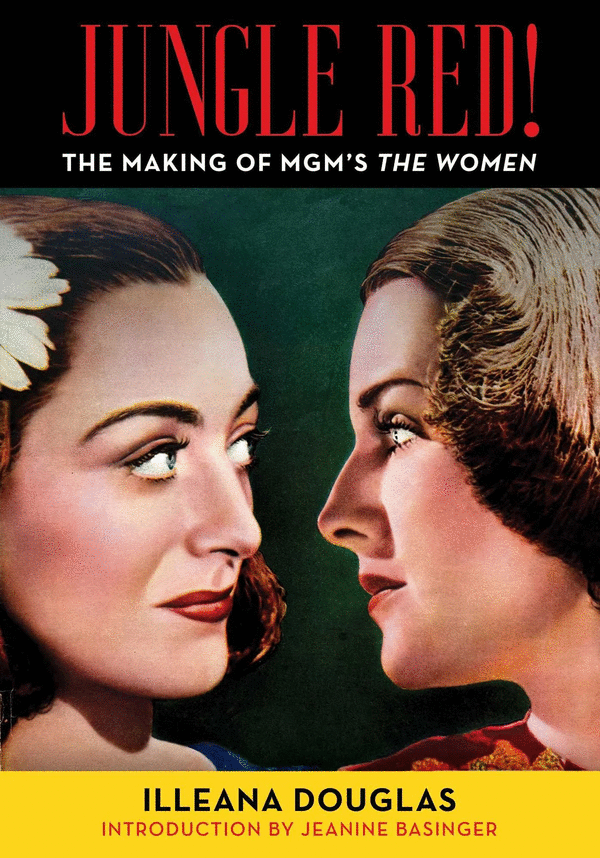
By the time Metro-Goldwyn-Mayer Studios held the world premiere of “The Women” at Grauman’s Chinese Theatre on Sept. 1, 1939, the film had so much buzz that 15,000 people packed Hollywood Boulevard for a glimpse of a cast that included Norma Shearer, Joan Crawford, Rosalind Russell, Joan Fontaine and Paulette Goddard.
“Mobs Storm ‘Women’ Premiere” trumpeted a headline in the MGM Studio News. “All-Feminine Cast Scores Triumph,” blared a headline on Hollywood gossip icon Louella Parsons’ column the next day.
“The Women,” adapted from Clare Boothe Luce’s 1936 Broadway hit of the same name, famously included more than 130 women in its cast but nary a single man. Even the pets the women pampered were female.
“Everyone from MGM was there,” says author-actress Illeana Douglas, whose new book “Jungle Red! The Making of MGM’s ‘The Women,’” includes the excitement of its Hollywood premiere. “There was a live fashion show in the patio of Grauman’s.
“In keeping with the movie, all the servers and people parking the cars were women,” she adds.
As “The Women” packed theaters across the country, it quickly established itself as one of the critical and commercial successes of 1939. But in recent years, its star seemed to fade, says Douglas, 65, who first discovered “The Women” as an acting student when she stumbled onto the script while looking for a monologue to perform.
“I just kind of fell in love with it, especially Rosalind Russell’s performance,” Douglas says of Russell’s role as the nosy busybody Sylvia Fowler, who kickstarts the story when she learns that the husband of her classy and contented cousin Mary Haines, played by Norma Shearer, is having an affair with perfume counter girl Crystal Allen, played by Joan Crawford.
The Jungle Red of the book’s title is the hot new fingernail polish many of the women get at the Manhattan salon where gossiping and backstabbing takes place, the scarlet hue a kind of war paint for the distaff battles to come.
“Over the years, it was one of those things that, you know, the movie’s on and you start to watch it,” she says. “But then I noticed over what seemed like the past 20 years it had kind of fallen out of favor. To the point that when I was saying I wanted to do a book about the making of ‘The Women,’ people didn’t even know the movie.
“So then I knew I wanted to make a book about it,” Douglas says. “I’ve always been obsessed with Hollywood history, and how everybody says 1939 was the greatest year in filmmaking.”
The Academy Awards nominations for Best Picture for 1939 included “Gone With the Wind,” “The Wizard of Oz,” “Mr. Smith Goes to Washington,” “Wuthering Heights,” “Stagecoach,” “Ninotchka,” and “Of Mice and Men.”
“So I thought, ‘Why not take this movie that everybody has kind of forgotten about and use it to talk about these great movie queens where all their careers converge for them to make this movie?’” Douglas says. “And also with George Cukor. This is the film that got him labeled a woman’s director, so I thought it would be interesting to really explore his relationship with the actresses.
“He also has a very compelling story, being fired from ‘Gone With the Wind’ because he was gay, and then basically being hired for ‘The Women’ because he was gay. I found that really fascinating.
“Sometimes, it’s easier talking about the past than it is the present,” Douglas says. “I like the idea of talking about an out director in 1939 and female empowerment. What did female empowerment look like in 1939?”
Queens of the lot
As it happened, Norma Shearer did not attend the premiere at Grauman’s Chinese Theatre after Joan Crawford skipped the cast luncheon Shearer hosted.
In many ways, Shearer and Crawford’s real-life relationship mirrored that of Mary and Crystal in “The Women,” with each actress striving to outdo each other on matters large – Shearer tried to keep her name the only one above the title – and small – they constantly sought to claim the bigger spotlight by where they stood in photographs or when they arrived on set.
Shearer, whose husband Irving Thalberg ran MGM until his 1936 death, was known as the Queen of the Lot for her knack at snagging the most prestigious roles in MGM’s movies. Crawford was more of an afterthought at the studio, cast in B-movies for her dancing and sex appeal, and left to fight for herself when a quality role like Crystal came along.
“With Joan Crawford, he biggest revelation for me was that they never mounted an Oscar campaign for her,” Douglas says, not just of “The Women” but for all of Crawford’s roles while she was under contract to MGM. “They never took her acting seriously, no matter what she did.
“If not for the fans supporting her career, I don’t know what would have happened to her at MGM,” she says. “Even with the great reviews she got for ‘The Women,’ they didn’t mount an Oscar campaign for her.
“I can understand her frustration with Norma Shearer getting an Oscar campaign literally every time she did a movie, and that, as Norma Shearer said, she didn’t feel [Crawford] belonged at a Tiffany studio like MGM.”
Rosalind Russell, perhaps even more than Crawford, had to fight to be cast in “The Women,” Douglas says.
“She’d been at the studio, she’s in her late 30s now, and stardom is just about out of reach for her,” she says of Russell. “She’s only playing second leads, and she goes to [producer] Hunt Stromberg, who she knows, and for the first time really stands up for herself and demands that she gets an audition.
“Once Russell got into ‘The Women,’ I mean, people were shocked because they had no idea she was funny,” Douglas says. “What I’m getting from all of these stories is that although they operated in this very sexist environment, you have to acknowledge these men did have respect for these women.
“And so they did let them audition, and they got in the film, and it changed their careers,” she says.
Joan Fontaine, whose career was just beginning in 1939, and Paulette Goddard, who’d finished a close second to Vivien Leigh for the part of Scarlett O’Hara in “Gone With the Wind,” had the next biggest roles as young wife Peggy Day and chorus girl Miriam Aarons, who end up in Reno for divorces with Mary, Sylvia and several other characters.
“I tried to paint a picture with each person of what the challenges they were facing were that they then overcame by being in ‘The Women,’” Douglas says. “You have Joan Fontaine, who is sort of considered the younger, less pretty, less talented sister of Olivia de Havilland.
“Her career is completely bombed out if not for George Cukor,” she says. “He tried to get MGM to sign her; they didn’t think she was very good. And then after that, she ends up getting “Rebecca” [the Alfred Hitchcock film that earned Fontaine the first of three Oscars, including a win for Hitchcock’s “Suspicion.”]
“Paulette Goddard had the situation where she’s married to Charlie Chaplin, and yet she’s in no man’s land after being cast in ‘Gone With the Wind’ and losing the part and then the embarrassment of that.
“Her being in ‘The Women,’ again, I think really, really saved her career,” Douglas says. “I don’t know what would have happened to her if she had just been left as what Charlie Chaplin said to her, ‘Well, now, you’re just going to be the actress that lost the part of Scarlett O’Hara.’
“That’s devastating,” she says. “So by her joining ‘The Women,’ this prestige film, with the catfight [between Miriam and Sylvia in Reno] and all the surrounding publicity, she’s able to arrest the past very quickly and start off her career.”
Nothing to Loos
While the actresses delivered glamour galore as their characters and in their real lives, “Jungle Red!” also reveals the stories behind the fabulous costumes MGM’s celebrated costume designer Adrian created for “The Women” and the amazing and expensive sets designed by art director Cedric Gibbons, and the hairstyles that captured each character’s personality by hairdresser Sidney Guilaroff.
Then there’s the novelist F. Scott Fitzgerald who, somewhat improbably, and little known until Douglas’s book, was given first crack at adapting Clare Booth Luce’s play for the screen. For that part of the book, Douglas is effusive in her praise of the help the archivists at the Margaret Herrick Library provided.
“They’re incredible,” she says of the staff at the Academy of Motion Picture and Sciences library. “The first day you go in, and you say I’m doing this book about ‘The Women,’ it was the same thing. Nobody had ever heard of ‘The Women.’
“And by the end of the week, I had everybody working in the library,” she says. “People are watching the movie. They were finding me all this material. Like I had been asking about the F. Scott Fitzgerald script, if there was a whole script, and I think they found it in a rather unlikely place. It wasn’t specifically with ‘The Women.’
“And so that was, of course, quite a find,” she says.
Fitzgerald moved to Hollywood in 1937 as his career as the acclaimed author of “The Great Gatsby” and “Tender Is the Night” faded and his alcoholism worsened. He hoped to revive his career and his economic prospects with screenwriting. It did not go well.
“I knew he worked maybe a couple of days on ‘Gone With the Wind,’” Douglas says. “I knew there was ‘Three Comrades’ [his only screen credit during his Hollywood period]. But what I didn’t understand fully, which I found to be fascinating, was that he was given many more opportunities than I realized.
“It wasn’t just the narrative that he wasn’t a very good scriptwriter,” she says. “He was given ample opportunity when he came out in the 1930s. That’s why I wanted to do the whole backstory and kind of compare his career as a screenwriter to Anita Loos. Because they both came out at the same time and I wanted to understand for myself.”
Fitzgerald’s screenplay was handed first to screenwriter Donald Ogden Stiers, with that version passing to Jane Murfin for an actual woman’s take on “The Women,” before it finally landed with Anita Loos, author of the 1925 novel “Gentlemen Prefer Blondes,” and a prolific and successful screenwriter.
Where Loos, who’d been an actress before moving into novels, non-fiction, plays and screenplays, seemed made for Hollywood, Fitzgerald seemed anything but, Douglas says.
“Anita Loos didn’t take her writing seriously at all,” she says. “And what I learned was that [Fitzgerald], just as he’d written the Great American Novel, he wanted to write the greatest film script of all time. He didn’t want to just write snappy dialogue for Jean Harlow.
“You just think, why on earth did he want to be a screenwriter?” Douglas says. “He didn’t fit in with the rest of this gang. He was kind of a loner. With ‘The Women, ‘ he thought he was a good joke writer, but he wasn’t. He was pretty bad.
“His idea of doing something funny was going to Norma Shearer’s house and getting really drunk and singing to her dog. Maybe that played really well in the early ’20s in Paris, but it didn’t play very well in Hollywood.”
Fitzgerald’s work on “The Women” included pages of notes in which he imagined the life of Mary Haines all the way back to infancy, Douglas says, laughing.
“It’s fascinating,” she says of his development of characters and backstories that ultimately were for naught. “He writes about this whole class of women. Of where they were born, what how they went to school, the kind of men they were with. As you read it, it looks like notes for a novel. It doesn’t look like notes for a movie.
“I mean, I can imagine him handing this stuff in and them going, ‘What the hell is this?’” Douglas says. “It’s like a Coen Brothers movie. The head of the studio is crass, and they don’t care about what social world Mary Haines came from.”
In contrast, Loos quickly found her footing on the studio lot, where for “The Women” she was often on set dashing off new jokes and material for the cast almost daily.
“She just accepted whatever script she worked on and fit in,” Douglas says. “They sat around, and they drank and they told funny stories, and she really assimilated into the Hollywood life. And he was not able to assimilate in any way, shape or form.”
Old Hollywood anew
In some ways, “The Women” represents the apex of MGM as the most prestigious movie studio during the Golden Age of Hollywood, Douglas says.
“The glamour, the queens of the lot, George Cukor’s return, fabulous costumes by Adrian,” she says. “Then just as the movie opens, within a month, World War II starts, and the slow dismantling of the studio system begins.
“That was another thing I wanted to pay homage to – the glamour of that era,” Douglas says. “Now, within a few years, Russell leaves MGM. Crawford goes to Warner Brothers. Adrian leaves, Cedric Gibbons leaves. That era is all going to completely fade away.
“I mean, Norma Shearer retires from the spotlight,” she says. “Somebody that so desperately wanted to be a star, and became a star, and rules her career with an iron will. And then walks away and marries her ski instructor.
“Each person, each woman that is involved in the movie is a unique and interesting personality in the 20th century. I think it’s fun for modern audiences, young women too, to look at these great women from the past.”
Douglas’s acting career includes films such as “Cape Fear,” “To Die For,” and “Ghost World,” as well as TV series including “Six Feet Under” and “Action,” the latter of which is part of the next book she’s writing.
But her roots in Old Hollywood are much deeper, thanks to her grandfather Melvyn Douglas, who Douglas notes in the acknowledgments of “Jungle Red!,” was a presence throughout the book.
That’s partly, Douglas notes, because Douglas acted opposite many of the women of “The Women.” He appeared opposite Shearer in 1942 as “We Were Dancing,” acted with Crawford in movies such as “The Gorgeous Hussy” from 1936 and “They All Kissed the Bride” in 1942, and with Russell in 1940’s “This Thing Called Love.”
Melvyn Douglas, who won the Oscar for best supporting actor for 1963’s “Hud” and 1979’s “Being There,” died when Illeana Douglas was 19, too soon for her to have asked him all the questions she might have wanted to today.
“He wasn’t a big storyteller of ‘Let me tell you about when I worked with this person and that person,’” she says. “But I was lucky enough to be around a couple of the film sets. I was the great listener, listening to him talk to Patricia Neal and John Houseman, with the great playwright Robert Anderson, who was a good friend.
“Myrna Loy was over at the house,” she says. “Now I could kick myself. I remember Myrna Loy, a conversation where she’s talking about Paulette Goddard and she said, ‘You know, Mel, you should really try to see Paulette.’ They had done a play together.
“I remember these little snippets of things, and then afterwards I was like, ‘Oh, why didn’t we go visit Greta Garbo? [with whom Douglas starred in “Ninotchka”] Or Paulette Goddard?’”
But Melvyn Douglas mostly talked about his more recent work, such as “I Never Sang for My Father” with Gene Hackman, which earned Douglas an Oscar nomination for best actor, the Roman Polanski film “The Tenant,” or the Alan Alda and Meryl Streep-starring movie “The Seduction of Joe Tynan.”
“You know, I don’t think he ever considered, except for the Ernst Lubitsch movies and comedies [Douglas worked with Lubitsch in “Angel,” “Ninotchka,” and “That Uncertain Feeling”], that they were great art,” Douglas says of her grandfather’s earlier career. “I think he’s completely wrong. I think they are.
“But he sort of downplayed the movies because that was more sort of what you did in those days,” she says.
At times, “The Women” has been downplayed, too, Douglas says. Most biographies of Cukor call it a lesser film, she noticed in researching “Jungle Red!”
“I’m giving people many reasons to say it’s not,” she says. “It needs to be reconsidered, and I think it is being reconsidered, as these things often go when you write a book about it.”
____
©2026 MediaNews Group, Inc. Visit ocregister.com. Distributed by Tribune Content Agency, LLC.






Comments