In 'Strip Club Heiress,' Laurel Woods explores her dad's murder conviction
Published in Books News
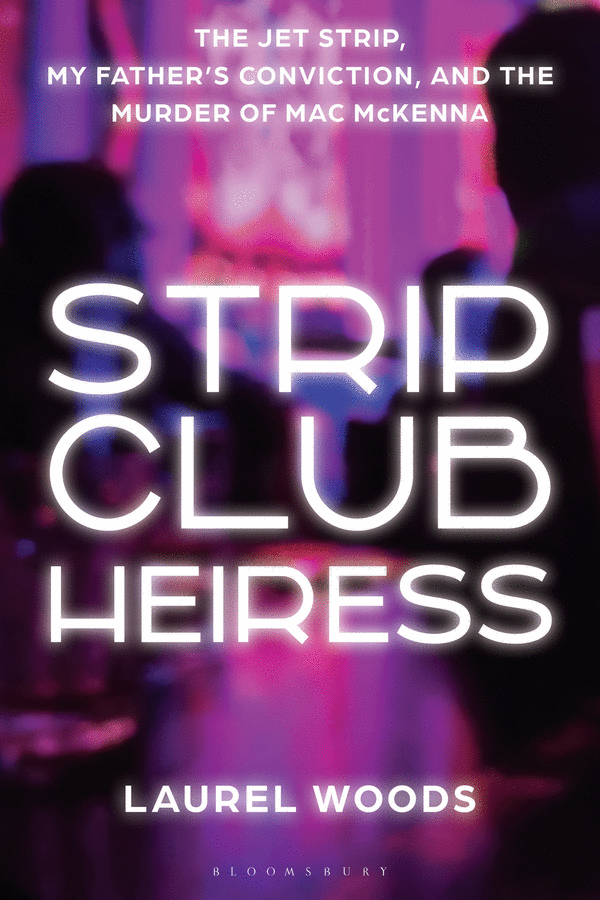
ANAHEIM, Calif. — Laurel Woods grew up idolizing her father Michael Woods, a former California Highway Patrol motorcycle officer turned owner of Southern California strip clubs with names such as Bare Elegance, the Jet Strip, and the Oddball Cabaret.
Lots of kids see their parents the way Woods saw her father. But few had a father who would test that faith the way that Michael Woods would test hers.
In March 1989, Michael Woods’ business partner Horace “Big Mac” McKenna was machine-gunned to death outside the sprawling Brea mansion where he kept exotic animals, including a Bengal tiger and an alligator named Elvis.
Police named Woods a person of interest soon after, but Laurel Woods told herself and anyone who’d listen that her dad had nothing to do with it.
Eleven years later, after the cold case heated back up, Woods and two other men were arrested in October 2000 and charged with the murder of McKenna.
Laurel Woods was certain he’d be home as soon as the authorities realized he was innocent.
One year later in September 2001, Woods was convicted of first-degree murder and sentenced to 25 years to life.
Even then, Laurel Woods stayed on Team Dad.
Yet somewhere deep inside, through years of collect calls and road trips to prisons across California, Woods says the truth, or at least the questions that lingered, got buried, walled off by her love for her dad.
“Looking back, I feel like subconsciously I must have known that something was going on,” Woods says. “But when I thought about it, at the top level, I kept thinking in my head, my dad wouldn’t do this to his family.
“Like, he loves us. He’s so protective of us. He prided himself on being in law enforcement and doing the right thing.
“There’s no way that he could possibly jeopardize the family or put the family through this,” she says. “And so through the years, I would question him, and he always had a reason for everything.”
In the new memoir “Strip Club Heiress: The Jet Strip, My Father’s Conviction, and the Murder of Mac McKenna,” Laurel Woods shares a terrific story of what it’s like when a loved one is found guilty of a terrible thing, and you have to decide where that relationship goes next.
“During the trial, obviously we’re in the papers all the time, and everyone’s like, ‘How could this man raise two daughters in a strip club?’” she says. “I wanted to write and say, ‘No, you can have a normal childhood growing up in strips. Oh, and by the way, my dad is innocent.
“And obviously, as the book unfolded, lots of things changed,’” she says, and laughs.
An unusual childhood
As a girl growing up in Newbury Park, Thousand Oaks and Westlake Village, Woods says life with her parents and younger sister Rachel was always fun.
“In the ’70s, life was so simple,” she says. “Like chasing each other around on the grass, climbing up the trees. Dad would hose down the backyard and chase my sister and I around.
“Both my parents had very difficult childhoods, very broken childhoods, so for them to raise us the way they did, I still think it’s so impressive. We were doted on and so loved, and my dad was so protective of us.”
Michael Woods was born in Jersey City, New Jersey, in 1932, one of nine kids living together in poverty.
“My dad was very young, like a toddler, and his mother sold him to this couple that lived a few blocks away,” Laurel Woods says. “Dad lived with this other family for six months, and you know, he was just in heaven because they had a house with heat.
“And they would feed him,” she says. “My dad said he was like a stray dog living with his mother. Then his mother decided she wanted him back, so against his will he went back to live with his mother.”
With his daughters, Michael Woods made sure they didn’t go without.
“We didn’t have a lot of money, but he was really creative, doing things for my sister and me to have fun,” Woods says. “He built us a swing set, and he built a sandbox. Then he bought a used boat and put it on the side of our house so my sister and I could have our own little fort to go to and play house.”
He supported her passion for “Star Wars” and “The Bionic Woman,” Laurel Woods’ favorite movie and TV show as a girl. There were camping trips to Pismo Beach and Carmel.
And then there was the Sunday morning when she was 9 years old that he took her and her 7-year-old sister on the most unlikely Take Your Daughter to Work Day outing imaginable.
“To me it was normal,” Woods says, laughing. “I was like, I’m finally seeing where Dad works.”
She didn’t really know what her dad’s work was beyond the fact that her mother wasn’t thrilled with it and the family wasn’t supposed to tell the neighbors about it.
“We knew there was a lot of whispering and a lot of secrets going on in my dad’s back room at the house,” Woods says. “So we knew it was something possibly bad or not good.”
“We get there about 10 a.m., and there’s a neon sign with a stripper, a girl on it,” she says. “So I was like, maybe this is like a car hop for people from the airport.”
Inside it’s pitch black, like walking out of the bright sun into a dark movie theater. Woods and her sister are immediately drawn to the disco dance floor with its flashing light-up tiles.
“It smelled too clean,” Woods says. “It smelled like cigarettes and Windex. And there were mirrors everywhere. My sister and I were like, ‘Oh my God, you own this place!'”
The DJ arrived and turned on the music as Woods and her sister danced on the stage until the professional dancers started trickling in for their shifts.
“My dad introduced us to some of the strippers, and they were so pretty and so nice to us,” Woods says. “We got drinks at the bar. I got my Shirley Temple, and Rachel got milk.”
As the doors opened for business, Michael Woods parked the girls in the back office upstairs and ordered them not to look at the video monitors.
“Of course, we did,” Woods says. “That’s when we saw these women taking their clothes off, and we were like, ‘Oh my!’ It was like watching scrambled porn. My sister and I, our mouths were just agape.
An Orange County hit
Woods and McKenna had known each other since their CHP days. Their partnership in the strip clubs was off the books, because McKenna had a criminal record for counterfeiting and couldn’t legally be on the paperwork.
In March 1989, McKenna was in a limousine waiting for the gate to open at his Brea mansion when a gunman opened fire on the car with an Uzi machine gun, hitting the vehicle more than 20 times.
Investigators had been circling the strip clubs he and Woods owned, searching for financial crimes related to how the cash flowed in and out of the businesses.
For Laurel Woods, the 1989 murder of McKenna had sent shockwaves through her laid-back life at the University of California, Santa Barbara. For one thing, Michael Woods told her he was worried the killer might come for him and his daughters, she says.
“I was at UCSB with palm trees, getting stoned, eating breakfast burritos, you know,” she says. “Then all of a sudden I’ve got this murder looming over me.”
“My parents went underground for a couple of months,” Woods says. “They just drove around California, stayed in hotels. My parents came up to visit me, and my dad was terrified. You could see he was very on edge, and that scared me.”
But the case soon went cold. Woods graduated from college and went to work at Playboy in Los Angeles as a legal coordinator in the business affairs office. Life returned to a version of normal.
After three years at Playboy, she landed a dream job at Industrial Light & Magic, a division of Lucasfilm, which had made her favorite movie, “Star Wars.” After several years there, she jumped to a tech company in San Francisco, where she was employed in the fall of 2000 when Michael Woods was arrested.
“That was not on my bingo card,” Laurel Woods says. “From then on, I mean, your body goes into fight or flight. It was honestly like an out-of-body experience. You cannot believe what’s going on, and you just think someone’s going to wake you and it was just a bad dream.
“Going to Orange County jail was terrible,” she said of the regular trips she, her mother and sister made over the next year. “I will never forget 550 North Flower, you know?”
The case investigators built against Woods argued he gave his bodyguard David Amos $50,000 to arrange the hit on McKenna, and Amos paid John Patrick Sheridan, an ex-con working at one of the strip clubs, $25,000 to pull the trigger.
Over the years, guilt ate at Sheridan’s conscience, leading him to confess. Dominoes fell quickly after that. Amos was arrested and agreed to wear a wire to lunch with Woods at Jerry’s Deli in Woodland Hills. That recording led to Woods’ arrest.
From the Orange County Jail, Woods asked his daughter to come back to Southern California to run the three nude clubs while he awaited trial. She agreed and took over operations over the next two years until his conviction.
“I had a job at Lucasfilm and then the next thing you know I’m helping my dad run his strip clubs,” she says. “If you had said to me, ‘Hey Laurel, in two years you’re going to be running strip clubs,’ I’d be like, ‘Get the [bleep] out of here.’
Epiphany on the telephone
One night in February 2011, a few years after Laurel Woods moved to New York City and a job at MTV, the phone rang at her Upper West Side apartment. That night, on a collect call from California inmate No. T-47887, an offhand comment by her father shattered her faith in his innocence after two decades of blind loyalty.
A year or two earlier, an MTV coworker suggested Woods start writing down some of the stories from her life, the wildest of them connected to being the daughter of a strip club entrepreneur. She created a blog to do so, which caught the attention of a producer at KCRW-FM’s “Unfictional” storytelling program.
Michael Woods knew she was going to tell their story on the program, and urged his daughter to use it as a platform to proclaim his innocence, as he still did a decade after his conviction. But when she played it for him over the telephone line in February 2011, her father’s reaction showed her what she’d never before seen.
“I wanted him to see what we were going through and he never did,” Woods says of her sense that Michael Woods cared more about his unlikely quest to be released from prison than he did the hardships that she, her younger sister and their mother had endured for years.
“You know, he could never not have the focus on himself,” she says. “And all I wanted was like a breadcrumb of him saying, ‘I’m sorry I put you in this position.’
“I knew he wouldn’t admit to the murder, but I just wanted some acknowledgment of what he had put us through. So I play the radio spot then. I get him back on the phone.
“He says, ‘No, Laurel, you are wrong. I wasn’t a cop. I was a California Highway Patrol officer,'” she says. “And oh my God, I was like, ‘That is your only takeaway after everything I’ve said?’ I got off the phone with him. He tried calling me back, and I did not pick up.”
The walls seemed to spin around as this small detail unlocked a cascade of realizations.
“It literally hit me like a ton of bricks,” Woods says. “I was like, ‘Oh my God, he did do it. He did.’ I called my friend Erin. I poured a big glass of wine, and I was like, ‘He did it.’
“And that’s when Erin was like, ‘Well, we all think he did it,'” she says. “That was also a huge shock. This whole time I thought my friends thought he was innocent. I just felt so stupid and naive.
“But that was also one of the best days of my life, really, because then I felt free. I was like, ‘He deserves [to be] where he is.'”
Life after lockup
Six years later, in June 2017, Michael Woods was paroled after 17 years in custody.
Laurel Wood hadn’t cut off contact with him after her epiphany on that winter night in New York City years earlier. But she’d pulled back, setting boundaries for herself, to protect herself from what she describes as her father’s controlling, self-absorbed personality.
“I never thought it would happen because parole is all about responsibility, remorse, and my dad had exhibited none of that,” she says. “He’d gotten diagnosed with narcissistic personality disorder in prison, and my dad would argue, ‘I’m not narcissistic, I’m proud.’
“So when he got out, I was so happy for him, but I was also terrified for the family. Like, was he going to turn into this controlling monster again?”
Woods hoped that on the outside, away from the prison phones and visiting rooms, her father might finally acknowledge what happened, and apologize for what he’d put the family through.
“He said, ‘I’m sorry for what happened,'” she says of the non-apology she received. “He didn’t say, ‘I’m sorry for what I did.’ I knew he would never admit to the murder, but I thought he would show some accountability. That’s when he said, ‘And you’re bitter, and you need to get over it.’
“That was another gut-wrenching moment,” Woods says. “So I had a decision to make for myself. I could continue to fester and be incredibly angry, or I could let it go and just accept him for who he is. Know he’s never going to change.”
Nine years after Michael Woods left prison, he’s still a large presence in Laurel Woods’ life, though his control over the family is diminished.
“My dad just turned 84 and my mom’s 80,” she says. “I just had lunch with them yesterday. I still see them a lot.
“I always struggle with my boundaries with my parents,” Woods says. “I mean, I’m 57, and they’re still helicopter parents. I’ve just learned to accept it. We have a great relationship, but it’s more on my terms.”
Reassimilating into civilian life wasn’t easy for Michael Woods, his daughter says. He had to learn to use a cell phone and the internet. He gets anxious at the speed of cars and trucks on the freeways. He’d sometimes call his table knife a “shiv.”
“He got out of prison, but he kind of lives that same life that he lived in his cell,” Woods says. “He has to have breakfast at a certain time. He has to have lunch at a certain time. He has to have dinner at a certain time. And he really just watches a lot of TV, which is what he did in prison. He does not feel safe out of a little radius around their house.
To second chances
You might wonder if her father, mother or sister have read “Strip Club Heiress.”
“Um, yeah, that’s a good question,” Woods says and laughs. “So my family is not happy about the book. I was very open about my dad being arrested. As you know, it was in the papers every day. We were on the news, all three channels, every night.
“But my sister and my mom did not tell any of their friends about it or talk about it,” she says. “So they’ve been unhappy.”
No one from her family came to Book Soup when the West Hollywood bookstore held an event for “Strip Club Heiress,” which was the store’s best-selling book the week of Woods’ book talk and signing.
But she did run into an unexpected guest at Book Soup that night.
“I saw that Johnny [Sheridan, the strip club employee who confessed to pulling the trigger on McKenna] had followed my Instagram account and then unfollowed it, so I knew he was aware of the book,” Woods says. “I did not think in the least that he would be there.”
But before the event began, Woods walked into the back of Book Soup and literally bumped into Sheridan, she says.
“He saw my face and froze, and I said, ‘Oh my God, Johnny, what are you doing here?’ and gave him a hug,” she says. “He said he wanted to see me but was afraid of how I’d react, hence why he was hiding in the back of the store.”
Sheridan, who came with another former strip club employee, stayed for the entirety and bought two copies of “Strip Club Heiress” for Woods to sign. Before he left, one of Woods’ friends asked him to sign a copy of the book for Woods.
Inside it, he wrote, “To second chances.”
©2026 MediaNews Group, Inc. Visit ocregister.com. Distributed by Tribune Content Agency, LLC.





Comments