Why the Declaration of Independence now includes comic book characters
Published in Books News
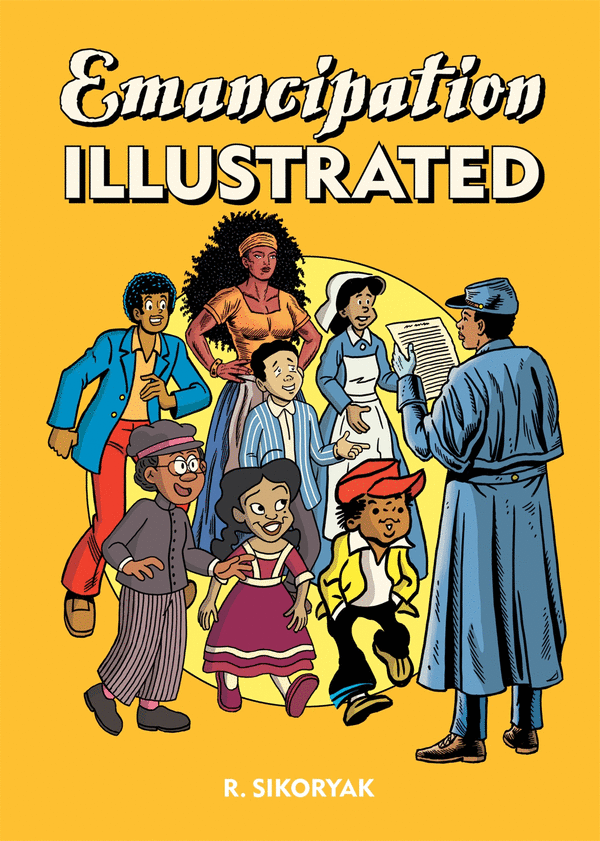
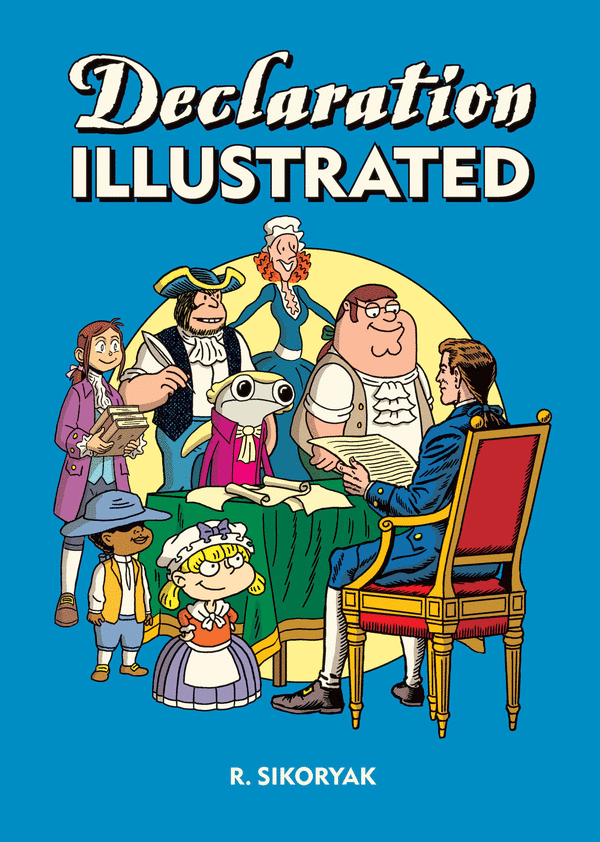
As he worked on an adaptation of some of America’s essential documents over the past few years, cartoonist R. Sikoryak says one element of the ongoing American experiment became clear.
“I rewatched the Ken Burns documentaries, and I was like, ‘OK, yeah, none of this was easy,” he says of the country’s early, and ongoing, development. “We can see from the past it was hard.”
His new book, “Declaration / Emancipation Illustrated,” combines the complete texts of the Declaration of Independence, the Emancipation Proclamation, and the Gettysburg Address and illustrates them with characters and scenes from comic books, comic strips and animated films and TV series, including "The Simpsons," "My Little Pony," "Black Panther," "Ziggy," the "Powerpuff Girls" and more.
“People identify with cartoon characters,” says Sikoryak, who skillfully takes on the styles of everything from "The Family Circus" to "Family Guy." “I like that interplay of familiar characters with important texts.”
And sharp-eyed readers will recognize reworkings of iconic comic book panels, including “The New Teen Titans,” “The Invaders” and “The Savage Sword of Conan.”
“I was strictly using American characters, U.S. characters,” he says about some of the restrictions he gave himself for the artwork. “They’re all characters created by, or who represent America in some way. So that was the rule for the book.”
Sikoryak, an artist and instructor at Parsons School for Design, got his start working on the oversize comics anthology RAW with Art Spiegelman and Françoise Mouly. Since then, his work has appeared in the New York Times Book Review, The New Yorker, The Onion, MAD, and “The Daily Show with Jon Stewart.” He illustrated the comic books that appeared in Tom Hanks’ novel, “The Making of Another Major Motion Picture Masterpiece,” and Sikoryak’s own books include “Constitution Illustrated,” “The Unquotable Trump,” “Terms and Conditions,” and “Masterpiece Comics.”
Genial and enthusiastic throughout our call, Sikoryak discussed his love of comics, what he learned doing his research and his belief that, despite our differences, people can find common ground.
The following conversation has been edited for length and clarity.
Q. Your book is an illustrated version of the Declaration of Independence, Emancipation Proclamation, and Gettysburg Address. How do you describe this kind of hybrid?
I grew up making comics and reading lots of comics, and I’ve tried to find ways to take my skills and use them in an interesting way. I used to do strictly literary adaptations, where I would take novels, and I would retell them as comics in different styles, kind of like what I’m doing now,
You could call it a graphic novel, you could call it an illustrated book, but basically, I just like taking the history I love from comics and combining it with texts that I think are important or interesting for people to reevaluate in new ways.
Q. Can you tell us about adapting classic novels as comics?
I always loved different kinds of comics. I grew up reading comic books and comic strips in the newspaper, and I like all sorts of visual storytelling. When I was working at Raw, I realized I wanted to find stories worth telling. I wanted to find a story bigger than me, more interesting, and that led me to adapting literary classics.
I did a version of Kafka’s “Metamorphosis” in the style of “Peanuts,” which was my favorite comic strip growing up, so making Charlie Brown the protagonist in Franz Kafka’s novel made sense to me, and I felt like there were obvious parallels between the characters, these neurotic people just trying to get through their lives and having these obstacles they could not overcome.
Q. How did that lead to working on an illustrated version of the Constitution and now this book?
I started with literary classics. I did “Crime and Punishment,” and these were short adaptations. They weren’t full-blown, 200-page versions. These were two pages, 15-page stories, but adapting literary classics, kind of faithfully, but also with a certain sense of humor, like it’s impossible to adapt “Crime and Punishment” into a 10-page story, but I made it into one. I’m playing with a lot of big ideas, and that was always of interest to me.
Like “Crime and Punishment,” like other classic novels, everyone says you should read the Constitution. Everyone says it’s important. Well, I had never read it all the way through, so I decided to adapt it into a comic. I thought, again, using the entire text, in this case, not leaving anything out, but putting in all the dicey parts of the rules and also showing how things evolved over time. I thought this is a document worth reading as a whole.
Q. How did you come upon the visual style for that one and the new book?
I didn’t want to just do it in one style, but I decided to adapt as many different cartoon styles as I could. I really wanted to show a wide swath of comics; so even people who aren’t readers of comics will recognize some of these characters from “A Charlie Brown Christmas” special, or from “Family Guy” or from “The Simpsons,” or from various superhero movies. I tried to use contemporary people who do web comics, people like Allie Brosh.
I had never read the whole Emancipation Proclamation before I decided to make this book. I did a real deep dive on it and tried to like tease apart the language and illustrate it, sometimes humorously, but always with the text there, so that it would hopefully be lively enough for people to pick up and flip through and maybe recognize themselves in it.
Q. There can be a friction between people who believe that if you love something, you can also have fun with it, versus those who don’t. Is that challenging to navigate?
I have a certain earnest streak to me, and I think that comes through in the work. Certainly, I will throw in some jokes here and there, but for the most part — there’s some editorializing, I suppose, in some of the image choices — but I am really keeping the text there. I’m not commenting in the text. If you just read the text, there’s nothing in the book that isn’t in the original document.
I’m really trying to be faithful to all my sources, whether it’s what Thomas Jefferson wrote or if it’s what Seth MacFarlane drew for “Family Guy,” I’m trying to represent the perspective of both sides — or the many sides.
One of the reasons I wanted to use the different styles is because you can find a page that feels very patriotic, and it feels kind of solemn, and then there’ll be another page that’s maybe a little absurd, or a little funny, or a little ironic, but that’s the tapestry of America. I really wanted people to feel like something in this would represent them.
In the best sense of what I think the country is, it’s all these people coming together — I know some people don’t think that’s what it is — but in my estimation, it’s really about all these people coming together, that’s kind of what the book represents. You could find specific pages that are nothing but solemn, but there is a certain, I hope, thrill, or as you say, friction, in the combination of all these things next to each other.
Q. What stood out to you as you reread the documents?
I’ve read a lot in the last year, and this wasn’t my insight, but I thought it rang true: So much of the Declaration is about the colonies wanting to make their own empire, so they are rejecting the rule of the British, but they really want to take over the rest of the continent, and they really want to be in control of that themselves.
So that’s definitely in there, and there’s some not-great language, you would say racist language, in the Declaration about the Indigenous people, and it’s really queasy to read that, because obviously the first three sentences of the Declaration are very inspiring, and that’s the ideal that you want to live up to. And, of course, we’re not going to use the word “slavery” anywhere — that’s the part that got cut out.
Our perceptions of what the document means are very different, which is another reason to draw it in different styles, because I wanted to emphasize that you can read this in different ways, and you can interpret it in different ways, and I tried to do that, too. I tried to do that myself.
Q. What are your thoughts as we approach America’s 250th anniversary?
So if we can agree there’s things that we can change and that we have agency, then I feel OK with the country right now. It’s been a rocky couple of years, and I’ve listened to way too many political podcasts while I was drawing this book, but I think if you look at these documents and you think about where they are in history, then I think you have to recognize that people can grow and people can change.
The whole reason to do the Emancipation Proclamation as the second side of this book was that someone, Abraham Lincoln, took what was in the Declaration and said, ‘This is important, this part at the beginning about “All men are created equal,” because he references the Declaration in the Gettysburg Address and in the Emancipation Proclamation. “Four score and seven years ago,” that’s referring directly to the Declaration, so you can take these documents and you can think about what they’re saying to you, and you can act on them.
You can take these as inspiration; as you read these documents, you see how things have shifted and how perceptions have changed. I think we still have the capacity to do that. We can have new documents, we can have better documents. This is what came before; I think we can build on this.
©2026 MediaNews Group, Inc. Visit ocregister.com. Distributed by Tribune Content Agency, LLC. ©2026 MediaNews Group, Inc. Visit ocregister.com. Distributed by Tribune Content Agency, LLC.








Comments