How a California wildfire inspired a book about hidden animal societies
Published in Books News
As the destructive Bobcat fire sent plumes of smoke billowing from the Angeles National Forest in 2020, Ryan Huling recalled that at the time news reports claimed the blaze caused “no injuries” and that no homes had been destroyed.
That irked the Sierra Madre writer, who watched from his cabin as flames incinerated the home of bears, coyotes, pumas and squirrels. He believes countless critters were killed or maimed by flames, and points to accounts of mountain lions emerging with singed paws and bears scrambling into communities.
“Anonymity has done them no favors, in the sense that people don’t know where they live, they don’t know what landmarks are important to them, they don’t know what areas carry special significance to bears and other animals,” Huling said.
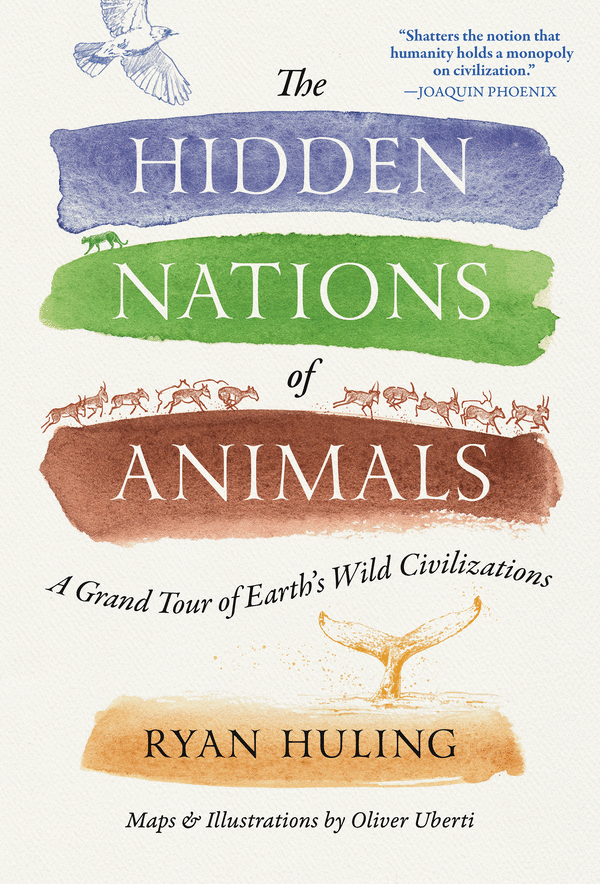
Yet through his research he discovered that rapidly advancing technology — including artificial intelligence, GPS tracking and crowdsourcing — is revealing more about animal “societies” than ever before. The revelation launched him on a worldwide tour of non-human communities, culminating in his debut book,“The Hidden Nations of Animals.”
Published this month, the book’s first chapter takes readers to North America’s “beaver belt,” roughly 1,100 miles in northern Canada that are jam-packed with beaver dams. According to Huling, the sheer density of those dams only became apparent thanks to technology that allows researchers to analyze high-resolution satellite imagery and identify them from space. One analysis found 2,700 dams surrounding a town of only about 1,000 people.
Another stop took him to Zambia, where African mole-rats dig complex tunnel systems that include designated nurseries, pantries and bathrooms. Just before Huling arrived, a researcher had used radio trackers to determine that the subterranean animals operate on a biological clock that has them alternate between a few hours of activity and a few hours of napping — not a bad work schedule!
Some of Huling’s other adventures include exploring a tornado of Mexican free-tailed bats outside of San Antonio and red-crowned cranes that have found refuge in the Korean Demilitarized Zone.
But uncovering these hidden worlds isn’t just left to the experts anymore. While the expense or difficulty of tracking wild animals has resulted in knowledge voids in the past, crowdsourcing is helping to fill in the gaps.
Today, any smartphone-toting nature lover can snap a photo of a great horned owl or a ground squirrel and upload it to a citizen science app such as iNaturalist. Some platforms are specialized, for example Merlin for birds and Happywhale for marine mammals. All that data is a rich playground for scientists. According to an article published last year in BioScience, iNaturalist data in peer-reviewed research grew tenfold in the previous five years.
Now, AI is making it so humans don’t have to necessarily look at the raw material. Instead, AI can mine images, videos or sound clips for the appearance of an animal of interest — or even catalogue individual critters. Happywhale has an AI feature that identifies particular humpbacks by unique patterns and shapes on their tails.
Technology is advancing so fast that Huling said it was hard to stay current. In his prologue, he mentions a researcher showing him a prototype of a teeny solar-powered radio tag for monarch butterflies. By the time the book hit the shelves, the concept was already live — harnessed, in one instance, to study how the brilliant orange insects use overwintering groves along the California coast. Just this week on Instagram, the California Department of Fish and Wildlife highlighted a study in which rare bumblebees are tagged with minute QR codes that can be read by remote cameras.
After about a half-year of travel, Huling returned home with a heightened awareness of what he calls “inconspicuous abundance” — that the world is teeming with more life than meets the eye. He puts this new lens to the test by venturing to the storm-battered shores of San Miguel Island off the coast of Santa Barbara. Considered “uninhabited” in the traditional sense, he finds that the rarely visited corner of Channel Islands National Park is a haven for lumpy seals, glimmering fish and squawking seabirds. Sharks lurk beneath the waves.
“For them, as now for me, this distinctive island remains anything but deserted,” he writes.
©2026 Los Angeles Times. Visit at latimes.com. Distributed by Tribune Content Agency, LLC.











Comments