A toast to the tuba -- and the value of music education
Published in Books News
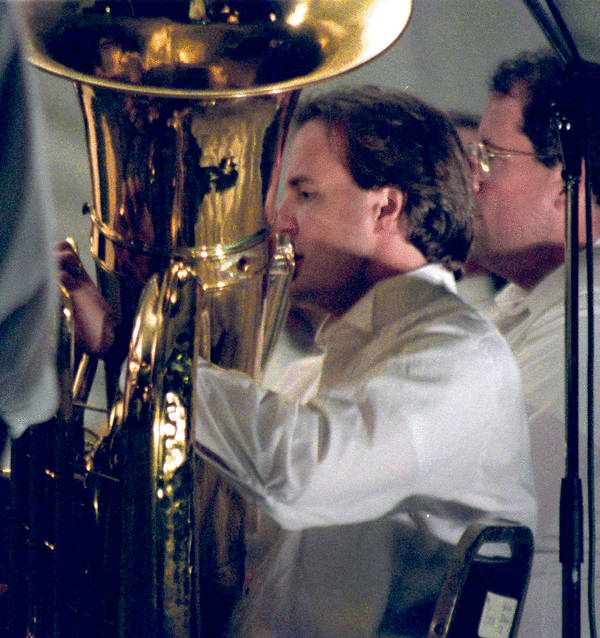
When the book “The Perfect Tuba” landed on my desk, I thought, “I’ll have to ask Robert Carpenter about this.” Every Central Florida music fan knows he’s the go-to guy for all things tuba.
Turns out “Perfect Tuba” author Sam Quinones had the same thought; I quickly realized Carpenter was interviewed and contributed to the book, which offers interesting info about the local tuba culture.
I hear you repeating, perhaps with a tad of disbelief, “local tuba culture”? But, wait, it gets better: At one time, Orlando was nationally known as a hotbed for tuba music. Who knew?
Well, Carpenter for one. He has been the principal tuba player for the Orlando Philharmonic Orchestra since its inception in 1993.
He remembers discussing the unusually large local tuba-playing population with colleagues back in the 1990s.
“In the middle of the night at a pizza joint, we said, ‘How many professional tuba players are in Orlando?'” he recalls. “We counted 26.”
That’s a lot of brass.
As Quinones’ engaging book explains, like so many entertainment-related facets of Central Florida life, this was down to Disney. Across the theme parks, you could find tuba players in a variety of shows and parades.
“No American city so small had acquired so many tuba players so quickly as Orlando, Florida,” Quinones writes of that golden age some 30-plus years ago. “The phone tree was almost magical. A call would go out, and soon two dozen tubists would appear at the Ale House to drink Guinness until the wee hours. … They formed a tuba scene that lasted a decade — playing constantly, drinking often, challenging each other to improve.”
As Disney downsized its complement of musicians, that tuba scene faded. But Orlando wasn’t done with the instrument — not by a long shot.
Carpenter — who didn’t play at Walt Disney World until years after that scene’s heyday — and friend Tom Treece were busy trying to perfect the sound of the tuba, an endeavor Quinones documents in the book. The Orlando Philharmonic played a part: Carpenter would experiment with different tubas during rehearsals to compare the sound quality.
“We were so fortunate,” he says. “Who has that? Who has a professional orchestra to do your testing?”
He credits former Philharmonic music director Christopher Wilkins with giving the go-ahead for the experimentation.
“He was part of it, giving opinions,” Carpenter recalls. “I told Chris what I was doing, and he was interested. I warned him, ‘It’s going to look like chaos back there,’ and he said, ‘That’s fine, you do it.'”
The Orlando chapters of “The Perfect Tuba” are scattered among the book’s uplifting main narrative of how providing youngsters with access to music education can change their lives — give them a feeling of belonging, provide a sense of purpose, teach them discipline and help with their academics.
To Carpenter, “that is by far the most important part of the book. In comparison, I am inconsequential in this.”
He hopes readers take the book’s lessons about the importance of music education to heart — whether it involves a tuba or some other instrument.
“Music education is a game changer for society,” he says. “It saves so many kids.”
He points to himself as an example of what music instruction can do. Of course, like many described in Quinones’ book, he stumbled into playing the tuba.
One day in seventh grade, Carpenter skipped a class he didn’t like and went to the band room. The band director was a neighbor who often drove Carpenter to school.
“I said, ‘I don’t like my class, and I’d like to join the band instead,'” Carpenter recalls. “No better way to put a big smile on a band director’s face. He said, ‘I’ll take care of the paperwork.'”
The only question was, what would Carpenter play?
“I hadn’t paid attention when they taught the instruments, so I said, ‘I’ll play anything,'” — another way to make a band director grin. “And he said, ‘Would you like to play the tuba?'”
The rest, of course, is history.
Also a professional engineer, Carpenter would go on to research tubas, build tubas, and generally “spend all my life pushing valves.” At one point, he owned 32 tubas; he says he’s down to 15 or so now.
He’s happy the book is raising the profile of his chosen instrument.
“It’s interesting there’s this much passion about tubas,” he says. “I’m not the only one.”
But he’s equally content to let the allure of the tuba remain a little mysterious, known only to the musicians who are rarely in the spotlight and usually found tucked away in a corner of the orchestra.
“It’s all by people who sit in the back row,” Carpenter chuckles. “We have a lot of fun back there, but nobody knows it.”
©2026 Orlando Sentinel. Visit at orlandosentinel.com. Distributed by Tribune Content Agency, LLC.





Comments