Book shows how Prince's sound grew out of the place he called home
Published in Books News
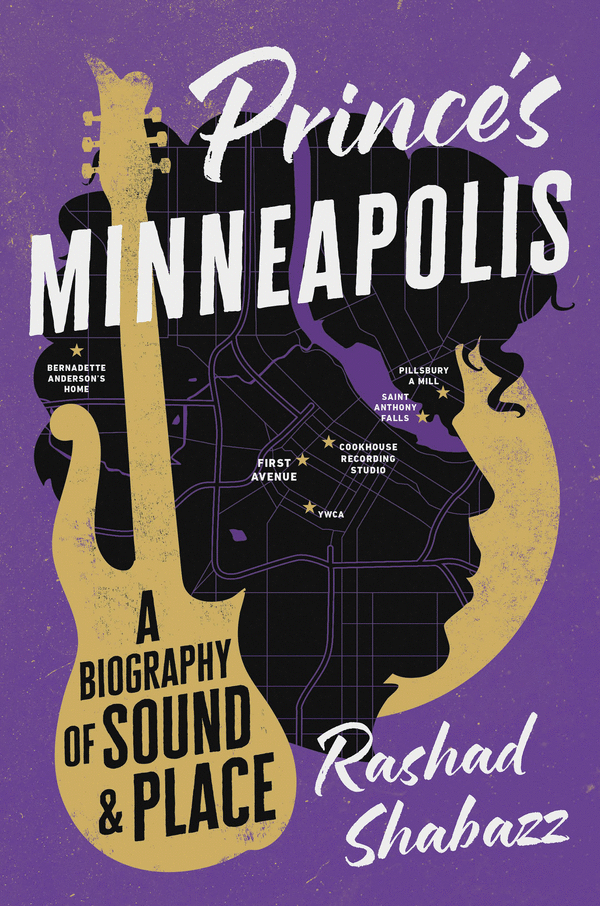
Get ready for a deep dive into the Purple One.
Among the questions suggested by Rashad Shabazz’s “Prince’s Minneapolis” are: When the late singer wrote “slave” on his cheek to protest his record company, was he thinking about his paternal great-grandparents, who were born into slavery? When the singer contacted Jonathan Cain of the band Journey to make sure “Purple Rain” didn’t sound like Journey’s hit “Faithfully,” how was that related to top 40 music Prince listened to as a kid? And how might growing up in both north and south Minneapolis have influenced the “Minneapolis Sound” he represented?
Shabazz writes that the Minneapolis Sound bears echoes of history and geography, including the forced removal of Indigenous people, the city’s history of segregation and the waves of immigrants who brought their music here. We asked Shabazz to elaborate. (This interview has been edited for clarity and concision.)
A: He told false stories about himself, and he really never let people in. He had nondisclosure agreements with his friends to never tell the public that they spent time together. So the public is curious.
A: There’s a backlog of 40 years of trying to understand this man who did not want to be understood, outside his music. That’s part of it. And he made so much music — the 20,000-plus songs in his vault. In the aftermath of his death, the record company and estate have been releasing them so he’s re-emerged in contemporary popular culture. His “Purple Rain” song was in “Stranger Things,” so it’s back on the charts. “Around the World in a Day” was back on the charts when it was released in an expanded, deluxe edition.
A: I wanted to use that framework: a kind of historical geography, looking at spatial phenomenon over time in very precise detail. I was always a big fan, of course, because I lived in Minneapolis and saw him many times and had a college girlfriend who is, in many ways, responsible for this book.
A: What I wanted to do is take a broader approach, to look at the context in which he emerged.
A: I was going to write about the music community he came out of but then Andrea Swensson wrote that fabulous book [“Got to Be Something Here”]. I thought, “This is great. A lot of this is done.” I began to think, “The term ‘Minneapolis Sound’ is associated with Prince,” but I wanted to think critically about what that means in terms of the sonic reality of the music he created, what that entails in instrumentation and harmony and rhythm. But I also thought about geography, that there was a larger music community than the one he was born into, coming up in the late 1960s and ’70s.
A: To the birth of the city. I began to see he was part of a musical community that came along more than a century before he was even thought of. Music was one way the city was able to bring together diverse groups from western Europe, from the south, from the northeast. Black and white, as well as immigrants coming in.
A: As superintendent of music education [starting in 1910], Giddings helped create a deeply democratic element that raised the music literacy of all students in Minneapolis public schools. It was universal and Minneapolis was the first district in the country to make music education compulsory. That had a tremendous impact on Prince.
A: Minneapolis, like many American cities, carved the city up along race lines, as well as economic lines. So the stark racial geography that created north and south Minneapolis was accompanied by sonic forces. Black people, living in the north, are mostly listening to R&B, blues-inspired jazz. But, also, early rock ’n’ roll and the blues are being played in those same places by Prince’s mother and father. Downtown, where white musicians were playing, you might hear white pop music, jazz standards. All of those sonic forces, articulated through geography, have rhythmic patterns, harmonic patterns.
A: By the time Prince is 14 or 15, he is playing funk, he’s deeply interested in R&B — James Brown, of course; Sly and the Family Stone; the Jacksons. He’s really interested in that but he’s also into pop music and a lot of the radio that proliferated in Minneapolis was white rock music. So Black musicians — him and Jimmy Jam and Morris Day and Terry Lewis — had to have a bit more of an expansive vocabulary. They couldn’t just play only Black music, though they played a lot of it.
A: All musicians all over the world, no matter where they are at, are drawing on the sonic geography around them. It just makes sense. If he was from Chicago, he’d have sounded different. If he was from Seattle, he’d have sounded different. This was the music around him, the music of Minneapolis.
Prince’s Minneapolis: A Biography of Sound and Place
By: Rashad Shabazz.
Publisher: University of North Carolina Press, 244 pages.
©2026 The Minnesota Star Tribune. Visit at startribune.com. Distributed by Tribune Content Agency, LLC.







Comments